
What keeps a retail CEO up at night in 2026?
It is not the lack of products. It is not even the competition. What truly keeps enterprise leaders awake is the growing gap between what customers expect and what current systems can actually deliver, at scale, in real time, across every channel.
Walk into any large retail enterprise today and you will find the same problems dressed in different clothes. Customer queries pile up. Support teams burn out. Personalization remains a buzzword instead of a reality. And despite millions spent on CRM and ERP systems, the one thing every shopper wants - a seamless, intelligent, fast experience - still feels out of reach.
This is exactly where the AI retail assistant is no longer just a promising idea. It is becoming the most consequential enterprise shift of this decade.
What Is Actually Happening in the Market Right Now?
The numbers are not subtle. According to McKinsey's State of AI 2025 report, 88% of enterprises now report regular AI use across their organizations a signal that AI has firmly moved from experimentation to core operations. For retail specifically, this shift is accelerating faster than any other vertical.
Gartner projects that by 2028, 33% of all enterprise software applications will include agentic AI, up from less than 1% in 2024 a 33-fold increase in four years. This is not gradual evolution. This is a structural transformation, and retail is right at the center of it.
The question enterprise leaders need to ask is not "should we adopt this?" The question is "how much runway do we have left before our competitors do?"
Why Is the Traditional Retail Model Breaking Down?
Think about what a typical enterprise retail operation looks like today. Hundreds of thousands of SKUs. Customers shopping across web, mobile, physical stores, and social channels simultaneously. Seasonal demand spikes that overwhelm human teams. Returns management that eats into margins. Loyalty programs that nobody actually feels loyal to.
The human-first, rule-based approach to retail operations was designed for a different era. An era when customer behavior was predictable, channels were few, and data volumes were manageable. None of those things are true anymore.
Enterprise retail leaders are now operating in an environment where a single customer might interact with a brand twelve times before making a purchase, across search, social media, live chat, email, and in-store. Managing that journey manually is not just inefficient. It is mathematically impossible to do well.
How Do AI Shopping Assistants Change the Game at the Enterprise Level?
AI shopping assistants are not chatbots with smarter scripts. That distinction matters enormously when you are evaluating them from a CEO's or CTO's perspective.
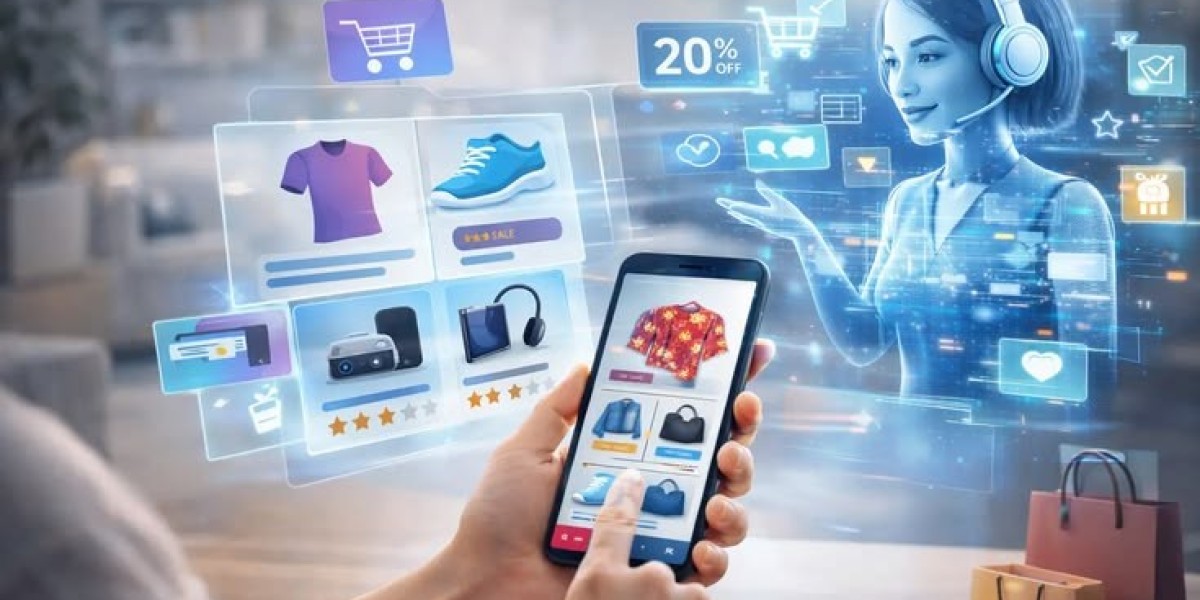
A modern AI retail assistant deployed at the enterprise level operates as an intelligent layer across your entire customer journey. It understands context. It remembers past interactions. It makes product recommendations based on actual behavioral signals, not just purchase history. It handles returns, answers complex queries, personalizes promotions, and escalates to human agents only when genuinely needed.
More importantly, it does all of this simultaneously, across thousands of concurrent customer interactions, without fatigue, without inconsistency, and without adding to your headcount.
The business impact of this is not marginal. McKinsey's research shows that AI-driven personalization increases revenue by an average of 10 to 15%, with best-in-class performers doing significantly better. For an enterprise with half a billion in annual revenue, that number is not a rounding error.
Is This Just About Customer Service, or Is It Bigger Than That?
Here is where enterprise leaders often think too narrowly.
The impact of the AI retail assistant is not confined to the customer service desk. When you deploy an enterprise AI agent architecture properly, it touches every layer of your retail operation.
Inventory forecasting becomes sharper because the AI is processing real-time demand signals that human analysts would miss. Pricing decisions get faster and more accurate because the assistant is continuously monitoring competitor moves and customer sensitivity. Marketing personalization improves because the system understands individual customer intent far better than any segment-based model ever could.
The retail leaders who will dominate the next five years are the ones who stop thinking about AI solutions as point solutions for individual problems and start seeing them as the central nervous system of their entire operation.
What Are the Real Barriers Enterprises Face Today?
Let us be honest about the challenges, because any executive reading this has already faced them.
The first barrier is integration. Legacy systems in retail - ERPs, POS platforms, loyalty databases - were not built to talk to modern AI infrastructure. The integration work is real and it is complex.
The second barrier is change management. Deploying an AI assistant is not just a technology project. It requires aligning your operations teams, training your staff, and building new workflows around AI outputs rather than against them.
The third barrier is choosing the right partner. Many enterprises have tried building AI capabilities internally and discovered that the gap between a prototype and a production-grade system is wider than expected. Others have bought off-the-shelf tools that looked impressive in demos but could not handle real enterprise complexity.
This is where working with a specialized AI development agency that has deep enterprise experience becomes less of a luxury and more of a strategic necessity.
Why Is 2026 the Year This Decision Cannot Wait?
The competitive moat being built by early AI adopters in retail is widening every quarter. McKinsey estimates generative AI could unlock between $2.6 trillion and $4.4 trillion in additional business value across industries and retail is one of the highest-capture verticals on that list.
The retailers who are deploying AI-powered virtual assistants at scale today are not just improving their NPS scores. They are building data flywheels. Every customer interaction trains their models. Every personalized recommendation generates more signal. Every automated resolution reduces cost while improving experience. The compounding effect of this is enormous and it gets harder to close the gap the longer you wait.
Ready to Understand What This Shift Means for Your Business Specifically?
Every retail enterprise is different. The right AI strategy for a fast-fashion brand is not the same as the right strategy for a B2B industrial distributor or a luxury goods retailer.
CrossML Private Limited works with enterprise retail leaders to design and deploy AI retail assistant solutions that are built for real operational complexity, not demo environments. Their team of enterprise AI specialists understands the integration challenges, the data architecture requirements, and the change management realities that make the difference between a pilot that stalls and a system that scales.
If you are a business owner or CEO thinking seriously about where AI fits in your retail growth strategy, the most valuable conversation you can have right now costs nothing.
Book your free AI consultation call with CrossML Private Limited today. One conversation. Zero obligation. Genuine clarity on what is actually possible for your enterprise.