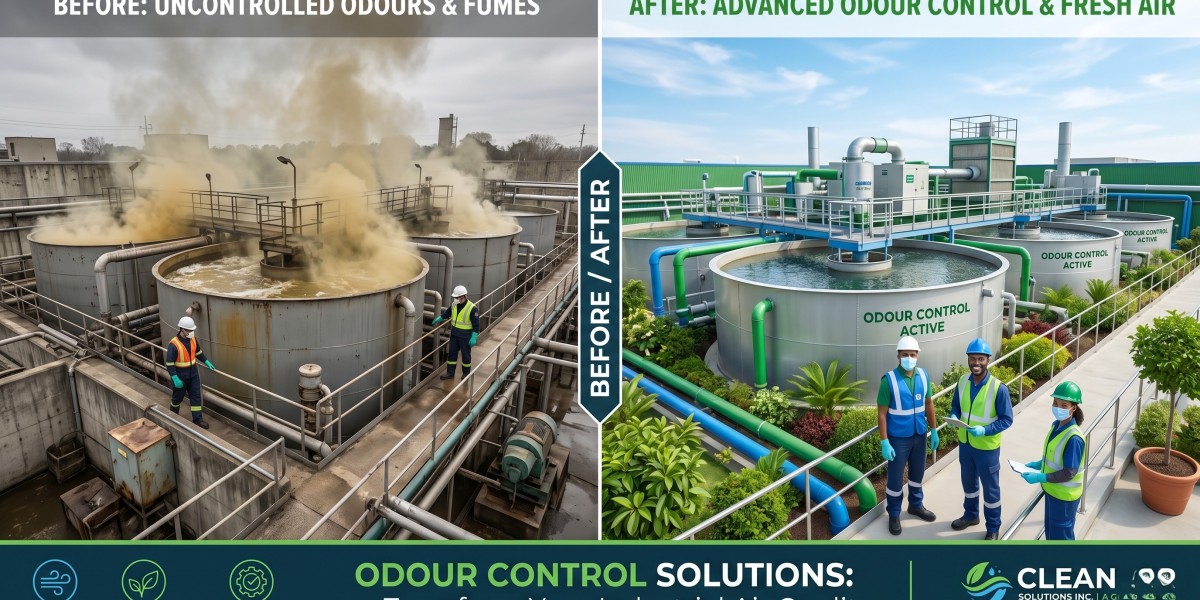

Introduction
One of the most important decisions a facility manager makes is choosing the right industrial odor control solutions. If you do it right, your plant will run without any problems. If you don't do it right, you'll have to deal with community protests, regulatory notices, and worker complaints that build up quietly until they become a formal compliance problem.
The problem isn't that there aren't enough products. There are many ways to control odors on the market, including chemical scrubbers, masking agents, and more advanced biological formulations. The real problem is figuring out which solution gets rid of the smell at its source, works well in your facility's normal operating conditions, and gives you a good return on investment.
This guide is based on real-life examples from wastewater and manufacturing settings. It gives you a useful framework for judging industrial odor control solutions, including what they are, where they work best, what to avoid, and how to choose the best one for your facility.
What Causes Industrial Odour Problems?
Industrial odour is not a single problem with a single source. It is a collection of chemical and biological events that vary by industry, process, and facility design. Understanding the chemistry behind your odour is the starting point for any effective control strategy.
The three dominant odour-causing compounds in industrial and wastewater environments are hydrogen sulphide (H₂S), ammonia (NH₃), and volatile organic compounds (VOCs). Each has a distinct origin and requires a different control approach.
H₂S forms when sulphate-reducing bacteria break down sulphur compounds in oxygen-deprived zones, septic tanks, waterlogged drainage channels, and sludge pits. Its detection threshold is around 0.5 parts per billion (ppb), which means even trace quantities produce strong, pervasive odour. Ammonia originates from the biological breakdown of nitrogen-rich waste, food residuals, urine, and proteins, and contributes a sharp, acrid character to wastewater odour profiles.
VOCs are a broader category. In food processing facilities, short-chain fatty acids from incomplete fermentation produce sour, rancid smells. In chemical manufacturing, solvent vapours and process off-gases generate odour that is distinct from wastewater sources but equally disruptive. In textile and dyeing industries, sulphur dye decomposition and reactive dye effluent contribute a persistent chemical odour that standard masking agents cannot suppress.
Compound | Industrial Source | Detection Threshold | Control Priority |
Hydrogen Sulphide (H₂S) | Anaerobic zones in tanks, sewers, sludge | ~0.5 ppb | Highest, corrosive and health-relevant |
Ammonia (NH₃) | Protein and urea decomposition in effluent | ~5 ppm | High, sharp odour, respiratory impact |
Methyl Mercaptan | Biological sulphur metabolism | ~0.002 ppb | High, extremely low odour threshold |
Volatile Fatty Acids | Fermentation in grease traps and waste pits | Variable | Medium, rancid, sour odour character |
Solvent VOCs | Manufacturing process off-gases | Compound-specific | Medium to high, facility and sector-dependent |
Common Areas Where Odours Develop in Industries
Odour rarely concentrates in a single location. In most industrial and wastewater facilities, multiple source points operate simultaneously. Identifying and prioritising these zones is essential before selecting a control method.
Wastewater Collection and Drainage Networks
Below-grade drainage systems, floor channels, sump pits, and collection mains, accumulate organic deposits that decompose anaerobically between cleaning cycles. In busy food production facilities, these channels can develop measurable H₂S concentrations within 48–72 hours of a cleaning event. Long drainage runs and sealed sump covers accelerate anaerobic conditions.
Primary Treatment Zones in ETPs and STPs
The inlet works, screens, and primary clarifiers in an ETP or STP receive raw, undigested effluent at its highest organic concentration. Primary clarifiers, particularly those with long retention times and poor surface skimming, produce significant H₂S and ammonia from the scum layer and settled sludge. These zones are consistently among the highest odour-intensity points in any treatment plant.
Sludge Processing and Storage Areas
Sludge thickeners, dewatering equipment, and sludge storage yards concentrate the organic content that drives odour generation. Dewatered sludge cakes stored in open yards, common in smaller industrial ETPs, generate H₂S and ammonia at rates that vary with temperature, moisture content, and storage duration. In Indian climatic conditions, sludge stored outdoors during summer months produces some of the most intense odour events in the industrial environment.
Grease Traps and Fat Interceptors
Commercial kitchens, food processing lines, and cafeteria facilities generate grease-trap odour that migrates into occupied spaces faster than most other wastewater-related odour sources. A grease trap under high load and without biological dosing can reach odour-detectable H₂S levels within the kitchen workspace in as little as 3–5 days after a clean-out.
Manufacturing Process Off-Gas Points
Certain manufacturing processes produce odour directly from production chemistry, rendering operations, fermentation vessels, chemical reactors, and drying systems. These point-source odours require different control approaches from wastewater-derived odour and often need engineering controls (extraction, scrubbing, or enclosure) rather than biological treatment.
Why Odour Control Matters for Businesses
Odour is not just an environmental issue. It has direct operational, legal, and financial consequences for the businesses that generate it.
Impact Category | Specific Consequence | Business Risk Level |
Regulatory compliance | State PCB notices under Environment (Protection) Act; odour nuisance provisions | High |
Community relations | Formal complaints from neighbours trigger mandatory inspections | High |
Worker health and safety | H₂S exposure above 10 ppm causes headaches, eye irritation, reduced alertness | Medium-High |
Corrosion damage | H₂S corrodes concrete, rebar, and metal infrastructure in ETP civil works | Medium |
Brand and guest impact | Odour migrating into guest-facing areas in hospitality damages reputation directly | High |
Productivity loss | Worker performance drops in odour-affected operational zones | Medium |
India's Environment (Protection) Act and associated standards set by the Central Pollution Control Board (CPCB) do not yet define a single numerical odour standard applicable to all industries, but odour nuisance provisions exist at the state level, and community complaints consistently trigger inspections that escalate into formal compliance proceedings. Proactive industrial odour control solutions reduce this regulatory exposure before it becomes a formal problem.
Different Types of Industrial Odour Control Solutions
The odour control market offers multiple technology categories. Each has a distinct mechanism, operating cost profile, and range of appropriate applications. Understanding these categories prevents the common mistake of selecting the wrong technology for the odour source.
1. Biological Odour Treatment (Source Suppression)
Biological industrial odour control solutions introduce specific bacterial strains that compete with and suppress odour-producing microorganisms, particularly sulphate-reducing bacteria responsible for H₂S. Applied as liquid or powder formulations dosed into tanks, drains, or sludge zones, they work at the biological source of odour rather than masking the output.
This category delivers the most durable odour reduction because it addresses the cause. Results build progressively over 7–14 days as beneficial bacterial populations establish. Well-maintained biological treatment programs reduce H₂S concentrations in tank headspace by 70–90% over a 3–4 week establishment period.
2. Chemical Scrubbers and Wet Scrubbing Systems
Wet scrubbers pass odorous air through a liquid chemical solution, typically sodium hydroxide (NaOH) or sodium hypochlorite, that reacts with and neutralises H₂S and ammonia. These are engineering installations suited to large enclosed odour sources: enclosed STP chambers, sludge dewatering buildings, or covered ETP structures. Capital cost is significant, but removal efficiency for H₂S and ammonia is consistently high (85–99%) when correctly sized and operated.
3. Chemical Odour Neutralisers
Chemical neutralisers are formulated compounds, not perfumes, that react with specific odour molecules (H₂S, ammonia) at the molecular level to neutralise them. They are applied as sprays, misting systems, or added to wastewater streams. They provide faster initial odour reduction than biological products but do not prevent continued odour generation. Best used as a rapid-response tool or in combination with a biological programme.
4. Masking and Fragrance-Based Agents
Perfume-based masking agents do not remove odour compounds, they add a competing fragrance to reduce perceived unpleasantness. They are appropriate for guest-facing or reception areas where temporary odour mitigation is needed, but they do not constitute a treatment strategy. Using masking agents as a primary industrial odour control solution in a wastewater environment is one of the most common and expensive mistakes facility managers make.
5. Biofilters and Biotrickling Filters
Biofilters pass odorous air through a packed bed of organic material (wood chips, compost, peat) that hosts microbial communities capable of degrading H₂S and VOCs. Biotrickling filters use an inert packing material with a circulating nutrient solution. Both systems are established engineering solutions for large-scale point-source odour control. They require space, capital investment, and ongoing maintenance but deliver consistent performance on enclosed odour streams.
Solution Type | Mechanism | Best Application | Typical H₂S Removal | Cost Profile |
Biological dosing | Source-suppression via competitive bacteria | Tanks, drains, septic, sludge | 70–90% (sustained) | Low-Medium (OpEx) |
Chemical scrubbers | Chemical neutralisation of odorous air stream | Enclosed STP/ETP structures | 85–99% | High (CapEx + OpEx) |
Chemical neutralisers | Molecular reaction with H₂S and NH₃ | Rapid-response; sludge yards | 60–80% (short-term) | Medium (OpEx) |
Masking agents | Fragrance competition with odour compounds | Guest-facing areas only | 0% (no removal) | Low (OpEx) |
Biofilters | Microbial degradation in packed media | Large point-source enclosed emissions | 80–95% | High (CapEx + OpEx) |
Benefits of Using Biological Odour Control Products
Among the available technologies, biological industrial odour control solutions stand out for industrial and commercial wastewater applications because they address odour at its source rather than intercepting or masking the output. Here are the operational benefits that facilities consistently report:
Durable Source Reduction
Biological treatment does not wear off when dosing stops, unlike chemical neutralisers which require constant application. Once a beneficial microbial community establishes in the treatment zone, it maintains H₂S suppression through ongoing competitive exclusion of sulphate-reducing bacteria. This self-sustaining quality makes the cost-per-unit-of-odour-reduction lower over time than chemical-only approaches.
Simultaneous BOD and Odour Improvement
Biological odour control products that contain substrate-specific bacterial strains do not only suppress odour-producing bacteria, they actively degrade the organic matter that those bacteria were feeding on. This means a well-chosen biological odour control product improves effluent BOD and COD alongside odour metrics. You get two operational improvements from a single intervention.
Compatibility with Existing Treatment Systems
Biological dosing products are compatible with active ETP and STP systems when applied correctly. They do not disrupt the existing biological community, they augment it. This means facilities do not need to modify infrastructure, halt operations, or obtain approvals before implementing a biological odour control programme.
Lower Long-Term Operating Cost
Chemical scrubbing systems and biofilters require significant capital investment and ongoing maintenance. Biological dosing programmes have a low entry cost, typically a product purchase and a dosing protocol, and maintenance costs that are predictable and manageable. For small to mid-size industrial facilities without the capital budget for engineered solutions, biological industrial odour control solutions offer the most practical route to consistent odour management.
Industries That Need Odour Control Systems
Odour control is a cross-sector requirement. These are the industries where the operational and compliance need is most acute:
Industry | Primary Odour Source | Most Affected Zones | Recommended Solution Type |
Wastewater Utilities / Municipal STPs | Primary clarifiers, sludge thickeners | Plant perimeter, sludge yards | Biological dosing + chemical scrubbers for enclosed zones |
Food & Beverage Processing | Process effluent, grease traps, waste holding | ETP inlet, waste storage, drains | Biological dosing; grease-targeting enzyme cultures |
Da
|