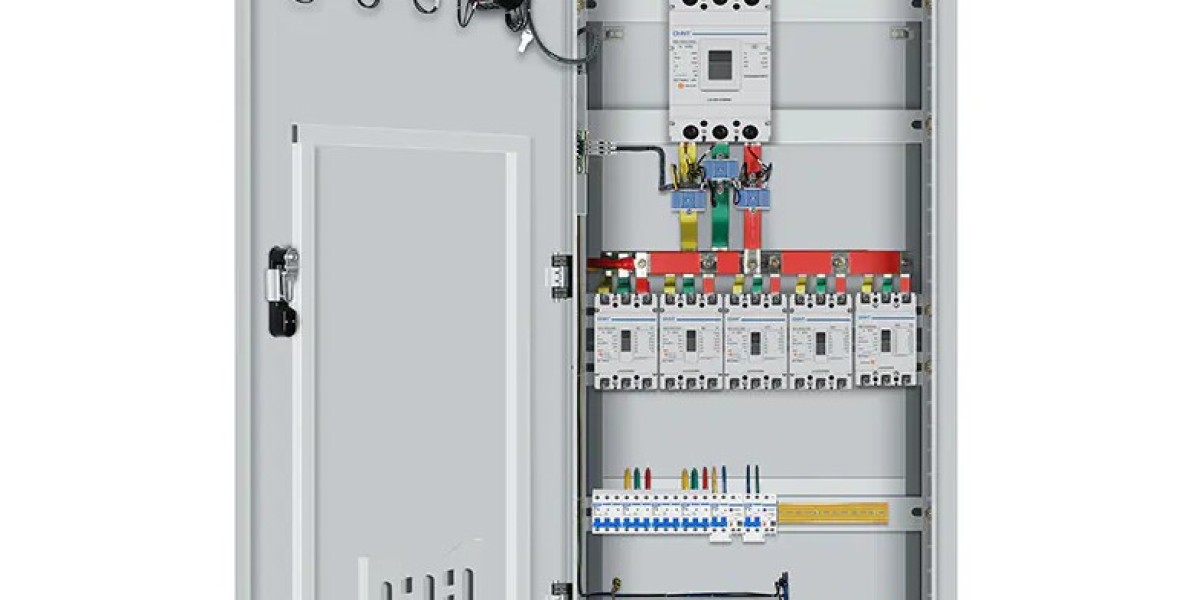

Electrical systems often appear stable from the outside, yet their performance depends heavily on internal component selection and structural design. When Cable Distribution Cabinets and Water Pump Control Panel units are engineered with attention to internal layout, material compatibility, and component coordination, the overall system becomes more predictable and easier to maintain.
Breaking Down Key Components Inside Cabinets
A cable distribution cabinet is more than a metal enclosure. Its internal structure determines how efficiently power is routed and protected.
Busbars are one of the core elements. Typically made from copper or aluminum, they distribute current across multiple circuits. Copper offers lower resistance and better conductivity, while aluminum reduces weight and cost. The choice often depends on project scale and environmental conditions.
Insulation materials surrounding busbars and terminals also play a role. High-temperature-resistant polymers help maintain stability under load fluctuations. Without proper insulation, heat buildup can lead to gradual degradation.
Circuit breakers and disconnect switches are arranged to isolate faults quickly. Their positioning within the cabinet affects accessibility during maintenance. A well-planned layout ensures that technicians can reach critical points without dismantling adjacent components.
Understanding Control Panel Core Modules
Water pump control panels rely on coordinated modules rather than a single control unit. Each module handles a specific function.
Contactors manage motor switching, while overload relays protect against excessive current. Together, they form the basic protection layer.
More advanced systems include variable frequency drives (VFDs). These devices regulate motor speed by adjusting frequency and voltage. By doing so, they allow pumps to match output with demand rather than operating at fixed speed.
Sensors provide real-time feedback on pressure, flow rate, and temperature. These inputs are processed by controllers, which then adjust operation accordingly.
The interaction between these modules determines how smoothly the system responds to changes.
Addressing Heat Management Challenges
Heat accumulation remains a common issue in electrical enclosures. High current flow generates heat, which can affect both performance and component lifespan.
Cable distribution cabinets often incorporate ventilation slots or forced cooling systems. In more demanding environments, heat exchangers or cooling fans are added.
Control panels also require thermal management. VFDs, in particular, generate heat during operation. Proper spacing between components allows airflow to circulate effectively.
Field data shows that reducing internal temperature by even 5°C can extend component lifespan significantly.
Improving Wiring Architecture
Internal wiring is frequently overlooked during design, yet it directly impacts reliability.
Organized wiring reduces electromagnetic interference between circuits. Shielded cables are often used for signal lines to prevent disruption from power cables.
Color coding and labeling improve clarity. When systems expand or require repair, technicians can identify connections without extensive tracing.
Cable routing channels within cabinets keep wires separated and prevent physical damage during operation.
Ensuring Compatibility Between Components
Component compatibility is essential for stable operation. Mismatched voltage ratings or response times can create inconsistencies.
For example, pairing a high-sensitivity relay with a slower circuit breaker may result in delayed fault isolation. This mismatch can expose equipment to unnecessary stress.
Manufacturers often standardize component selection to ensure consistent performance across installations.
Supporting Modular Design Approaches
Modern systems increasingly adopt modular design principles. Instead of fixed configurations, cabinets and panels are built with interchangeable sections.
This approach allows individual modules to be replaced or upgraded without affecting the entire system.
In water pump control panels, additional pump control units can be integrated as demand increases. Cable distribution cabinets can also expand by adding new compartments.
Modularity reduces downtime during upgrades and supports long-term adaptability.
Enhancing Durability Through Material Selection
Material choice influences how systems perform under different environmental conditions.
Cabinet enclosures are often made from steel with protective coatings to resist corrosion. In humid or coastal environments, stainless steel or treated aluminum may be used.
Control panel housings must also resist moisture and dust. Sealing standards such as IP ratings help define protection levels.
Internal components are selected based on expected load cycles and environmental exposure. Durable materials reduce the frequency of replacements.