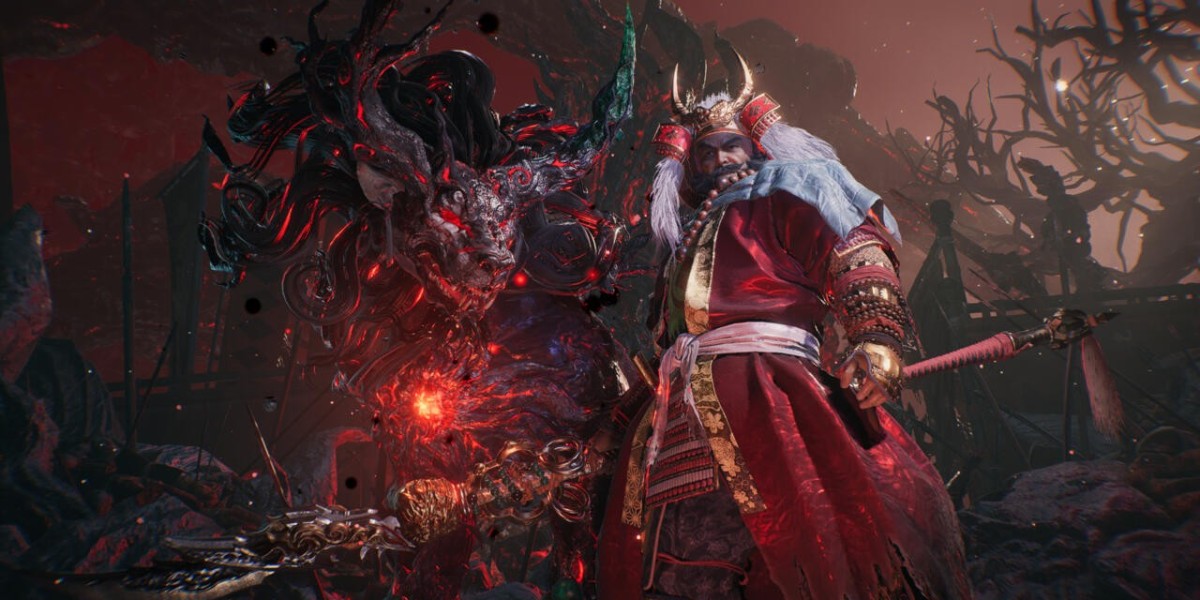

Nioh 3 feels like an amalgamation of Team Ninja’s work over the past nine years. It’s still quintessentially Nioh, but also draws on elements from two of the Japanese studio’s most recent games, Wo Long: Fallen Dynasty and Rise of the Ronin, applying and repurposing aspects of them to fit Nioh’s distinctive style. The end result is a studio hitting its stride with evident confidence: a team galvanized and inspired after taking time away from the series to explore new ideas before returning in triumphant fashion, lessons learned. Nioh 3 is Team Ninja firing on all cylinders, expanding and refining combat systems that were already sublime, while introducing more exploration and discovery through its shift to a rewarding “open field” design.
Nioh has always fallen under the souls-like umbrella; there are bonfire equivalents, “souls” you lose on death, stat-scaling, a punishing difficulty, and level design centered around shortcuts. However, with its fast-paced, stance-switching combat and historical Japanese setting, Nioh pulls more from fighting games and the likes of Ninja Gaiden, Tenchu, and Onimusha than From Software’s output, effectively differentiating the series with its own idiosyncratic flavor. Nioh 2 built upon the first game’s strong foundations, and now Nioh 3 takes things a step further. It’s bigger and better, broader and more complex, yet oddly more approachable than its predecessors — without losing any of its bite.
One of Nioh 3’s most significant new additions is the introduction of two distinct combat styles: Samurai and Ninja. Each one is essentially its own build, with unique weapons and armor attached, and you can instantly switch between them on the fly to chain combos, poise-break your opponent, and whittle down their health. Samurai is Nioh as you know it, emphasizing deflects; stance-switching; heavier weapons such as katanas, switchglaives, and spears; and the series’ signature Ki Pulse, where hitting R1 after attacking will instantly recover some lost stamina. There are new techniques at your disposal, too, such as an Arts Gauge that charges when attacking and guarding against enemy attacks, allowing you to unleash enhanced versions of both strong attacks and Martial Arts (customizable combat maneuvers you can unlock), dealing extra damage without consuming any Ki.
Even after three games, these core mechanics are still immensely satisfying. There’s a rhythmic flow to combat that comes from the timing needed to nail the game’s Ki Pulse and stance-switching mechanics, adding to the responsive fluidity present in every action you take. Not to mention how gratifying it is to slice through yokai and humans alike, lopping off heads and spraying excessive blood like you’re Tsubaki Sanjuro without any of the restraint. From the bright spark and loud clash of steel that signifies a successful deflect to the sheer amount of compelling techniques at your disposal, Nioh 3’s combat is best in class, and the Ninja style adds yet another layer to its unadulterated brilliance.
The weapons in your Ninja arsenal are on the faster side, including kusarigamas, tonfas, and splitstaves. You’re also much more fleet-footed in general, creating a discernible difference between the two styles. Aside from being able to quickly dodge out of danger, you can also utilize a mechanic called Mist to both evade and divert the enemy’s attention by creating a shadow of yourself. Since Ninja doesn’t consume as much Ki as Samurai, Mist replaces the Ki Pulse, allowing you to dash away from your opponent and let your stamina replenish on its own.
There are a plethora of Ninjutsu at your disposal, too, replacing the Samurai’s various stances. These range from throwable weapons like shurikens and caltrops to fireballs and special moves that let you quickly close the gap on enemies. The Ninja style might not be as complex as the Samurai, but it’s no less satisfying. The weapons ooze style, and vanish-stepping around enemies is a joy, particularly when you phase behind them to take full advantage of the Ninja’s increased back damage.
Both styles feature their own comprehensive skill trees where you can purchase Ninjutsu and Martial Arts to fill out your repertoire, customizing each moveset in a way that’s incredibly fleshed out. The elemental Guardian Spirits also return, presenting even more options by allowing you to unleash special attacks that can both damage and deplete a yokai’s maximum Ki.
Then there are skills that unlock more techniques and buff specific attributes; Soul Cores that let you summon bosses for brief but powerful attacks or utilize ranged magic; and a new version of the Yokai Shift called Living Artifact, where you take the form of a Guardian Spirit for a short period, preventing enemy attacks from killing you, and imbuing your offense with your chosen Guardian’s element. There’s a lot going on, but I never felt overwhelmed. This is coming from someone who finished Nioh and played Nioh 2 for around 10 hours, but all of these systems feel intuitive, and the onboarding process is gradual enough that consuming everything and putting it into action is surprisingly palatable.
Nioh 3’s other big swing is the shift to what Team Ninja calls “open field” design. In practice, this sits somewhere between Nioh’s traditionally linear levels and an open world. Much like Rise of the Ronin, the game consists of multiple maps rather than a single interconnected world; the difference is that, while Rise of the Ronin felt like a standard and fairly expansive open world, Nioh 3 is much more curated and focused. There are sections on each map that still feel like classic Nioh, with multiple paths coalescing into one as you naturally open up shortcuts, but they’re also connected to whole other areas you’re free to explore. You might stumble upon a grand temple teetering on the edge of a cliff, or exit a cave to find the giant Daidara Bocchi — a folktale said to have created Japan — emerging from the ocean.
You’re consistently rewarded for your exploration in tangible ways, too. Finding friendly yokai, such as Kodama and Chijiko, lets you boost the efficacy of healing elixirs and unlock new Martial Arts and Ninjutsu. There are enemy bases to clear, and side quests that tie into the main story. These typically revolve around defeating enemies in a specific location, but that’s hardly surprising for a game built on combat, and I never took umbrage with more opportunities to cut down a yokai or 12.
It helps that the enemies you’ll face are much more varied than in the past. From giant enemy crabs and anthropomorphic bats to demonic farmers and cavalry troops riding atop headless horses, each one presents unique challenges and is either pulled directly from Japanese folklore or inspired by it. The maps you’ll travel between offer similar versatility as well. Nioh 3’s story is par for the course, meshing history with original storytelling that, if nothing else, does its job, propelling you from one conflict to another.
This time around, you’ll travel between different eras of Japanese history, fighting across the Edo, Warring States, Heian, and Bakamatsu periods. Each one has its own distinct aesthetic, whether it’s the vibrant red and amber flora of the Sengoku period or the frigid snowfall coating Kyoto in white during the Heian era. It’s not the best-looking game, alternating between impressive vistas and distracting low-res textures in areas you’re not meant to go. However, the game’s technical performance mostly holds up, at least on the base PlayStation 5. There are a couple of disappointing areas, such as Ryotan Temple, where the frame rate inexplicably struggles, but it generally manages to achieve 60fps in performance mode.
Even if it’s not the most graphically impressive game, the shift to an open-field structure does make the world feel much more alive. It also has the added impact of improving Nioh 3’s approachability. The challenge is just as imposing as its predecessors, but if you’re having trouble with a boss, you now have the opportunity to put it on the back burner and go do something else. Maybe head to an unexplored region of the map or polish off a few side quests. By the time you return, you’ll be a few levels higher, have better equipment, and be in for a slightly easier time.
Speaking of which, Nioh 3 still ensures you’re a veritable loot goblin, especially now that there are two different combat styles to equip weapons and armor for. Mercifully, Team Ninja has introduced some new quality-of-life features to cut down on menu time. You can fiddle with the game’s settings to auto-pick up items and dispose of any below a rarity of your choosing, with the option of selling these items, trading them for Amrita (Nioh’s answer to souls), or dismantling them for crafting materials. You might still spend a fair amount of time in menus min-maxing your build, but sorting through the mountains of loot you acquire has been streamlined to the point where you can almost ignore a lot of it. I still wish gear felt more meaningful, whether through unique weapons or cutting down on the bloat, but these settings are an improvement at least.
From quality-of-life enhancements like this, to excellent new additions and refinements to its core systems, Nioh 3 is absolutely superb across the board. It’s an evolution of the Nioh formula where every single new idea lands. There might still be a couple of issues, but they’re relatively minor in the grand scheme of things. Nioh 3 is Team Ninja at its very best, learning from its own development side quests to return with renewed vigor. The end result is the best game in the series so far, and one not to be missed.