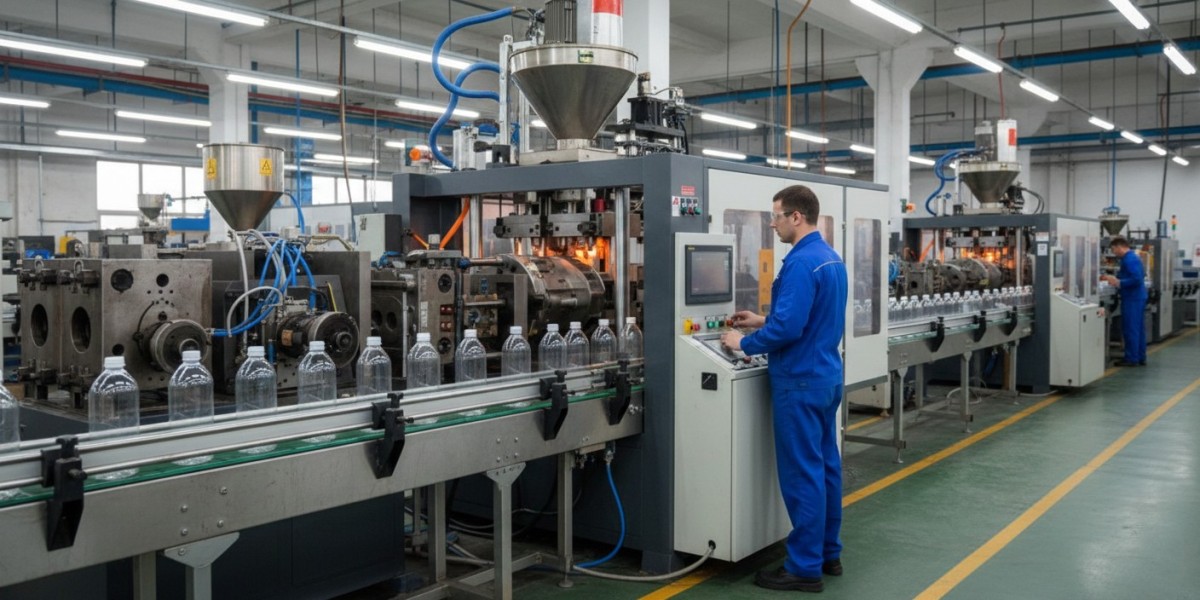

A blow molding machine is designed to form hollow plastic products by expanding heated plastic inside a mold. While the concept appears simple, the industrial execution involves precise temperature control, accurate mold design, and synchronized mechanical movement.
The blow molding method guarantees that each unit produced in large-scale plastic industry is identical to the previous one. This repeatability becomes essential when factories are producing or even millions of units per month. Without consistent forming pressure, cooling time, and material flow, product variation would increase, leading to waste and quality rejection.
Modern machines integrate automation and digital control panels that allow operators to adjust wall thickness, cycle time, and extrusion parameters. This level of control turns blow molding machines into production stabilizers rather than simple forming tools.
The Industrial Role of Plastic Blow Molding Machines
Plastic Blow Molding Machines play a direct role in shaping how factories manage volume, cost, and product integrity. Their value extends beyond forming containers and bottles.
They support continuous production without frequent stoppages, helping factories meet tight delivery schedules. When combined with automated trimming and inspection systems, they reduce the need for manual handling, lowering labor dependency and error margins.
Industries favor blow molding machines because they allow manufacturers to scale production without redesigning the entire production line. A single machine setup can support multiple mold types, enabling product variation while maintaining operational consistency.
Extrusion Blow Molding Machines and Their Production Impact
Among different blow molding technologies, Extrusion Blow Molding Machines are especially significant in industrial settings. They are commonly used to manufacture containers, drums, tanks, and packaging products with complex geometries.
Melted plastic is extruded into a hollow tube called a parison in extrusion blow molding. After that, this portion is placed into a mold and inflated to fit the shape of the cavity. The process allows for greater flexibility in wall thickness control and material distribution.
Industries benefit from extrusion blow molding because it supports high output with minimal scrap generation. The ability to regrind excess material and reuse it further improves material efficiency, which directly influences production costs.
Production Consistency as a Core Value Driver
Consistency defines production value in plastic industries. Blow molding machines ensure that every unit maintains uniform dimensions, weight, and strength.
This consistency reduces customer complaints, lowers return rates, and strengthens brand reliability for manufacturers supplying packaging or consumer goods. When containers must meet exact volume requirements, blow molding machines ensure compliance across every batch.
Production consistency also simplifies downstream processes such as labeling, filling, and sealing. When product dimensions remain stable, automated packaging systems operate more efficiently with fewer stoppages.
Material Optimization and Waste Reduction
One of the strongest production advantages of blow molding machines lies in material control. Advanced machines regulate parison thickness during extrusion, ensuring that plastic is distributed only where structural strength is required.
This targeted material use reduces resin consumption without compromising durability. Over time, even small reductions in material usage lead to significant cost savings at scale.
Additionally, excess flash and trimmed material can often be recycled directly back into the production cycle. This closed-loop capability makes blow molding machines compatible with sustainability goals and cost-conscious manufacturing strategies.
Production Speed and Output Efficiency
Industrial production value is closely tied to output speed. Blow molding machines operate on short cycle times, allowing manufacturers to produce high volumes within limited time frames.
Modern machines feature rapid mold closing systems, efficient cooling channels, and synchronized ejection mechanisms. These features reduce idle time between cycles, ensuring continuous output.
High-speed production does not come at the expense of quality. Automated controls maintain temperature stability and pressure balance, ensuring that speed enhancements do not create defects or shape inconsistencies.
Structural Strength and Product Durability
Blow molding machines enable manufacturers to control wall thickness distribution across the product. This capability ensures that stress-prone areas receive additional material reinforcement.
For industrial containers, chemical packaging, or automotive components, this structural control becomes critical. Products must withstand pressure, impact, and environmental exposure without deformation.
Plastic Blow Molding Machines deliver durability through engineering precision rather than excess material usage. This balance improves both product lifespan and production economy.
Adaptability Across Plastic Industry Segments
The production value of blow molding machines increases with their adaptability. A single system can support diverse industries with minimal adjustments.
Packaging manufacturers use them for bottles and containers. Chemical industries rely on them for robust storage solutions. Automotive sectors apply blow molding for ducts and fluid reservoirs. Household product manufacturers depend on them for everyday items.
This cross-industry relevance makes blow molding machines long-term investments rather than single-purpose equipment.
Automation and Smart Control Systems
Modern blow molding machines integrate digital interfaces that allow real-time monitoring of production parameters. Operators can track temperature zones, pressure levels, and cycle times through centralized control panels.
These systems reduce human error and improve repeatability across shifts. When integrated with factory-wide automation, machines can adjust output based on demand without manual intervention.
Smart diagnostics also help detect potential faults before they result in downtime. Preventive alerts allow maintenance teams to address issues early, protecting production schedules.
Long-Term Operational Reliability
Production value extends beyond daily output. Blow molding machines are designed for long operational lifespans when maintained properly.
Their mechanical components are engineered to handle continuous operation under heat and pressure. With routine maintenance, machines remain productive for years without performance degradation.
This reliability lowers replacement costs and ensures predictable production planning, which is essential for contract-based manufacturing.
Comparison Table: Production Value Impact of Blow Molding Technologies
| Production Aspect | Blow Molding Machine | Extrusion Blow Molding Machines |
|---|---|---|
| Output Stability | Maintains uniform shape and size across batches, reducing rejection rates | Provides advanced control over parison thickness, improving shape accuracy |
| Material Efficiency | Optimizes resin use through controlled inflation | Allows regrinding and reuse of excess material |
| Production Speed | Supports rapid cycle times for mass production | Designed for continuous, high-volume industrial output |
| Product Flexibility | Suitable for a wide range of hollow products | Handles complex shapes and larger containers efficiently |
| Long-Term Value | Lowers operational cost through consistency | Improves scalability with minimal material waste |
Quality Assurance and Industry Compliance
Many industries operate under strict quality standards. Blow molding machines help manufacturers meet these standards through repeatable forming accuracy.
Products designed for food, medical, or chemical use must meet hygiene, strength, and volume requirements. Automated blow molding systems ensure compliance by minimizing variability.
Consistency also simplifies certification processes and audits, strengthening manufacturing credibility in regulated markets.
Economic Impact on Plastic Manufacturing Plants
From a business perspective, blow molding machines directly influence profit margins. Reduced waste, faster output, and consistent quality lead to lower production costs per unit.
Factories can fulfill large orders without expanding floor space or workforce. This efficiency allows manufacturers to accept higher-volume contracts while maintaining cost control.
Over time, the machine pays for itself through reduced scrap, stable output, and improved market competitiveness.
Sustainability and Modern Manufacturing Goals
Blow molding machines support sustainability efforts through material optimization and recyclability. Many systems are compatible with recycled plastics, allowing manufacturers to integrate eco-conscious production strategies.
Energy-efficient heating systems and optimized cooling cycles further reduce power consumption. These efficiencies align with modern manufacturing goals without sacrificing productivity.
Conclusion: Strategic Production Value in Modern Plastic Industries
The production value of a blow molding machine goes far beyond shaping plastic. It lies in consistency, material efficiency, output reliability, and long-term operational stability. Plastic Blow Molding Machines and Extrusion Blow Molding Machines enable manufacturers to meet rising demand while maintaining strict quality standards and cost control.
For industries operating in competitive manufacturing environments, especially those focused on high-volume output, choosing advanced systems such as Blow Molding Machines in UAE allows businesses to strengthen production capabilities, reduce operational risks, and maintain a strong position in the plastic manufacturing sector.
Visit for news and updates at peruativo.com