
Precision machines often operate under complex loads from multiple directions. When bearings lack sufficient rigidity, components can shift slightly during operation. This small movement leads to vibration, positioning errors, and reduced machining accuracy.
How Structural Flexibility Reduces Accuracy
Weak bearing support can cause:
Inconsistent cutting or positioning results
Increased wear on mechanical parts
Reduced repeatability in automation systems
Frequent recalibration and downtime
In high-precision industries, even minor structural movement can impact product quality.
The Solution: What Is an RU Cross Roller Bearing?
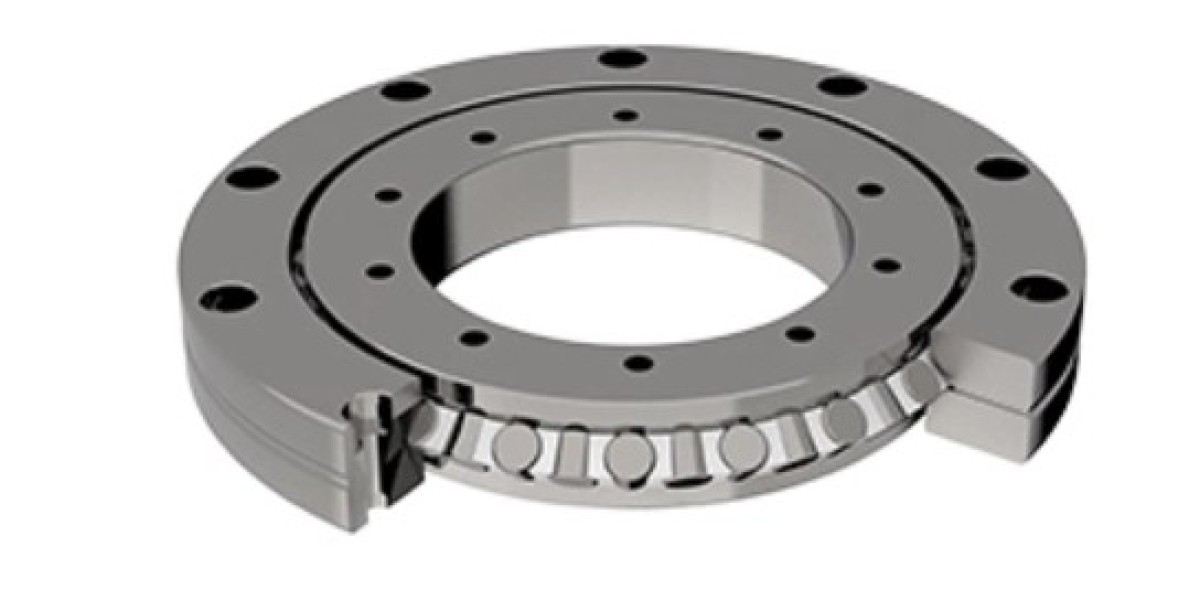
An RU cross roller bearing is a precision bearing with an integrated inner and outer ring. It uses cylindrical rollers arranged at right angles to each other, allowing it to handle loads from all directions.
How the Crossed Roller System Works
The rollers are alternately positioned at 90 degrees, enabling the bearing to support radial, axial, and moment loads simultaneously. Line contact between rollers and raceways increases stiffness and load capacity compared to ball bearings.
Because the inner and outer rings are integrated, the structure is more stable and easier to mount.
Problems with Traditional Bearing Assemblies
Conventional systems often require multiple bearings to handle different load directions. This can lead to:
Complicated installation and alignment
Lower overall rigidity
Increased assembly space
Higher risk of mounting errors
These limitations can reduce machine accuracy and increase maintenance time.
How RU Cross Roller Bearings Solve These Issues
One-Piece Structure for Maximum Rigidity
The integrated ring design improves structural strength. This reduces deformation under heavy or moment loads, keeping machine components stable during operation.
Compact Design with High Load Capacity
Despite its compact size, the crossed roller arrangement allows high load capacity. Engineers can design smaller, lighter systems without sacrificing performance.
Key Features That Matter to Engineers
Engineers select RU cross roller bearing solutions because they provide:
Support for radial, axial, and moment loads
High rigidity and precision
Compact integrated structure
Simplified mounting and alignment
Smooth rotation with low vibration
Long operational life
These features improve both design efficiency and machine performance.
Comparison: Standard Bearing Setup vs RU Cross Roller Bearing
| Feature | Standard Multi-Bearing Setup | RU Cross Roller Bearing |
|---|---|---|
| Load Support | Multiple bearings required | Single bearing handles all |
| Rigidity | Moderate | Very high |
| Installation | Complex alignment | Easy mounting |
| Space Requirement | Larger | Compact |
| Precision | Limited | High precision |
| Structural Stability | Lower | Excellent |
Real Industrial Applications
RU cross roller bearings are widely used in precision and heavy-duty applications such as:
CNC rotary tables
Robotics and automation joints
Medical imaging systems
Semiconductor manufacturing equipment
Precision measuring devices
These machines demand both high accuracy and stable load support.
Why Manufacturers Prefer RU Cross Roller Bearings
Manufacturers benefit from improved reliability and simpler machine design. Using high-quality RU cross roller bearing solutions helps:
Increase motion accuracy
Reduce component count
Simplify assembly
Lower maintenance requirements
Extend equipment lifespan
This results in better productivity and lower total operating costs.
How to Choose the Right RU Cross Roller Bearing
When selecting a bearing, engineers should evaluate:
Required load capacity
Desired rotational accuracy
Mounting dimensions and space
Operating speed and lubrication
Environmental conditions
Correct selection ensures optimal machine performance and long-term durability.
Conclusion
Machines that require high rigidity and precision benefit greatly from RU cross roller bearings. Their integrated design, high load capacity, and compact structure make them ideal for advanced industrial systems. Choosing the right bearing solution ensures stable performance and improved manufacturing quality.