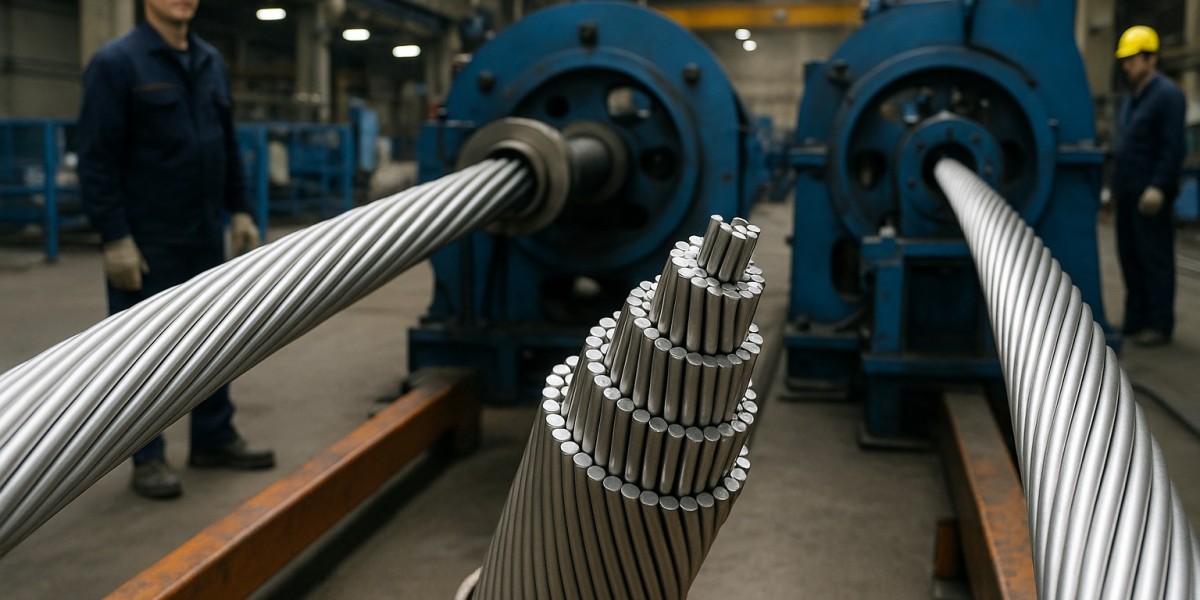

In today’s power transmission and distribution networks, selecting the right conductor is a critical engineering and procurement decision. Among the most widely used solutions worldwide, the ACSR conductor (Aluminum Conductor Steel Reinforced) continues to play a central role in overhead transmission lines due to its balanced combination of mechanical strength, electrical performance, and cost efficiency.
This article provides a clear, professional overview of the ACSR conductor its construction, advantages, applications, and key selection considerations written specifically for power utilities, EPC contractors, engineers, and procurement teams.
What Is an ACSR Conductor?
An ACSR conductor is a composite overhead conductor consisting of a central steel core surrounded by one or more layers of hard-drawn aluminum strands.
Steel core: Provides high tensile strength and mechanical support
Aluminum layers: Carry the electrical current efficiently
This design allows ACSR conductors to span long distances, withstand high mechanical loads, and operate reliably in demanding environmental conditions.
Key Construction Features of ACSR Conductors
Steel Reinforced Core
The galvanized steel core delivers exceptional tensile strength, enabling the conductor to handle:
Long span installations
High wind and ice loads
Increased line tension without excessive sag
Aluminum Outer Strands
The aluminum layers offer:
High electrical conductivity
Lightweight construction compared to copper
Excellent corrosion resistance in most environments
This combination makes the ACSR conductor a proven choice for both transmission and sub-transmission lines.
Advantages of Using ACSR Conductor in Power Projects
High Mechanical Strength
ACSR conductors are designed to perform under heavy mechanical stress. The steel reinforcement ensures structural integrity even in harsh climates and mountainous or river-crossing terrains.
Cost-Effective Performance
Compared with all-aluminum alternatives, ACSR conductors offer:
Lower installation costs for long spans
Reduced tower and structure requirements
Long service life with minimal maintenance
Proven Reliability
With decades of field performance worldwide, ACSR conductors remain a trusted solution for utilities seeking predictable and standardized performance.
Wide Range of Sizes
ACSR conductors are available in multiple strand configurations and cross-sectional areas, allowing engineers to optimize designs for voltage level, current capacity, and environmental conditions.
Common Applications of ACSR Conductor
ACSR conductors are widely used across power infrastructure projects, including:
High-voltage and extra-high-voltage overhead transmission lines
Medium-voltage distribution networks
Long-span river crossings and valleys
Utility grid expansion and reinforcement projects
Their mechanical robustness makes them particularly suitable for regions with high wind loads or heavy ice accumulation.
ACSR vs AAC and AAAC: A Practical Comparison
While AAC (All Aluminum Conductor) and AAAC (All Aluminum Alloy Conductor) offer excellent conductivity and corrosion resistance, they lack the mechanical strength required for long spans.
| Feature | ACSR | AAC | AAAC |
|---|---|---|---|
| Tensile Strength | High | Low | Medium |
| Span Capability | Long | Short | Medium |
| Weight | Moderate | Light | Light |
| Typical Use | Transmission lines | Urban distribution | Coastal areas |
For projects where mechanical strength and span length are critical, ACSR conductor remains the preferred engineering choice.
Manufacturing Quality Matters
The performance of an ACSR conductor depends heavily on manufacturing precision, raw material quality, and process control. Key factors include:
Consistent aluminum strand conductivity
Uniform steel core galvanization
Accurate stranding and compaction
Compliance with international standards
As a global manufacturer, HNBF Power produces ACSR conductors using controlled manufacturing processes designed to meet utility-grade performance expectations for power transmission and distribution networks.
Selection Considerations for Engineers and Buyers
When specifying an ACSR conductor, professionals should evaluate:
Required current-carrying capacity
Span length and mechanical load conditions
Environmental exposure (wind, ice, pollution)
Applicable standards and project specifications
Working with an experienced manufacturer ensures the conductor is properly matched to both electrical and mechanical requirements.
FAQs About ACSR Conductor
1. Why is ACSR conductor used instead of pure aluminum?
Pure aluminum conductors lack sufficient tensile strength for long spans. The steel core in ACSR provides the mechanical reinforcement needed for overhead transmission lines.
2. Is ACSR conductor suitable for high-voltage transmission?
Yes. ACSR conductors are widely used in high-voltage and extra-high-voltage transmission systems due to their strength and proven reliability.
3. How long does an ACSR conductor last?
With proper design and installation, ACSR conductors can operate reliably for several decades with minimal maintenance.
4. Can ACSR conductors be customized?
Yes. Strand configuration, steel core size, and aluminum cross-section can be customized to meet specific project requirements.
5. Is ACSR conductor cost-effective for large projects?
Absolutely. Its balance of strength, performance, and long service life makes it a cost-efficient solution for large-scale power infrastructure.
Conclusion: A Reliable Choice for Modern Power Grids
The ACSR conductor remains a cornerstone of global power transmission infrastructure. Its combination of electrical efficiency, mechanical strength, and economic value makes it a dependable solution for utilities and EPC contractors worldwide.
If you are planning a transmission or distribution project and require a reliable, utility-grade conductor solution, HNBF Power offers customized ACSR conductor manufacturing backed by technical expertise and global supply capability.
Contact HNBF Power today to discuss your project requirements and receive a tailored conductor solution designed for long-term performance and reliability.