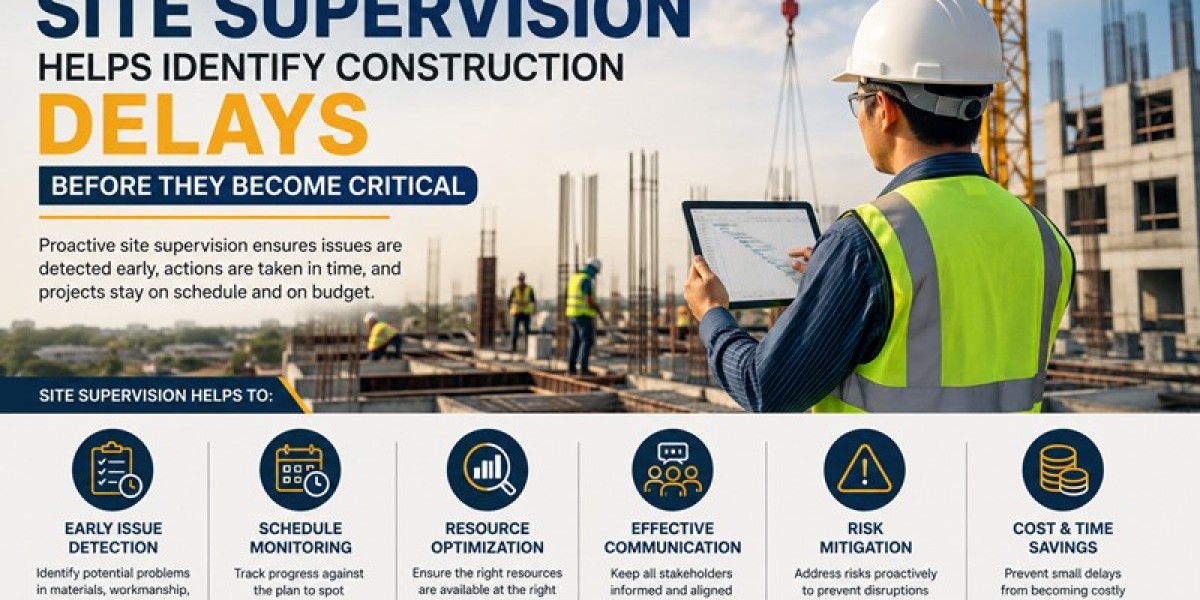

Most industrial construction projects don't fail on a single bad day. They fail through a slow accumulation of small, unremarkable slippages , a delivery that's a week late, a crew short by four workers, a drawing revision still pending approval. Individually, none of these looks like a crisis. Together, over four or five weeks, they can consume every day of the schedule float a project has.
The gap between "we noticed something was off" and "the project is officially delayed" is where site supervision either earns its value or fails to.
The Real Cost of Late Detection
Government data makes the scale of the problem hard to ignore. Major infrastructure projects has repeatedly shown several hundred monitored projects running behind their original completion dates, with average time overruns stretching well beyond a year. That overrun rarely originates on the day it's officially flagged, it originates weeks or months earlier, in a variance nobody escalated in time. This is precisely the gap that structured construction site supervision for delay prevention is designed to close
Academic research on Indian construction delays points to a consistent set of root causes: poor site coordination, weak planning discipline, communication breakdowns between contractors, labour productivity shortfalls, and rework. Almost none of these are unpredictable, external shocks , they are conditions that develop gradually and are, in principle, observable well before they cause a missed milestone.
This is the core argument for supervision built around continuous signal-reading rather than periodic status checks:
A monthly progress review tells you what already happened.
A well-run daily and weekly supervision cadence tells you what's about to happen.
Only the second version gives a project team enough runway to actually recover.
From Status Reporting to Signal Reading
The instinct on many sites is to treat supervision as a checking function , confirming that work matches drawings, that safety protocols are followed, that quantities match the bill of quantities. That's necessary, but not sufficient for delay prevention.
The shift that separates reactive supervision from proactive supervision is a change in the question being asked. Instead of "what got done today," effective supervisors ask "what, if left unresolved, will stop tomorrow's work from happening." That question is forward-looking by design, and it's what converts a site diary into an early-warning tool.
In practice, this means reports stop reading like activity logs and start reading like risk statements. "Cable tray installation 35% behind" is descriptive. "Cable tray installation is behind because Area B material hasn't cleared customs, and if it doesn't arrive within four days, the downstream cable-pulling activity loses its remaining float" is actionable , it names a cause, a deadline, and a consequence.
Five Signals Worth Tracking Every Day
Not every data point on a construction site carries the same predictive weight. Based on how delays actually propagate through interdependent packages , civil, MEP, process equipment, utilities, commissioning , five signals consistently surface problems earliest.
1. Workfront readiness, not just activity status
An activity marked "on schedule to start Monday" can still be at risk if its prerequisites aren't confirmed. Before any major activity begins, supervision should be able to answer, in a single pass: is the preceding work actually released by QA/QC, is the required material physically on site and inspected, is the crew mobilized, and is the permit signed. An activity with two or more open prerequisites three days before its planned start is a forecast risk, regardless of what the master schedule says.
2. Productivity trend, not productivity snapshot
A single slow day rarely matters. A productivity index , actual output divided by planned output , that stays below roughly 0.85 for more than three consecutive days almost always indicates a structural issue (workfront congestion, an unresolved drawing query, or an under-resourced crew) rather than a one-off dip. Tracking the trend, not the daily number, is what catches this.
3. Float consumption on near-critical activities
Projects tend to watch the critical path closely and ignore everything else. But an activity moving from 20 days of float to 5 days over three weeks is often a clearer warning sign than a critical-path activity that's stable. The Project Management Institute's guidance on schedule control specifically emphasizes managing near-critical paths alongside the critical path , because today's near-critical activity is often tomorrow's critical one.
4. The drawing-to-material pipeline, tracked together
Engineering release delays and procurement delays are usually monitored separately, which hides how often they compound each other. A structural drawing running a week late and a fabrication order running two weeks late might each look tolerable in isolation, but together they can push steel erection past its available float. Supervision that reviews these two trackers side by side, rather than in separate meetings, catches compounding risk that neither tracker shows alone.
5. Manpower gap with a stated reason
A shortfall between planned and actual crew size is only useful information if it comes with a cause. "62 of 80 civil workers present" tells you nothing actionable. "62 of 80 present because Area C workfront isn't released" tells you exactly what to fix , and it's usually not "hire more workers."
Why the Pattern Differs on Greenfield and Brownfield Sites
The same five signals matter on every project, but the risk they carry changes with site type.
On greenfield sites, the dominant risk is interface density , civil, structural, MEP, process, and utilities packages progressing simultaneously with limited history to predict friction points. Supervision here earns its value mainly through workfront-readiness discipline: confirming, package by package, that one contractor's finish line is genuinely another contractor's start line before work is scheduled.
On brownfield sites, the dominant risk is time-boxed access , shutdown windows, live utilities, and restricted zones around an operating facility compress the room for error. A two-day slip in preparatory work before a 72-hour shutdown can consume the entire window, with restart implications for an already-running production line. Supervision on brownfield projects needs an added layer most greenfield checklists don't emphasize enough: shutdown readiness verification, checked days in advance rather than assumed on the morning of.
Turning a Signal Into a Recovery Action
Spotting a variance early only helps if it leads to a defined response. A workable escalation sequence looks like this:
Name it , state the specific deviation, not a general impression ("14% below plan," not "behind schedule").
Trace it , identify the actual cause, since manpower shortfalls, material delays, and drawing gaps require entirely different fixes.
Size the impact , check whether the affected activity sits on the critical path, a near-critical path, or has enough float to absorb it.
Assign and date it , one named owner, one recovery deadline, reviewed at the next site meeting.
Verify recovery , confirm the corrective action actually restored the productivity or float it was meant to, rather than assuming it did.
Projects that skip the last step tend to repeat the same variance, under a different name, a few weeks later.
Making Early Warning a Habit, Not a Policy
None of this requires elaborate technology to start. A short daily meeting built around one forward-looking question , "what could stop tomorrow's target from being met" , combined with a rolling two- to six-week look-ahead schedule checking drawing, material, labour, and workfront readiness for every upcoming activity, covers most of what's described above. Digital dashboards and BIM coordination help at scale on multi-package industrial projects, but the underlying discipline , trend over snapshot, cause over symptom, verified recovery over assumed recovery , is what actually prevents delay.
How IMARC Engineering Can Help
IMARC Engineering's site supervision and construction management teams are structured around this signal-reading approach rather than end-of-week status reporting. For greenfield and brownfield industrial projects across pharma, chemicals, food processing, automotive, and energy sectors, IMARC integrates daily workfront-readiness checks, float and productivity tracking, and a documented escalation protocol directly into project controls , so that variances surface while there's still enough schedule flexibility to act on them. For projects already underway and showing early signs of slippage, IMARC's teams can also step in to assess current site conditions, identify which deviations are genuine schedule risks versus manageable noise, and build a recovery plan around the activities that actually threaten the completion date.
Speak With An Expert: https://www.imarcengineering.com/contact?service=site-supervision-and-civil-execution-oversight
Conclusion
The difference between a construction delay that gets absorbed and one that becomes a project crisis usually comes down to how early it was noticed and how specifically it was acted on. Site supervision that limits itself to confirming what happened yesterday will always be a step behind. Supervision built around a small set of forward-looking signals , workfront readiness, productivity trend, float consumption, the combined drawing-material pipeline, and manpower gaps with named causes , gives project teams the one thing that actually prevents delay: enough time to fix the problem before it reaches the critical path.
Contact Us:
IMARC Engineering
Phone: +91-120-433-0800
Email: sales@imarcengineering.com
India: C-130, Sector 2, Noida, Uttar Pradesh 201301
LinkedIn: https://www.linkedin.com/showcase/imarc-engineering/