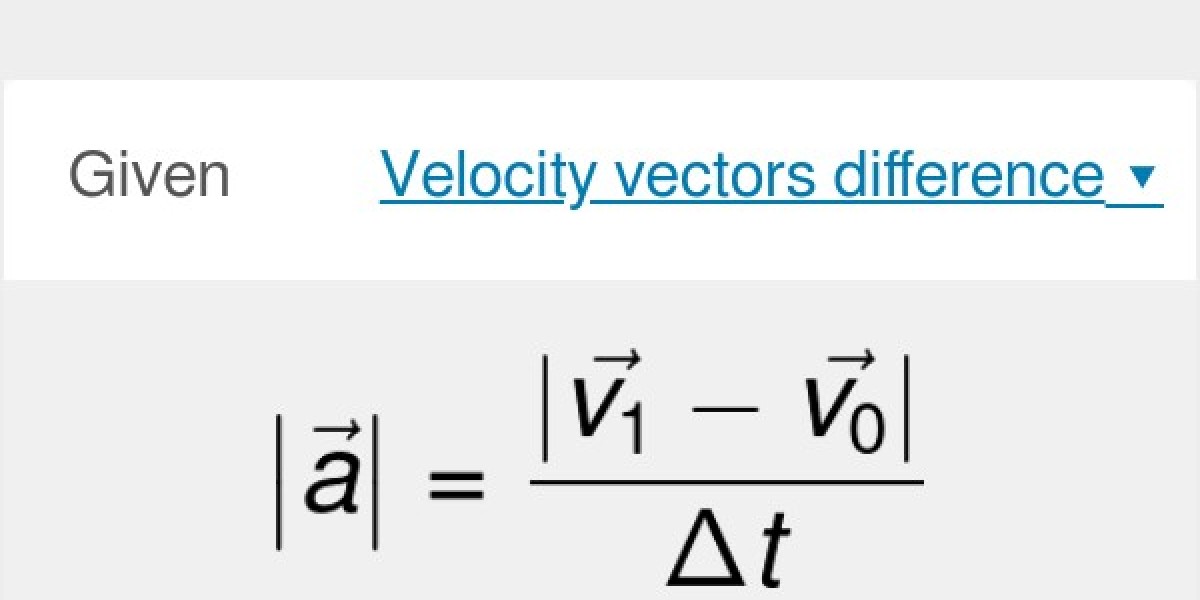

Understanding motion and its variations is a fundamental concept in physics. From the simplest movement of a car to the complex dynamics of celestial bodies, the ability to quantify changes in motion can provide invaluable insights. One of the most effective ways to achieve this is by using a magnitude of acceleration calculator, a digital tool designed to determine how quickly an object's velocity changes over time. This tool is essential not only for students striving to understand kinematics but also for engineers, scientists, and hobbyists who work with motion in practical scenarios.
Acceleration, in physics terms, is defined as the rate of change of velocity per unit of time. It is a vector quantity, meaning it has both magnitude and direction. The magnitude tells you how strong the acceleration is, while the direction indicates which way the object is accelerating. Calculating acceleration manually often involves multiple steps, including determining initial and final velocities, time intervals, and sometimes even displacement. This is where a magnitude of acceleration calculator simplifies the process, ensuring accurate results quickly and efficiently.
Why Measuring Acceleration is Important
Measuring acceleration is not just an academic exercise; it has real-world applications. In automotive engineering, understanding how a car accelerates can influence design choices for safety, fuel efficiency, and performance. In sports, analyzing an athlete’s acceleration helps optimize training techniques and improve performance. Similarly, in space exploration, precise calculations of acceleration are crucial for navigating spacecraft and ensuring they reach their intended destinations.
Without accurate measurements, it would be challenging to predict motion or design systems that rely on precise timing and force application. For example, if an engineer is developing a roller coaster, knowing the exact acceleration at various points ensures passenger safety while maximizing thrill. Even everyday technologies like smartphones rely on understanding acceleration; accelerometers detect device orientation and movement, enabling features like screen rotation, step counting, and motion-based gaming.
How a Magnitude of Acceleration Calculator Works
A magnitude of acceleration calculator typically requires three pieces of information: initial velocity, final velocity, and the time taken for this change. Using these inputs, it applies the formula:
a=vf−vita = \frac{v_f - v_i}{t}a=tvf−vi
Where:
aaa is acceleration,
vfv_fvf is final velocity,
viv_ivi is initial velocity,
ttt is the time interval.
The tool can handle both positive and negative acceleration values, allowing users to measure both speeding up and slowing down. Additionally, many calculators offer options for more advanced inputs such as distance traveled or forces applied, expanding their usefulness beyond basic classroom exercises.
For students preparing for exams, using a magnitude of acceleration calculator can save time and reduce errors, enabling them to focus more on understanding concepts rather than tedious calculations. This is especially valuable when tackling complex problems where multiple steps and conversions are involved.
Practical Applications of Acceleration Calculations
Acceleration calculations have applications in multiple fields:
Automotive Industry: Engineers use acceleration data to improve vehicle safety, optimize fuel efficiency, and enhance performance metrics like 0-60 mph times.
Aerospace Engineering: Precise acceleration measurements are critical for spacecraft trajectory planning, landing simulations, and testing propulsion systems.
Sports Science: Measuring athlete acceleration helps coaches refine techniques, prevent injuries, and boost performance in activities such as sprinting, swimming, or cycling.
Consumer Electronics: Devices like smartphones and fitness trackers rely on accelerometers to provide motion-sensitive features.
Structural Engineering: Buildings and bridges are analyzed for how they respond to dynamic forces such as wind or earthquakes, which involves understanding acceleration and motion.
These applications illustrate that understanding motion is not limited to physics textbooks—it’s deeply integrated into modern technology, safety systems, and performance optimization across industries.
Step-by-Step Guide to Using a Magnitude Calculator
Using a magnitude of acceleration calculator is straightforward:
Identify Initial and Final Velocity: Determine the object’s velocity before and after the time interval. These values must be in consistent units, typically meters per second (m/s).
Measure the Time Interval: Record the duration over which the velocity changes. Ensure the units match the velocity inputs to maintain calculation accuracy.
Input Values: Enter these numbers into the calculator fields. Advanced tools may allow optional inputs for displacement, mass, or force to provide additional calculations.
Obtain Acceleration: The calculator will provide the magnitude of acceleration, often along with units and graphical representations.
Interpret Results: Positive values indicate speeding up, while negative values (deceleration) indicate slowing down.
Using these steps, even complex motion scenarios can be analyzed efficiently, making it a practical tool for students, professionals, and hobbyists alike.
Common Mistakes in Acceleration Calculations
Despite the simplicity of the formula, errors can occur if careful attention isn’t paid to the inputs. Common mistakes include:
Incorrect Units: Mixing meters per second with kilometers per hour can lead to drastically wrong results. Always convert units consistently.
Ignoring Direction: Acceleration is a vector quantity. Neglecting its direction can misrepresent the motion.
Using Average Instead of Instantaneous Velocity: For scenarios involving non-uniform acceleration, using instantaneous velocities is crucial for accuracy.
Overlooking Time Intervals: Miscalculating the duration over which motion occurs can significantly affect the calculated acceleration.
By relying on a digital magnitude of acceleration calculator, many of these errors can be minimized, ensuring more reliable results.
Integration with Learning Resources
For students, particularly those preparing for rigorous exams like the IB Physics curriculum, integrating tools like acceleration calculators with past papers enhances understanding. Practicing problems while using calculators for verification allows learners to develop both conceptual and computational skills. The combination of theoretical study and practical calculation prepares students for exams efficiently. Later in the course, reviewing ib physics past papers alongside digital tools enables students to tackle a wide range of problems, from simple kinematics to multi-step dynamics questions.
Advanced Features of Modern Calculators
Modern magnitude of acceleration calculators often go beyond basic computations. Some advanced features include:
Graphical Representations: Visualizing acceleration over time helps in understanding patterns like uniform acceleration, deceleration, and variable motion.
Multiple Input Types: Users can input either velocity or displacement and time, and the calculator can determine the missing variable.
Unit Conversions: Many calculators automatically convert units to ensure consistency and accuracy.
Vector Analysis: For motion in two or three dimensions, vector calculators provide both magnitude and directional information.
These features not only enhance accuracy but also make learning and applying physics concepts more interactive and intuitive.
Real-Life Examples
Vehicle Braking: A car decelerates from 25 m/s to a complete stop in 5 seconds. Using a calculator, the acceleration (deceleration in this case) can be determined quickly, ensuring engineers can design safe braking systems.
Rocket Launch: During lift-off, a rocket accelerates from 0 to 1000 m/s in 60 seconds. Calculating the magnitude of acceleration helps engineers fine-tune engines and fuel consumption.
Sports Performance: An athlete increases sprint speed from 0 to 10 m/s in 2 seconds. Understanding acceleration aids in refining training methods for peak performance.
Each scenario highlights how practical tools transform theoretical formulas into actionable insights.
Benefits of Using a Digital Magnitude Calculator
Time Efficiency: Eliminates tedious manual calculations.
Accuracy: Reduces human error in computations.
Ease of Use: Intuitive interfaces allow even beginners to perform complex calculations.
Versatility: Useful in classrooms, labs, engineering projects, and real-world applications.
By leveraging these tools, both students and professionals can focus on understanding motion’s implications rather than getting bogged down by arithmetic.
Conclusion
In the modern world of physics and engineering, understanding the intensity of motion changes is essential.From classrooms to laboratories and from sports tracks to space missions, the ability to measure and interpret acceleration accurately allows us to understand the world of motion in a precise, meaningful way. Embracing digital calculators ensures that calculations are not only accurate but also insightful, helping users visualize and comprehend the intensity of motion changes in a variety of contexts.