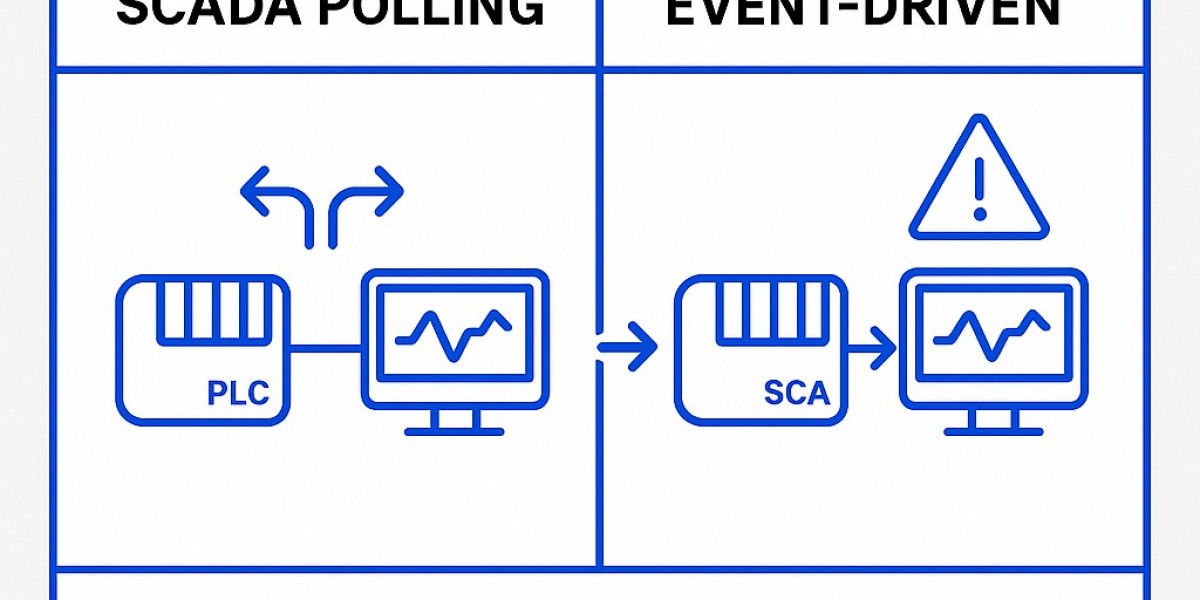

In modern industrial plants, fast and accurate data is very important. Machines, sensors, PLCs, and SCADA systems continuously generate data that helps engineers monitor processes and take quick actions. When this data reaches late, it creates Data Acquisition Latency, which can affect production, safety, and efficiency.
Two common methods are used in Industrial Data Acquisition Systems to collect data from PLCs: SCADA Polling and Event-Driven Data Acquisition. Understanding the difference between these two methods helps in choosing the right approach for Low Latency Data Acquisition.
What Is SCADA Polling?
SCADA polling is the traditional and most commonly used method. In this approach, the SCADA system asks the PLC for data at fixed time intervals. For example, SCADA may request data every 1 second, 2 seconds, or 5 seconds.
Even if the process value does not change, SCADA still keeps asking for the same data again and again. This creates unnecessary communication traffic and increases SCADA Data Latency, especially in large systems with many PLCs and tags.
SCADA polling works well for small systems, but as the system grows, polling delays become more visible and affect real-time monitoring.
What Is Event-Driven Data Acquisition?
Event-driven data acquisition works differently. Instead of SCADA continuously asking for data, the PLC or device sends data only when a value changes or when a specific event occurs.
For example:
A temperature crosses a limit
A motor starts or stops
An alarm condition appears
In such cases, data is immediately pushed to the SCADA system. This method reduces unnecessary data transfer and improves PLC Data Acquisition Speed.
Event-driven systems are widely used in modern automation and IIoT environments where fast response is required.
Which Is Faster: Polling or Event-Driven?
When it comes to speed, Event-Driven Data Acquisition is faster than SCADA polling.
In polling systems, data updates depend on the polling interval. If SCADA polls every 2 seconds, the system may show old data even if the process has already changed. This delay directly adds to Data Acquisition Latency.
In event-driven systems, data is sent instantly when a change happens. This makes the system more responsive and supports Low Latency Data Acquisition, especially for critical signals and alarms.
Impact on Industrial Data Acquisition Systems
In large Industrial Data Acquisition Systems, polling can overload networks and slow down overall performance. As more devices are added, SCADA has to work harder to collect data, increasing delay.
Event-driven systems reduce network load because only useful data is transmitted. This improves system stability, reduces SCADA Data Latency, and supports real-time decision-making.
However, polling is still useful for non-critical data such as reports, logs, or slow-changing values.
Best Practice: Use a Hybrid Approach
The best solution is not choosing only one method. Most modern systems use a hybrid approach:
Event-driven data for critical signals, alarms, and fast-changing values
Polling for non-critical and slow-changing data
This balanced approach improves PLC Data Acquisition Speed without overloading the network and keeps the system stable.
Final Thoughts
Both SCADA polling and event-driven data acquisition have their place in industrial automation. But when speed and real-time response are important, event-driven systems clearly perform better.
Reducing Data Acquisition Latency is key to improving system performance, safety, and efficiency. By choosing the right data acquisition method, industries can achieve faster monitoring, better control, and more reliable operations.