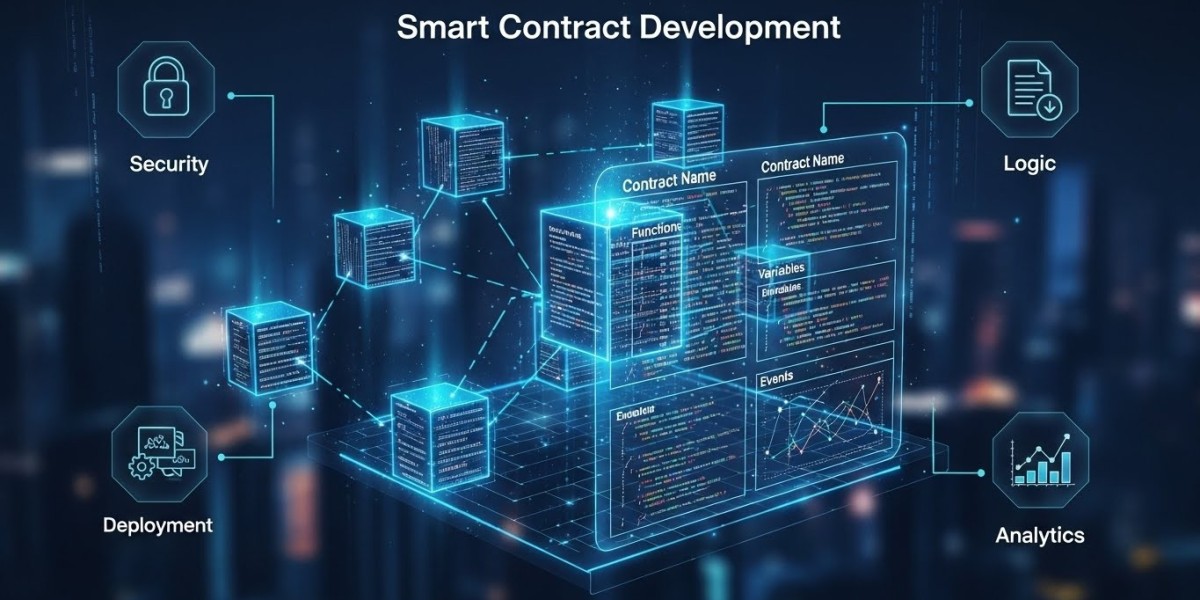

Decentralized applications (dApps) are rapidly redefining how digital systems are built, governed, and used. Unlike traditional applications controlled by centralized entities, dApps operate on blockchain networks where transparency, trust, and autonomy are built into the system itself. At the core of this paradigm shift lies a fundamental innovation: smart contracts. These self-executing programs encode the logic that powers decentralized platforms, enabling automation, security, and verifiable interactions without intermediaries.
As industries increasingly explore blockchain-based products from finance and real estate to gaming, identity, and supply chain understanding the role of smart contracts in dApps has become essential. This article examines how smart contracts underpin decentralized applications, the architectural evolution behind them, real-world examples, and why professional smart contract development services play a critical role in building secure and scalable systems.
Understanding Smart Contracts and dApps: A Technical Foundation
Before exploring their relationship, it’s important to clarify what smart contracts are. A smart contract is a programmable piece of code stored on a blockchain that automatically executes when predefined conditions are met. The concept was first proposed in the 1990s by cryptographer Nick Szabo, but it was Ethereum that transformed smart contracts into a global development standard.
A decentralized application uses a combination of on-chain and off-chain components. While the user interface and some business logic may run outside the blockchain, the core operations transactions, governance mechanisms, asset transfers, state management are executed through smart contracts.
A dApp typically includes:
Smart Contracts — on-chain logic that handles rules and automated execution.
Front-End Interface — the user-facing application interacting with smart contracts.
Off-Chain Services — APIs, indexing layers (e.g., The Graph), storage solutions (e.g., IPFS), oracles, and cloud-based services.
Smart contracts thus act as the “backend” of the decentralized world, ensuring that a dApp behaves exactly as intended transparent, autonomous, and tamper-proof.
Why Smart Contracts Are the Backbone of dApps
1. Trustless Interaction and Removal of Intermediaries
Traditional digital systems rely heavily on third parties banks, payment processors, legal authorities to authenticate, validate, and execute transactions. Smart contracts eliminate this dependency.
Once deployed, the code becomes the sole authority in the system. Every rule from loan repayment schedules to gaming rewards is enforced by the contract without the possibility of manipulation.
This “trustless” nature is especially valuable in sectors where disputes, fraud, or human error are common. For instance, decentralized finance (DeFi) platforms like Aave and Uniswap execute trades and loans entirely through smart contracts with no central operator controlling funds.
2. Automation and Efficiency
One of the defining advantages of smart contracts is automation. A decentralized lending dApp, for example, automatically:
Verifies collateral
Executes liquidation
Calculates interest rates
Transfers assets
This eliminates manual processing, reduces cost, and accelerates execution time.
This automation is precisely why businesses across industries from insurance to supply chain are turning to a smart contract development company to design tailored workflows and replace inefficient legacy systems.
3. Immutability and Security
Once deployed, a smart contract cannot be altered unless pre-coded to allow upgrades. This immutability ensures:
No unauthorized changes
No corruption of data
Decisions remain consistent over time
However, immutability also means mistakes can be costly. High-profile smart contract exploits (like the DAO hack or various DeFi breaches) highlight why audits and secure coding practices are essential.
A professional smart contract development agency ensures that contracts follow best practices such as:
Formal verification
Multi-layered audit testing
Upgradable architecture design
Gas optimization
Secure random number generation
Security is therefore one of the most critical roles smart contracts play in sustaining reliable and scalable dApps.
4. Decentralized Governance
Many dApps incorporate decentralized governance, enabling users to vote on upgrades, policies, or financial decisions.
Smart contracts manage:
Voting mechanisms
Token-weighted decision systems
Proposal management
Governance execution after voting
DAOs (Decentralized Autonomous Organizations) rely completely on smart contracts for these functions. Without them, democratic and transparent governance would be impossible.
A leading example is Compound Finance, where community members propose and vote on protocol changes entirely through on-chain governance contracts.
5. Handling Digital Assets and Tokenization
Most dApps involve digital assets fungible tokens (ERC-20), NFTs (ERC-721), or other custom standards. Smart contracts manage:
Minting
Burning
Transfers
Rewards distribution
Asset locking and vesting
For example:
NFT dApps like OpenSea use smart contracts for ownership verification and royalty distribution.
Gaming dApps like Axie Infinity rely on smart contracts to manage in-game currencies and digital collectibles.
Token sale platforms use vesting contracts, liquidity locking, and staking systems all built via smart contracts.
This makes smart contract expertise essential, which is why many projects rely on specialized smart contract development solutions to create efficient and scalable asset ecosystems.
Architectural Role of Smart Contracts in dApp Development
Smart contracts don’t simply execute predefined logic they define the entire architecture of a decentralized application. Let’s break down their architectural impact:
A. Core Logic Execution Layer
All primary functions of a dApp are encoded in smart contracts. These include:
User authentication (wallet-based)
State changes
Business logic for rules and operations
Validation of data
Asset management
This architecture ensures the system’s foundation cannot be tampered with or manipulated.
B. Transparent and Verifiable State Management
In traditional applications, users cannot verify backend actions. In dApps, blockchain ensures that each execution step is:
Visible
Recorded permanently
Publicly verifiable
Smart contracts manage and update the application state on the blockchain, reducing disputes and increasing user trust.
C. Interoperability and Composability
A unique advantage of smart contracts is composability.
This allows dApps to integrate seamlessly with other existing smart contracts.
Example:
A DeFi platform can integrate with Chainlink for oracles, with Uniswap pools for liquidity, and with Aave for lending all without exclusive partnerships.
Smart contracts make decentralized ecosystems behave like “money Legos,” leading to rapid innovation and cross-app synergy.
D. Event Logging and Data Emission
Smart contracts emit events that dApps listen to in real time. These events:
Trigger UI updates
Record transaction logs
Signal external services (like bots or subgraphs)
This architecture makes dApps reactive and dynamic.
Real-World Use Cases Where Smart Contracts Power dApps
1. Decentralized Finance (DeFi)
DeFi is the most prominent example of smart contract-driven dApps.
Protocols like MakerDAO, Curve Finance, and Synthetix automate complex financial operations including:
Lending
Borrowing
Trading
Yield farming
Collateral management
This ecosystem handles billions in Total Value Locked (TVL), all governed by smart contracts.
2. Gaming and Metaverse Applications
Blockchain-based games use smart contracts for:
NFT minting
Tokenized rewards
Marketplace operations
On-chain governance
Asset verification
Smart contracts ensure fair play, transparent rewards, and true asset ownership.
3. Supply Chain Management
Smart contracts automate:
Order verification
Multi-party approvals
Shipment tracking
Payment settlement
Companies use them to enhance transparency, reduce fraud, and remove manual bottlenecks.
4. Identity and Authentication dApps
Projects like ENS (Ethereum Name Service) and decentralized ID platforms use smart contracts for:
Name registration
Permissioned access
Reputation scoring
On-chain credential management
This reduces dependency on centralized identity authorities.
5. Insurance Automation
Insurance dApps automate:
Policy creation
Claim validation
Payout execution
Smart contracts eliminate disputes and ensure instant claim fulfillment using decentralized oracles.
Challenges in Smart Contract-Driven dApps
While smart contracts unlock vast potential, they also introduce challenges:
1. Security Vulnerabilities
Poorly written contracts can lead to exploits causing millions in losses.
2. Scalability Limitations
High gas fees and network congestion impact dApp performance.
3. Complex Development Requirements
Smart contract development requires expertise in cryptography, gas optimization, testing, and auditing.
4. Upgradability Constraints
Once deployed, changing a contract requires careful design patterns like proxy upgrades.
These challenges highlight the importance of choosing an experienced smart contract development company capable of delivering secure, optimized, and future-proof solutions.
Why Professional Smart Contract Development Services Matter
Building a smart contract is not just about writing code; it's about creating secure, scalable, and high-value systems. Professional companies offer:
Security audits
Architecture planning
Gas optimization
Upgradable contract design
Compliance-friendly token standards
End-to-end dApp integration
Formal testing and quality assurance
A skilled smart contract development agency can significantly reduce risks and accelerate launch timelines.
Future of Smart Contracts in dApps
The future of smart contract-powered dApps is evolving through several innovations:
1. AI-Enhanced Smart Contracts
AI models may analyze contract vulnerabilities, optimize execution, and automate governance decisions.
2. Cross-Chain dApps
Interoperability layers like Polkadot, Cosmos, and LayerZero enable smart contracts to interact across multiple chains.
3. Account Abstraction
This will simplify user onboarding and improve transaction automation.
4. Zero-Knowledge Proofs
ZK-powered smart contracts will enable privacy-preserving dApps without compromising trustlessness.
Conclusion
Smart contracts are the foundational technology behind decentralized applications, enabling automation, security, transparency, and user sovereignty. Their role extends far beyond simple transactional logic they define governance, ownership, interoperability, financial operations, and the core architecture of decentralized ecosystems.
As Web3 matures, the demand for secure, scalable, and feature-rich smart contract systems will continue to rise. Businesses building dApps should collaborate with a professional smart contract development company, smart contract development agency, or use specialized smart contract development services to ensure long-term reliability and security.