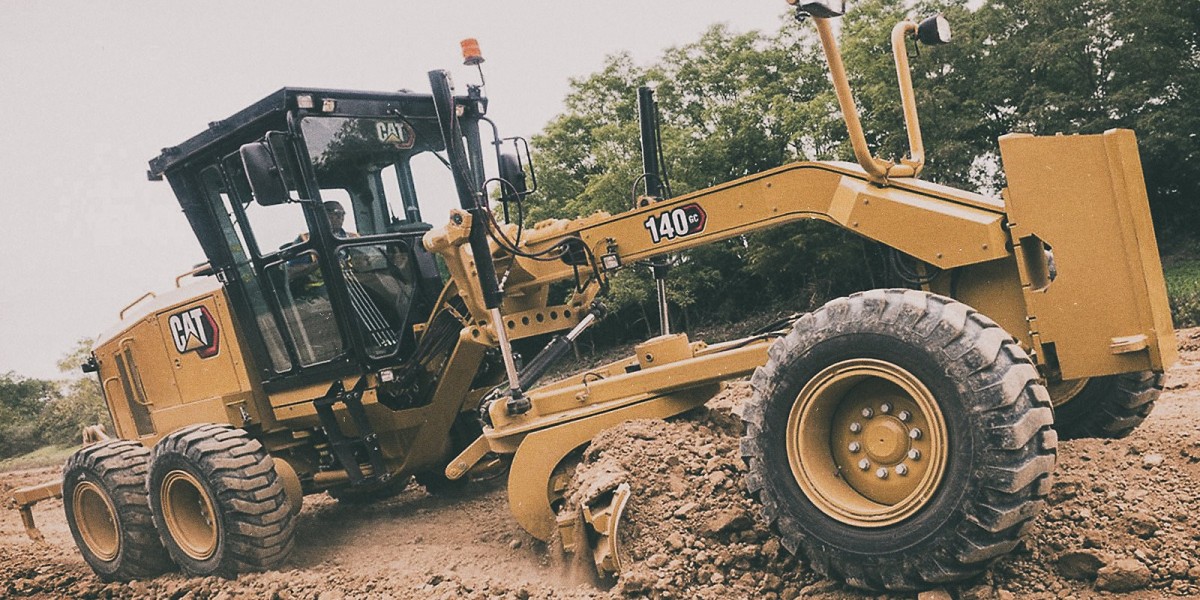

When contractors begin to search for used motor graders for Sale, a controversy often arises: Is it better to be precise or reliable? Both qualities matter, but you use them differently depending on your work type, operating conditions, and expectations for an older machine. Understanding how each of them impacts real-world performance can enable buyers to make more informed and confident choices.
Understanding Precision in Older Motor Graders
When grading, it is not only about making a clean pass; it is about having consistent and accurate blade movements that maintain tolerances throughout the jobsite. The older graders are very diverse in this aspect, particularly when the parts are worn with time.
Responsiveness of blade control.
Steering accuracy
Hydraulic finesse
Capability to sustain fine-grade tolerances.
Accuracy in old machines can be determined by the condition of the circular drive, the looseness of the linkages over time, and the sensitivity of the hydraulics. Such models as CAT 140H or John Deere 770D are famous for maintaining their accuracy even after thousands of hours, as long as they are properly maintained. However, with the age of mechanical parts, operators can experience tiny delays in hydraulic reaction or minor play in the articulation, minor problems that can influence the outcome of fine grading.
Understanding Reliability in Older Motor Graders
Where accuracy is the concern of precision, consistency is everything to reliability. Reliability is important to contractors since downtime is costly, particularly in remote locations where the service support is minimal.
Engine durability
Drivetrain endurance
Minimal downtime
The reason why older graders are praised for being reliable is that they were designed with less complex designs and robust mechanical systems. Most of them are capable of operation for decades under good care, particularly when the parts are easily sourced in the aftermarket.
The state of the transmission, hydraulic pumps, articulation joints, and cooling system is very crucial to reliability. A grader that begins without stuttering, changes without difficulty, and does not overheat when under load is much more useful than one that requires constant attention, even when its accuracy is mediocre.
Key Differences Between Precision and Reliability
Precision and reliability affect various dimensions of performance:
Precision focuses on:
Accurate blade movement
Smooth grading transitions
Tight controls
Reliability focuses on:
Strong engine output
Resistance to breakdowns
Reduced lifetime operating cost.
Other older graders are reliable but have moderate precision. Some are very precise but need more regular service. Buyers need to know what characteristic will directly benefit their project requirements.
How Advanced Controls vs. Mechanical Simplicity Affects the Trade-Off
Modern technology has influenced older generations since the late 1990s and early 2000s by introducing early-generation electronic controls. These systems were created to enhance grading accuracy, but they come with trade-offs.
Early electronic grade controls on older graders.
Pros: higher accuracy
Cons: high cost of repair in the event of sensor or module failure.
Fully mechanical graders
Advantages: easy, dependable, in-the-field repairs.
Cons: less refined precision
The level of hydraulic sophistication also determines the level of precision and reliability. Older graders that have advanced hydraulic valves provide a more consistent blade control, but can also be more susceptible to contamination or wear.
Condition-Based Evaluation: Choosing What Matters Most
Not all projects require the exactness of a pinpoint. Others need brute strength, and others depend on smooth finishing. This is why customers ought to consider the things that are important.
Where accuracy is the key:
Fine grading
Highway surface finishing
Airport construction
Where reliability is the order of the day:
Remote-area operations
Long daily operating hours
Inadequate access to technicians.
Knowing your operating environment assists in deciding whether you need to seek out very accurate Old Motor Graders For Sale or models that are reputed to be tough in the long run.
Inspection Guide for Precision
Some of these elements have a direct impact on the accuracy of an older grader.
Circle drive and wear strips
Mechanisms of blade side-shift and pitch.
Hydraulic response delays
Steering cylinder accuracy
Articulation and front axle play.
Any slackness or play will show up on the ground as irregular cuts or uneven grading.
Inspection Guide for Reliability
A good grader is a grader that starts with ease, runs well, and loads without any complaint. The main points of inspection are:
Engine compression results
Transmission shift quality
Hydraulic pump condition
Cooling system health
Frame integrity and evidence of past structural repair.
A machine that has good fundamentals will save a lot of money in maintenance, though it may not be the most accurate.
Real-World Pricing Insights
Accuracy is usually expensive. Old graders that have responsive hydraulics, tight controls, and well-maintained circle drives are more expensive due to the fact that they produce smoother results. Machines with rebuilt engines or transmissions also remain highly reliable and maintain strong resale value.
Due to the fluctuation of demand in the industry, you will most likely find Old Motor Graders for Sale sold at different prices depending on which of the two they are better at.
Finding the Better ROI: Precision or Reliability?
The most optimal ROI is by selecting a grader matching your project type. Precision increases productivity in cases where most of your work is finished. When you are dealing with harsh conditions and long working hours, you need a machine that is reliable so that it remains at the workplace.
Final Decision Framework
The following are factors that should be used when making a purchase decision:
Identify project needs
Assess the level of operator skills.
Take into account the supply of components and technicians.
Compare productivity potential
Trade-off purchase price and long-term maintenance.
In evaluating Old Motor Graders For Sale, keep in mind that the correct selection is the one that satisfies your requirements at all times, not the most sophisticated or the toughest one.
FAQs
1. Are precision-focused older graders more expensive?
A: Yes, graders that have narrow hydraulic systems and precise blade controls tend to be more expensive since they will minimize rework on fine-grade work.
2. What affects the reliability of an old grader the most?
A: The greatest contributors to long-term reliability are engine condition, transmission health, and cooling system performance.
3. Can an older grader deliver good precision after many hours?
A: Yes. When the circle drive, hydraulics, and linkages are in good condition, you can use an older machine to perform high-precision work.
4. Which brands offer the best balance of precision and reliability?
A: Contractors usually favor Caterpillar and John Deere because older grader models maintain good accuracy and reliability over time.