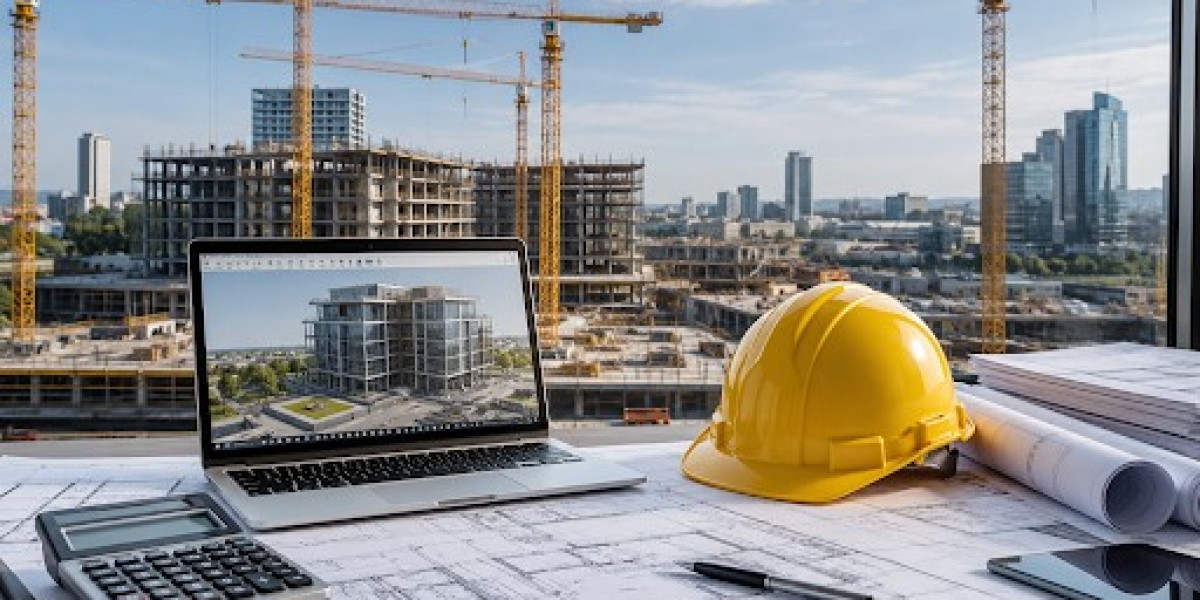

Commercial construction estimating is vital because it turns the following raw factors into a robust budget before a single dollar is invested.
Drawings
Specifications
Market pricing
If there is no detailed, line-item estimate, it means owners and contractors are pricing blindly. Moreover, wrong industry data leads many projects to run over budget as a result. Thus, accurate estimating is the single control point that detects mistakes, price swipes, and scope gaps before they become change orders.
What Is Commercial Construction Estimating?
Commercial construction estimating is the process of estimating the entire cost of a commercial build from architectural drawings, such as:
Materials
Labor
Equipment
Subcontractor pricing
Overhead
Contingency
It is different from residential estimation because commercial projects involve layered trades, such as:
Mechanical
Electrical
Fire suppression
Structural steel
Curtain wall
All of the above must be quantified and priced separately, then reconciled into one principal budget. A commercial estimate is not a guess; it is a quantity takeoff aligned to current material and labor prices. Every cost is backed by drawings, making the estimation verified and easy to comprehend.
Why Does Commercial Estimating Matter For Cost Control?
Estimating is the front line of construction cost control because every dollar in the budget originates from it. Industry research on cost overruns regularly points back to the estimate. As per the National Cooperative Highway Research Program, roughly 32% of construction budget overruns occur directly due to errors, and the average overrun across projects ranges from 15% to 28%. For bigger commercial tasks, that percentage translates into real money. A 20–30% swing on a mid-size warehouse or office project means loss of millions. Budget overruns or delays are quite common in construction projects of all types and sizes.
How Does Commercial Estimating Differ From Construction Cost Analysis?
Estimating and cost analysis work hand-in-hand but serve different points in a project's lifecycle.
Function | When it happens | What it delivers |
Commercial Construction Estimation | Pre-construction / bidding | A detailed budget built from takeoffs and current pricing |
Construction Cost Analysis | During and after construction | A comparison of actual spend vs. the original estimate, flagging variance |
Material Cost Estimation | Pre-construction, ongoing | Real-time pricing for lumber, steel, concrete, MEP components |
Cost analysis depends totally on having an accurate estimate as a benchmark. Without accuracy, there is no baseline to measure drift. Hence, companies that know how to control expenses see estimating and analysis as two in one. Often it's done in the exact same system and/or by the same people.
What Causes Estimating Errors on Commercial Projects?
Estimating errors tend to come from a short list of recurring gaps rather than one-off mistakes:
Incomplete scope reading: Omitted line items in mechanical, electrical, or site work drawings.
Outdated pricing: Using previous year's material or labor prices rather than current market data.
Unpriced long-lead items: Multi-month lead time, volatile prices for switchgear and transformers, and HVAC equipment.
Missing contingency logic: No structured allowance for design changes or market boom.
Manual takeoff errors: Quantity mistakes from measuring drawings manually rather than digital takeoff tools.
How Do Commercial Estimating Services Protect a Project Budget?
Estimating plays a critical role in keeping projects on track by offering in-depth, current, and verifiable estimates. When the ownership team can have accurate line item pricing before construction starts, it puts them at a huge cost advantage. SMA Estimating LLC provides independent and trade-by-trade takeoffs and material cost estimates with labor and supplier pricing that can be found in the market. It is a way for a client to submit a timely and accurate bid, and also control costs throughout the project. An accurate estimate in the beginning will be more valuable for budgeting and planning compared to making changes after spending money on creating an incorrect estimate.
Key Takeaways
Estimating errors account for roughly a third of all construction cost overruns. It is the highest-leverage point for cost control.
Commercial projects need trade-by-trade, drawing-based takeoffs, not lump-sum guesses.
Cost analysis only works if it has an accurate estimate to measure against.
Long-lead, volatile-priced items (steel, HVAC, switchgear) need to be identified and priced early.
Working with dedicated commercial estimating services like SMA Estimating LLC gives project teams an independent, accurate budget baseline before bidding. This reduces the risk of the overruns that plague the majority of commercial builds.
Conclusion
Commercial construction estimating is too complex and too high-stakes to manage without a rigorous estimate behind every decision. Historical industry data reveals that most of the cost overruns are due to gaps in the original estimate and not due to on-site surprises. Getting the takeoff, pricing, and contingency planning right before bidding is what keeps a project's budget and its timeline intact from groundbreaking to closeout.