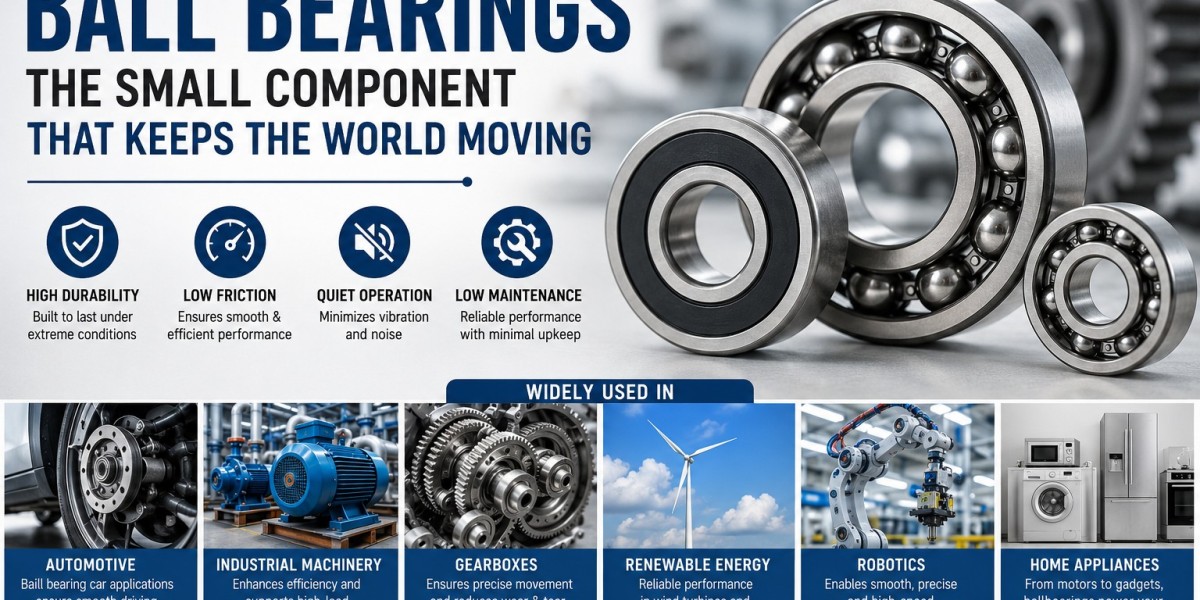

Ball bearings are among the most important mechanical components used across industries. From automobiles and industrial machinery to home appliances and medical equipment, ball bearings play a critical role in reducing friction and ensuring smooth movement. Whether you are searching for ballbearings for industrial applications or looking for the right ball bearing car components, understanding how these precision-engineered products work can help you make the best choice.
In this guide, we will explore what ball bearings are, their different types, applications, advantages, and why steel ball bearings and roller ball bearing solutions are widely preferred across various industries.
What Are Ball Bearings?
Ball bearings are rolling-element bearings designed to reduce rotational friction while supporting radial and axial loads. They consist of steel balls placed between two circular rings known as races. As the balls roll, they minimize the contact surface between moving parts, allowing machinery to operate efficiently.
Modern ballbearings are manufactured with high precision to ensure durability, reduced wear, and improved performance. They are available in different sizes, materials, and load capacities to suit various industrial and commercial requirements.
How Do Ball Bearings Work?
The primary function of ball bearings is to replace sliding friction with rolling friction. Instead of two metal surfaces rubbing directly against each other, the balls rotate smoothly between the inner and outer races. This significantly reduces energy loss, minimizes heat generation, and increases equipment lifespan.
High-quality steel ball bearings are especially known for their strength, corrosion resistance, and ability to withstand heavy operational loads.
Types of Ball Bearings
Different applications require different bearing designs. Some of the most commonly used types include:
1. Deep Groove Ball Bearings
These are the most widely used ball bearings because of their versatility. They can handle both radial and moderate axial loads and are commonly found in electric motors, pumps, fans, and household appliances.
2. Angular Contact Ball Bearings
Designed for applications involving combined radial and axial loads, these bearings are frequently used in automotive transmissions and machine tools.
3. Self-Aligning Ball Bearings
These bearings automatically compensate for shaft misalignment, making them suitable for agricultural machinery and conveyor systems.
4. Thrust Ball Bearings
Used primarily for axial loads, thrust bearings are ideal for low-speed applications such as turntables and lifting equipment.
5. Roller Ball Bearing
A roller ball bearing combines rolling elements to support significantly higher loads than conventional ball bearings. These bearings are commonly used in heavy industrial equipment, mining machinery, construction equipment, and gearboxes where durability is critical.
Importance of Steel Ball Bearings
Among various bearing materials, steel ball bearings remain the most popular due to their outstanding mechanical properties.
Some key benefits include:
Excellent wear resistance
High load-carrying capacity
Superior durability
Corrosion resistance with proper coatings
Reliable performance under extreme temperatures
Long service life with proper lubrication
Manufacturers often use chrome steel or stainless steel to produce premium-quality bearings that deliver exceptional precision and reliability.
Applications of Ball Bearings
Today, ballbearings are used in almost every industry.
Some common applications include:
Automotive industry
Industrial machinery
Aerospace equipment
Medical devices
Electric motors
Agricultural equipment
Construction machinery
Household appliances
Robotics
Power generation
Each application requires specific bearing dimensions, load ratings, lubrication methods, and material selection.
Ball Bearing Car Applications
A modern ball bearing car contains numerous bearings that ensure smooth operation of different mechanical systems.
Some major automotive applications include:
Wheel hubs
Gearboxes
Steering systems
Alternators
Air conditioning compressors
Engine components
Transmission systems
Electric vehicle motors
Without high-quality ball bearings, vehicles would experience increased friction, excessive heat, reduced fuel efficiency, and premature component failure.
Automotive manufacturers rely on precision-engineered bearings to improve safety, driving comfort, and overall vehicle performance.
Advantages of Ball Bearings
Choosing the right ball bearings provides numerous operational benefits.
Reduced Friction
Rolling motion minimizes resistance, resulting in smoother mechanical operation.
Longer Equipment Life
Lower friction reduces wear on shafts and moving parts.
Improved Energy Efficiency
Machines require less power to operate, reducing energy consumption.
Lower Maintenance Costs
Quality bearings require less frequent replacement and maintenance.
High-Speed Performance
Ball bearings can operate efficiently at high rotational speeds.
Quiet Operation
Precision bearings produce minimal vibration and noise.
These advantages make ballbearings indispensable across industrial and commercial sectors.
How to Choose the Right Ball Bearings
Selecting the appropriate bearing depends on several factors.
Consider the following before purchasing:
Load capacity
Speed requirements
Operating temperature
Lubrication method
Environmental conditions
Material type
Bearing dimensions
Sealing requirements
For heavy-duty industrial operations, a roller ball bearing may provide better load support, while steel ball bearings remain ideal for precision and long-term durability.
Maintenance Tips for Ball Bearings
Proper maintenance significantly extends bearing life.
Follow these best practices:
Lubricate bearings regularly.
Keep bearings clean and free from contaminants.
Inspect for unusual vibration or noise.
Replace damaged bearings immediately.
Avoid overloading machinery.
Store bearings in a dry environment.
Use the correct installation tools.
Routine maintenance ensures optimal performance and minimizes unexpected equipment downtime.
Why Quality Matters
Not all ball bearings offer the same level of performance. High-quality bearings undergo rigorous manufacturing and quality testing to ensure precision, durability, and consistent operation.
Investing in premium steel ball bearings can reduce maintenance costs, improve equipment efficiency, and maximize return on investment over time.
Whether for industrial machines or a ball bearing car, selecting certified products from reputable manufacturers ensures long-lasting performance.
Future of Ball Bearings
Advancements in manufacturing technology continue to improve bearing performance. Smart bearings equipped with sensors can now monitor temperature, vibration, and load conditions in real time.
Modern ballbearings are also being developed using advanced materials and specialized coatings that enhance corrosion resistance, reduce lubrication requirements, and improve energy efficiency.
As industries embrace automation and electric mobility, demand for high-performance roller ball bearing solutions and precision steel ball bearings is expected to grow significantly.
Conclusion
Ball bearings are essential components that improve the efficiency, reliability, and longevity of countless machines and vehicles. Whether you need bearings for industrial machinery, manufacturing equipment, or a ball bearing car, selecting the right type ensures optimal performance and reduced maintenance costs.
From standard ball bearings to heavy-duty roller ball bearing solutions and durable steel ball bearings, every application requires careful consideration of load capacity, operating conditions, and material quality. By understanding their types, benefits, and maintenance requirements, businesses and individuals can maximize equipment performance while minimizing downtime.
Frequently Asked Questions (FAQs)
1. What are ball bearings used for?
Ball bearings are used to reduce friction between moving parts while supporting radial and axial loads in machinery, vehicles, motors, pumps, and industrial equipment.
2. What is the difference between ball bearings and roller ball bearing?
A roller ball bearing uses cylindrical or tapered rolling elements to support heavier loads, while standard ball bearings are designed for lower friction and higher rotational speeds.
3. Why are steel ball bearings preferred?
Steel ball bearings offer high strength, excellent wear resistance, long service life, corrosion resistance, and reliable performance under demanding operating conditions.
4. Where are ball bearings used in a car?
A ball bearing car uses bearings in wheel hubs, transmissions, steering systems, engines, alternators, air conditioning compressors, and electric motors.
5. How long do ball bearings last?
The lifespan depends on operating conditions, lubrication, load, and maintenance. High-quality bearings can last for many years when properly maintained.
6. How do I know when a ball bearing needs replacement?
Common signs include excessive noise, vibration, overheating, reduced machine efficiency, rough rotation, or visible wear and damage.
7. Can ball bearings be reused?
If a bearing shows no signs of wear or damage and has been properly cleaned and inspected, it may be reused. However, damaged bearings should always be replaced.
8. How should ball bearings be maintained?
Regular lubrication, cleaning, proper installation, and routine inspection are essential for maximizing the lifespan and performance of ballbearings.