
Kuwait is a country where Islamic principles are embedded deeply into daily life, consumer expectations, and regulatory requirements. For businesses operating in the food, beverage, cosmetics, and hospitality sectors, halal compliance is not a niche market consideration. It is the standard that the overwhelming majority of Kuwait's consumer base expects, and in many product categories, it is a legal requirement that cannot be overlooked.
Halal certification in Kuwait has moved beyond being a voluntary quality signal to becoming a fundamental commercial requirement for businesses that want to operate credibly, access retail distribution networks, supply government institutions, and export to international markets that recognise Kuwaiti halal standards. Businesses that approach this requirement with proper preparation and professional support achieve certification efficiently and build the compliance infrastructure that sustains it. Those that approach it informally face delays, rejections, and commercial consequences that proper planning would have prevented.
This guide covers everything Kuwait businesses need to know about the halal certification process, from understanding the regulatory framework to completing the certification journey with the support of qualified halal consultants in Kuwait.
Understanding Halal Certification in Kuwait
What Halal Certification Actually Means
Halal certification is the formal process through which an authorised certification body verifies that a product, production process, or business operation complies with Islamic dietary and ethical requirements. For food and beverage products, this means confirming that all ingredients are permissible under Islamic law, that no cross-contamination with prohibited substances occurs during production, and that slaughter of animals, where applicable, follows prescribed Islamic procedures.
For cosmetics, personal care products, and pharmaceuticals, halal certification confirms that formulations do not contain ingredients derived from prohibited sources and that manufacturing processes meet the required standards of purity and segregation.
The certification is not a one-time declaration. It is an ongoing compliance status that is maintained through periodic audits and renewed on a defined schedule, which means the systems and processes a business builds to achieve certification must be designed for sustainable, continuous operation rather than one-time compliance.
The Regulatory Framework Governing Halal in Kuwait
Kuwait's halal regulatory framework is governed by the Ministry of Commerce and Industry and the Ministry of Awqaf and Islamic Affairs, which together establish the standards and oversight mechanisms that apply to halal compliance across different product categories. Kuwait has adopted halal standards that align with international frameworks, including Gulf Standardisation Organisation standards, ensuring that Kuwait-certified products are recognised across GCC markets and many international trading partners.
Food safety regulations administered by the Public Authority for Food and Nutrition add an additional compliance layer for food businesses, requiring that halal compliance is integrated with broader food safety management systems rather than managed as a separate standalone program.
Who Issues Halal Certification in Kuwait
Halal certification in Kuwait is issued by accredited certification bodies that are authorised to conduct halal audits and issue certificates recognised by Kuwaiti regulatory authorities. The selection of an appropriate certification body is an important decision that affects both the credibility of the certificate and its recognition by the retailers, distributors, and export markets the business is targeting.
Professional halal certification consulting services in Kuwait help businesses identify the right certification body for their specific product category, target markets, and operational context, avoiding the common mistake of pursuing certification from a body whose certificates are not recognised by the specific buyers or markets the business is trying to access.
Which Businesses in Kuwait Need Halal Certification
Food Manufacturing and Processing
Food manufacturers and processors operating in Kuwait face the most comprehensive halal certification requirements. Every ingredient in every product must be verified as halal, production facilities must demonstrate physical and procedural segregation from non-halal materials, and cleaning and sanitation procedures must meet halal purity standards. This applies to businesses producing products for the Kuwaiti domestic market and to those exporting food products to international markets that require halal certification from Kuwait.
Restaurants and Food Service Businesses
Restaurants, catering companies, and food service businesses in Kuwait seeking to demonstrate halal compliance to their customers and to satisfy requirements for supplying government institutions, schools, hospitals, and corporate clients benefit significantly from formal halal certification in Kuwait. Certification provides documented, independently verified evidence of halal compliance that customer assurance and contract requirements increasingly demand.
Importers and Distributors
Businesses importing food, beverage, or cosmetic products into Kuwait need to ensure that imported products carry appropriate halal certification recognised in Kuwait. Businesses distributing products to Kuwaiti retailers and food service operators often find that halal certification of their supply chain and distribution practices is required by their clients as part of supplier qualification.
Cosmetics and Personal Care Products
Kuwait's cosmetics and personal care market is increasingly sophisticated in its halal expectations. Consumers and retailers are looking beyond food and beverage to apply halal standards to skincare, hair care, makeup, and personal hygiene products. Businesses in this sector seeking to access Kuwait's mainstream retail channels benefit from formal halal certification that addresses the specific ingredient and formulation requirements applicable to cosmetics.
The Business Case for Halal Certification in Kuwait
Consumer Trust and Market Access
In Kuwait's market, where the consumer base is predominantly Muslim and halal compliance is a basic purchasing criterion for most product categories, formal certification provides the trust signal that drives purchase decisions. The halal certification mark on a product tells consumers that an independent authorised body has verified compliance with the standards they rely on, which is considerably more persuasive than a self-declaration of compliance that carries no independent verification.
For businesses seeking distribution through Kuwait's major retail chains and supermarkets, halal certification is frequently a mandatory listing requirement. Without it, products simply cannot access the shelf space and distribution networks that commercial success in Kuwait's retail market requires.
Export Opportunities and International Markets
Halal certification in Kuwait is not just about the domestic market. Kuwait's halal certification is recognised in a growing number of international markets, particularly across the OIC member countries that collectively represent one of the world's largest and fastest-growing consumer markets. For Kuwait businesses with export ambitions, halal certification provides the internationally recognised compliance credential that opens doors in markets from Southeast Asia and the Middle East to Europe and North America, where halal consumer segments are growing rapidly.
Competitive Advantage in Kuwait's Food Sector
In product categories where halal certification is not yet universally held by competitors, being certified provides a meaningful competitive differentiator. And in categories where certification is becoming the norm, not being certified creates a competitive disadvantage that affects both pricing power and channel access. Either way, the commercial case for pursuing halal certification in Kuwait is compelling for any serious food or consumer goods business.
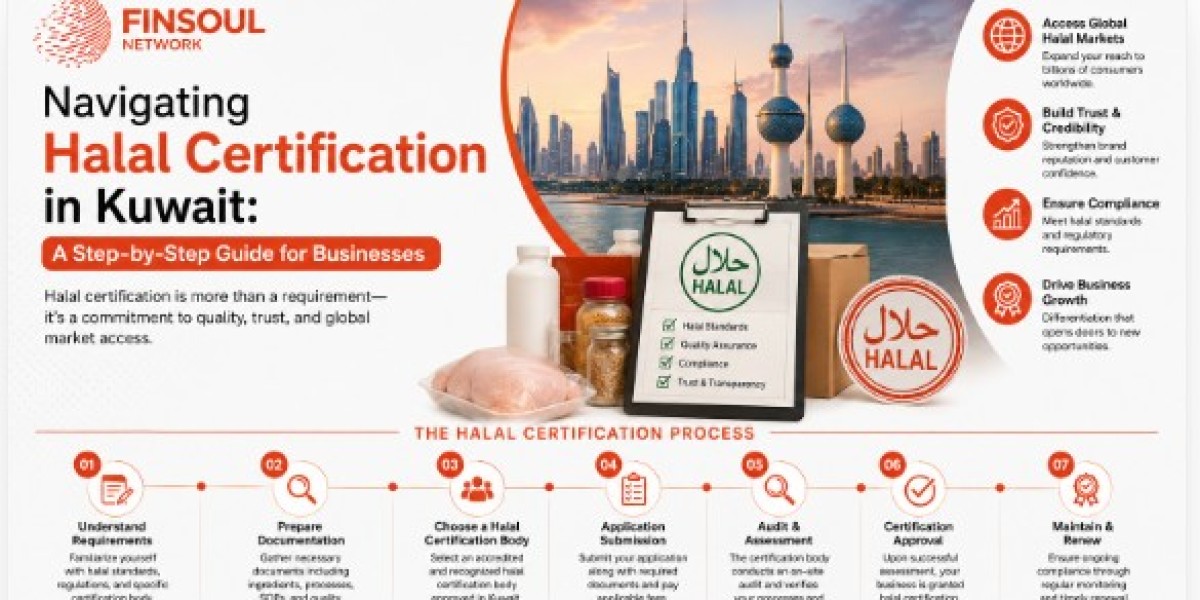
The Step-by-Step Halal Certification Process in Kuwait
Step 1: Understand the Applicable Halal Standards
The first step in pursuing halal certification in Kuwait is understanding which halal standards apply to your specific products and operations. Different product categories, different certification bodies, and different target markets may involve different applicable standards. Understanding these requirements clearly at the outset prevents the misdirected preparation effort that occurs when businesses assume a single universal standard applies to all situations.
Halal certification consulting services in Kuwait provide the expert guidance needed to identify the applicable standards for your specific situation and to understand what each standard requires in practice.
Step 2: Conduct an Internal Halal Compliance Review
Before engaging a certification body, conducting an honest internal review of your current compliance status against the applicable halal standards identifies the gaps that need to be addressed before certification is achievable. This review covers ingredient sourcing and verification, production processes and equipment, segregation and contamination prevention procedures, documentation and record-keeping systems, and staff training and awareness.
Understanding these gaps clearly allows the business to prioritise corrective actions and build a realistic timeline for achieving certification readiness.
Step 3: Implement Required Changes to Processes and Ingredients
Based on the internal review findings, the business implements the changes needed to bring its operations into compliance with the applicable halal standards. This may involve reformulating products to replace non-compliant ingredients, changing suppliers to source halal-certified raw materials, modifying production sequences or cleaning procedures to ensure adequate segregation, installing physical barriers or dedicated equipment where cross-contamination risk exists, and developing the documentation systems needed to demonstrate and maintain compliance.
This implementation stage is where professional support from experienced halal consultants in Kuwait delivers the most immediate value. Consultants with direct experience of Kuwait's halal certification requirements know exactly what auditors look for and can guide implementation in a way that achieves genuine compliance efficiently rather than through trial and error.
Step 4: Engage a Halal Certification Body
Once the business is confident that its operations meet the applicable halal standards, the next step is formally engaging an accredited halal certification body to conduct the audit and issue the certificate. The selection of the certification body should be guided by the recognition requirements of the business's target markets and distribution channels, ensuring that the certificate issued will be accepted by the buyers and markets the business is seeking to access.
Step 5: Submit Your Application and Supporting Documentation
The formal certification application requires submission of comprehensive documentation covering the business's products, ingredients, suppliers, production processes, quality management systems, and compliance procedures. The documentation package must be complete, accurate, and well-organised.
Incomplete or inaccurate applications delay the certification process and create a negative first impression with the certification body. Professional halal certification consulting services in Kuwait ensure that application documentation meets the certification body's requirements completely before submission.
Step 6: Facility Audit and Inspection
The certification body conducts a formal audit of the business's facilities, processes, and documentation to verify that halal compliance is genuinely implemented and not merely documented on paper. Auditors examine ingredient storage and handling, production processes, segregation measures, cleaning procedures, documentation records, and staff knowledge of halal requirements.
Businesses that have prepared thoroughly through proper implementation and rehearsed their teams on the audit process consistently achieve better audit outcomes than those that have not. Pre-audit preparation support from halal consultants in Kuwait significantly improves audit performance.
Step 7: Certificate Issuance and Ongoing Compliance
Following a successful audit, the certification body issues the halal certificate for the certified products or operations. The certificate has a defined validity period, typically one year, after which it must be renewed through a surveillance audit that confirms ongoing compliance.
Maintaining the systems and practices that achieved certification is essential for successful renewal. Businesses that allow compliance standards to slip between audits face the risk of certificate suspension or withdrawal, which creates significant commercial disruption.
The Role of Halal Consultants in Kuwait
What Professional Halal Consultants Actually Do
Halal consultants in Kuwait bring specialist knowledge of halal standards, Kuwait's regulatory framework, and the practical requirements of the certification process that most businesses do not possess internally. They conduct the internal compliance review, guide implementation of required changes, prepare certification application documentation, train staff on halal requirements and audit expectations, and provide ongoing support for compliance maintenance after certification is achieved.
The breadth of expertise that experienced halal consultants in Kuwait bring means that businesses avoid the costly mistakes that come from attempting to navigate the certification process without specialist guidance. They know which certification bodies are most appropriate for specific situations, what documentation auditors expect to see, and how to address common compliance challenges in ways that satisfy auditor requirements without creating unnecessary operational disruption.
Why Halal Certification Consulting Services in Kuwait Improve Outcomes
The investment in professional halal certification consulting services in Kuwait consistently delivers better outcomes than self-managed certification attempts in several measurable ways. Certification is achieved faster because the path is well-understood and common pitfalls are avoided. First-time audit success rates are higher because preparation is thorough and targeted. And ongoing compliance is more sustainable because the systems implemented with professional guidance are designed for durability rather than minimum viable compliance.
For businesses where halal certification is a commercial necessity rather than an optional enhancement, the time saved, the cost of failed audits avoided, and the commercial value of achieving certification quickly all make professional consulting support a clearly worthwhile investment.
Common Challenges Businesses Face in Halal Certification
Several recurring challenges cause Kuwait businesses to experience delays or difficulties in the halal certification process. Ingredient verification across multi-tier supply chains is one of the most complex challenges, particularly for businesses sourcing ingredients from multiple international suppliers. Establishing that every ingredient in every product is halal-certified requires a structured supplier management process that many businesses have not previously needed to build.
Cross-contamination risk management is another common challenge, particularly for businesses that produce both halal and non-halal products in shared facilities. Demonstrating adequate segregation through physical and procedural controls requires careful planning and implementation.
Documentation gaps represent a third common challenge. Halal auditors expect comprehensive, well-maintained records that demonstrate ongoing compliance. Businesses that have operated informally, without systematic documentation of ingredient verification, cleaning procedures, and production records, need to build these documentation systems as part of their certification preparation.
Maintaining Halal Certification After Initial Award
Achieving halal certification in Kuwait is a significant commercial milestone, but it is the beginning of an ongoing compliance commitment rather than a one-time achievement. Maintaining certification requires continuous attention to ingredient sourcing, production process integrity, documentation quality, and staff awareness.
Changes that affect halal compliance, including new ingredients, new products, new suppliers, or changes to production processes, must be assessed for their halal compliance implications before implementation. The certification body must be notified of significant changes and may require additional audit activity to confirm that certification remains valid.
Building a halal management system that makes compliance maintenance systematic and routine rather than reactive and periodic is the most reliable approach to sustaining certification through successive renewal cycles.
How Halal Certification Supports Kuwait Vision 2035
Kuwait Vision 2035 identifies the development of a diversified, internationally competitive private sector as a national priority. For Kuwait's food, beverage, and consumer goods industries, halal certification is one of the most direct enablers of the international market access that Vision 2035's export development goals require.
As Gulf and global halal markets continue to grow, Kuwait businesses with credible, internationally recognised halal certification in Kuwait are positioned to participate in export opportunities that certification-free competitors cannot access. Building Kuwait's reputation as a source of credibly certified halal products contributes to the national economic diversification agenda while creating genuine commercial value for the businesses that invest in certification.
Conclusion
Halal certification in Kuwait is a commercial necessity for businesses across the food, beverage, cosmetics, and hospitality sectors. The certification process is structured and achievable for any business that approaches it with thorough preparation, honest internal assessment, and professional support from qualified halal consultants in Kuwait. The commercial benefits, including consumer trust, retail access, export eligibility, and competitive positioning, consistently justify the investment in professional halal certification consulting services in Kuwait that make the process efficient and the outcome sustainable.
Businesses that achieve and maintain halal certification in Kuwait are not just satisfying a regulatory requirement. They are building a commercial asset that opens markets, strengthens client relationships, and supports the kind of sustainable growth that Kuwait's most demanding commercial environment rewards.