
The first question in launching any business is, "How much can I earn from this?” And the same question applies when you're planning to launch a digital super app using a Gojek clone script.
Well, the good news is that you can earn from so many things: rides, food, groceries, payments, home services, all in one place.
While the Gojek clone business model may look complex on the surface due to its multiple service layers, the revenue structure is fairly simple. Understanding it is the first step, and then figuring out ways to make money from your Gojek clone becomes clearer.
What is the Gojek Clone Business Model?
A Gojek clone brings multiple services into one place. The idea is simple: a single app for rides, food, groceries, home services, and parcels. This way, users can use the app for multiple purposes, while businesses cast a wider net and make money from every transaction.
The whole thing works through four groups:
Users of the app who schedule services like rides, food delivery, or home assistance
Service providers like plumbers, electricians, and cab drivers who cater to various requests
Merchants/Businesses like restaurants, grocery shops, and specialty retailers that accept orders through the app
The admin, who controls and monitors the entire platform from a centralized dashboard.
Revenue Models of the Gojek Clone
#1. How Does the Commission Model Work?
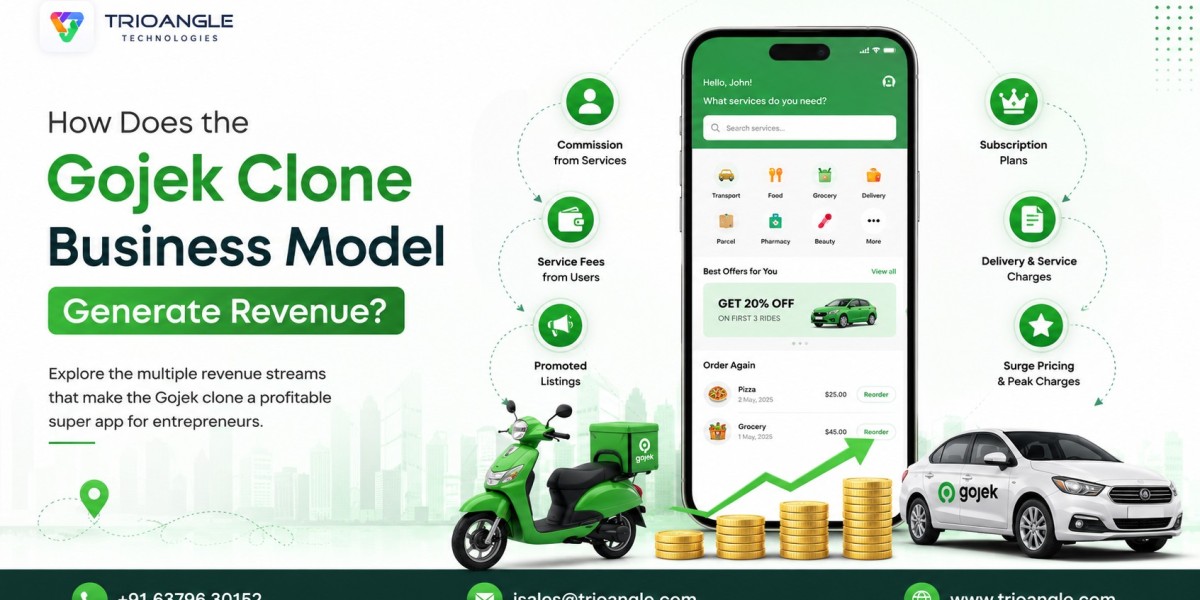
This is the core. Every transaction on the Gojek clone app passes through your hands. A customer orders food, a restaurant accepts, and a driver delivers it. You take a percentage of that order value before the rest reaches the restaurant or driver.
Most Gojek clone script operators set different rates by service type. Ride-hailing typically ranges from 15 to 25 percent. Food delivery rates can be even higher.
#2. How Does the Platform Earn from Service Providers?
Beyond commission, providers often pay for better visibility inside the Gojek clone app.
If you are a restaurant owner and the app has 50,000 daily users, being featured on the homepage has real value. A Gojek app clone gives you a clean way to charge for it, whether that is a monthly listing fee, a one-time slot, or a bidding system.
#3. How Does Surge Pricing Add to the Revenue?
When demand spikes, you don’t have to do anything, your everything app raises ride prices automatically. The dynamic pricing system built into the Gojek clone script allows a share of that additional fare to flow back to the platform, creating revenue without any additional effort.
#4. Why Do Subscription Plans Matter in a Gojek Clone?
Subscription tiers create predictable monthly revenue. For a founder, recurring revenue is worth more than pure transaction revenue. It smooths slow periods and simplifies financial planning.
#5. How Do In-App Ads Contribute to Revenue?
Once real traffic starts coming in, ad placements naturally become valuable. Since you control the ad slots on your platform, you can manage both the pricing and the relationships with advertisers directly.
Conclusion: Are You Ready to Launch Your Gojek Clone App?
Commission, listing fees, subscriptions, ads, and service fees. Together, they build a stronger Gojek app clone model that is hard to compete with through a single move.
Map it out before you go live with your Gojek clone script. Know which streams activate on day one and which ones follow after user milestones. That clarity makes growth planning a lot cleaner.
Visit: https://www.trioangle.com/gojek-clone/
WhatsApp - +91 63796 30152
Email ID - sales@trioangle.com
Telegram- https://t.me/Trioangle_Technologies