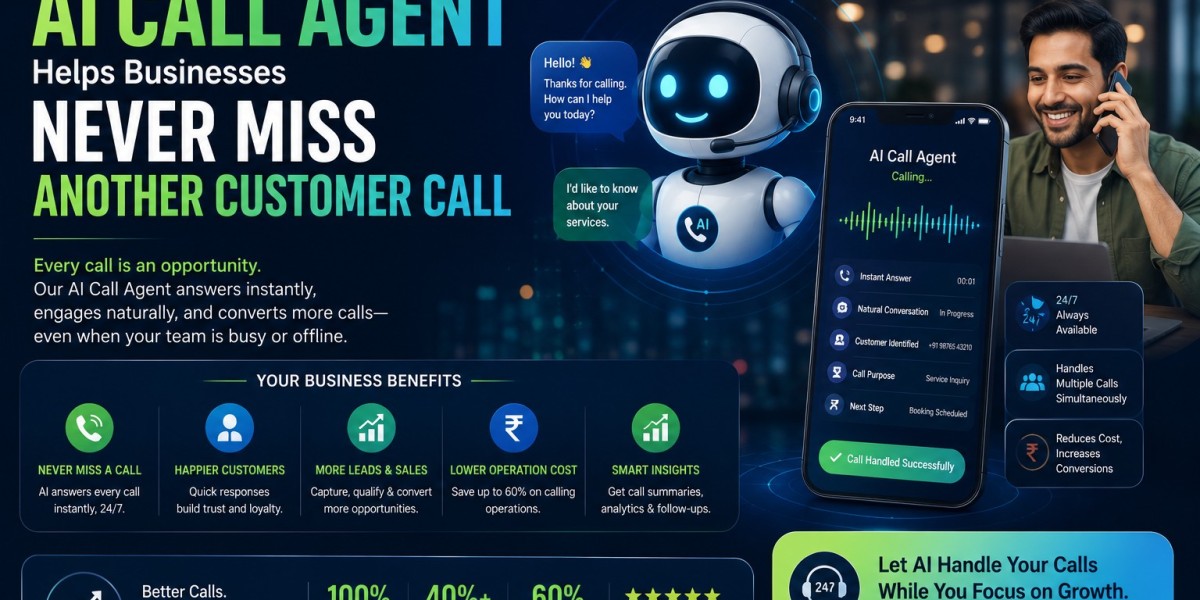

An AI call agent is an intelligent voice automation system that answers business calls 24/7, handles customer inquiries, books appointments, qualifies leads, and logs data to your CRM, all without human intervention. Businesses using AI call agents report up to a 90% reduction in missed calls and an ROI of 300–800% in the first year.
Every missed call is a decision made for you. The customer called. You didn't answer. So they called someone else.
That's not a hypothetical. According to a 2023 study by 411 Locals analyzing 85 businesses across multiple industries, 62.2% of business calls go unanswered. And once a caller hangs up? Research from Aircall shows that 85% of those customers will never call back.
For small and mid-sized businesses, this translates to $62,000 or more in lost revenue every year. For larger operations handling higher call volumes, the figure can exceed $126,000 annually, before factoring in lifetime customer value or referrals.
The problem is not that businesses don't care. The problem is that human availability has a ceiling. Staff gets busy, offices close, and call volumes spike unpredictably. No matter how well you hire or how carefully you schedule, there will always be a gap between when customers call and when someone is available to answer.
That gap is exactly where an AI Call Agent steps in.
Why Missed Calls Are Costing Businesses More Than They Think
The immediate revenue loss is the visible part. Missing a call from a real estate prospect worth $2,000 to $8,000 per transaction stings. Missing a legal inquiry worth $1,500 to $5,000 is painful. But the compounding effects are what most businesses underestimate.
Phone calls convert to revenue 10 to 15 times more effectively than web leads, according to Invoca. When those calls go unanswered, you're not just losing the transaction. You're losing a customer relationship that could span years.
Consider the after-hours problem. Research from Anthrova shows that 47% of customer calls happen outside standard business hours. A water heater fails at 7 PM. A patient needs to reschedule a procedure. A property buyer wants to book a showing before the weekend. The businesses that answer those calls close the deal. The ones that don't lose it to whoever picks up first.
There's also the marketing spend angle. Every missed call represents wasted investment in SEO, ads, or outreach that drove that caller to pick up the phone. When your conversion funnel ends with a ringing line and nobody home, your acquisition cost climbs while your return drops.
The math is not abstract. It is measurable, and it is actionable.
What Is an AI Call Agent and How Does It Work?
An AI call agent is an intelligent software system that handles inbound and outbound phone calls using speech recognition, natural language processing, and conversational AI. It understands what a caller is saying, interprets their intent, and responds in natural, human-like speech, all in real time.
Unlike outdated IVR systems that force callers to navigate rigid menus, a modern AI phone assistant holds a genuine two-way conversation. It can answer questions, collect information, book appointments, qualify leads, and route complex cases to the right human team member.
The best systems operate with latency under 200 milliseconds, which makes the conversation feel natural rather than robotic. OnDial, for example, delivers responses in under 200ms with 99.4% transcription accuracy across more than 100 languages and 50 regional accents.
What separates a capable AI call agent from a basic voicebot is its ability to integrate with your existing business tools. CRM platforms, scheduling software, helpdesk systems, and communication channels can all be connected, meaning the agent is not working in isolation. It's working inside your operation.
Key Ways an AI Call Agent Keeps Businesses Available 24/7
Instant Response at Any Hour
The most direct benefit is availability. An AI call agent answers on the first ring, at 2 AM on a holiday, during lunch, and at peak volume when three other lines are ringing. There is no hold music and no voicemail. The caller gets immediate, useful engagement every time.
Automated Appointment Scheduling
Voice automation handles the entire booking workflow without human intervention. The agent checks availability, proposes times, confirms the appointment, and sends a follow-up, all within a single call. For healthcare providers, real estate agencies, and service businesses, this alone can recover tens of thousands in annual revenue.
Lead Qualification Before Human Handoff
Not every call warrants the same level of attention. A smart AI call agent asks the right questions upfront, identifies hot leads, and routes them to the appropriate sales rep immediately. Lower-priority inquiries get handled directly without consuming any human time.
CRM Integration and Automatic Logging
Every call gets documented. Customer data, inquiry details, sentiment scores, and resolution notes are logged automatically to your CRM, whether that's Salesforce, HubSpot, or another platform. Sales and support teams start every follow-up with complete context rather than starting from zero.
Scalability During High-Volume Periods
A human call center requires weeks of hiring and training to scale. An AI call agent scales in seconds. Whether you're handling 10 calls or 10,000, the system responds to every one simultaneously with no degradation in quality.
Real-World Use Cases Across Industries
Real Estate
Property inquiries have a short shelf life. A prospective buyer or renter calling at 8 PM on a Friday will not wait until Monday. An AI phone assistant answers immediately, captures the inquiry, qualifies the lead, and schedules a showing confirmation, all without an agent present. Given that each missed real estate call can represent $2,000 to $8,000 in lost commission, the business case is direct.
Healthcare
Medical practices deal with high call volumes, strict compliance requirements, and time-sensitive appointment requests. An AI receptionist handles appointment booking, rescheduling, insurance verification queries, and after-hours triage while staying fully HIPAA-compliant. Missing even one appointment per day at a $300 average procedure value can cost a practice over $100,000 per year.
SaaS and Technology Companies
Customer support automation is a priority for software businesses where trial users need fast answers and churned customers often cite slow response as a reason they left. An AI call agent handles tier-one support queries, routes technical issues to the right team, and captures product feedback for analytics, all at scale.
Agencies
Marketing, PR, and consulting agencies often operate with lean teams handling multiple clients. Business phone automation means client calls are answered professionally at all hours, new business inquiries are captured immediately, and account managers are never interrupted by calls they could have handled asynchronously.
Enterprise Operations
Large enterprises face a different challenge: consistency across high call volumes. When hundreds of agents are handling customer interactions, message drift and human error create compliance risks and brand inconsistency. A virtual call agent delivers the same accurate, on-brand response every single time, supported by enterprise-grade encryption and compliance certifications including SOC 2, PCI DSS, and ISO standards.
How Voice Automation Improves Customer Support, Teams
A common concern about AI in customer service is that it replaces people. The more accurate framing is that it redirects them.
When an AI call agent absorbs repetitive, high-volume inquiries, including account balance questions, order status updates, appointment confirmations, and FAQ responses, human agents are freed to handle the interactions that actually require empathy, judgment, and nuanced problem-solving.
The result is better performance across the board. Human agents handle fewer low-complexity calls and are less likely to burn out. Response times for complex cases improve because queues are shorter. First-call resolution rates rise because the calls reaching human agents are the ones humans are genuinely equipped to handle.
Voice AI software also provides structured data that traditional call handling cannot. Every conversation becomes an analyzable record. Sentiment trends, resolution rates, peak call times, and recurring inquiry patterns all surface through AI-powered analytics dashboards. That information feeds directly into staffing decisions, product improvements, and customer experience strategy.
What Makes a Good AI Phone Assistant?
Not all voice AI software is built the same. When evaluating an AI phone assistant for your business, the factors that matter most are:
Natural Language Understanding: The agent should handle accents, interruptions, topic switches, and conversational phrasing without breaking down. Rigid scripting leads to frustrating caller experiences.
Low Latency: Delays of more than 300 to 400 milliseconds make a conversation feel mechanical. Sub-200ms response time is the standard to aim for.
Seamless Integrations: If the agent cannot connect to your CRM, calendar, and communication tools, it creates more manual work rather than less. True plug-and-play integration is essential.
Multilingual Capability: For businesses serving diverse markets, the ability to auto-detect and respond in 100 or more languages without additional setup is a significant operational advantage.
Compliance and Security: For healthcare, finance, and legal businesses, the AI call agent must operate within appropriate regulatory frameworks, including HIPAA, GDPR, and PCI DSS.
Analytics and Reporting: The agent should generate actionable data from every call, including sentiment scores, resolution rates, and call volume patterns, so you can continuously improve customer support operations.
OnDial is built to meet all of these criteria. It supports over 100 languages, integrates with major CRM and scheduling platforms with no engineering required, and maintains full compliance certifications for regulated industries. It delivers call handling that feels less like automation and more like a highly capable, always-available team member.
Stop Losing Revenue to Missed Calls
Missed calls are not a staffing problem with a hiring solution. They are a structural problem with a structural solution.
Businesses that implement AI call agents are not just reducing missed calls. They are changing the economics of customer acquisition, retention, and support. They are recapturing revenue that was already being generated by marketing and simply failing to convert. They are building a customer experience that is available, consistent, and intelligent, regardless of time zone, call volume, or team capacity.
The businesses seeing 300 to 800% ROI in their first year from voice automation are not outliers. They are the early movers in an adoption curve that is accelerating quickly.
If your business relies on phone calls to generate or retain revenue, and most do, the question is not whether an AI call agent would pay for itself. The data already answers that. The question is how much longer you can afford to let the gap between "call received" and "call answered" drain your pipeline.
Explore what OnDial can do for your business, and see how AI-powered voice automation can ensure that the next call your business receives is one you never miss.
Frequently Asked Questions
What is an AI call agent and how is it different from a traditional phone system?
An AI call agent is a conversational AI system that answers, understands, and responds to calls in real time using natural language processing. Unlike traditional IVR systems that route callers through pre-recorded menus, an AI call agent holds a natural two-way conversation, qualifies leads, books appointments, and integrates with business tools like CRMs and calendars without requiring human intervention.
How much revenue can a business recover by using an AI call agent?
This depends on call volume, industry, and average transaction value. Based on data from Anthrova and Davinci Virtual, small businesses lose an average of $62,000 to $126,000 annually from missed calls. Businesses that implement AI call handling typically report 300 to 800% ROI in the first year by converting previously missed calls into booked appointments and closed sales.
Can an AI phone assistant handle calls in multiple languages?
Yes. Advanced platforms like OnDial support more than 100 languages and 50 regional accents. The system auto-detects the caller's language and responds accordingly, with no additional setup required. This makes multilingual AI call handling practical for businesses operating across diverse geographic markets.
Is AI customer service automation suitable for small businesses?
Absolutely. AI call agents are scalable and priced to be accessible at multiple business sizes. For small businesses with lean teams, voice automation means 24/7 call coverage without the overhead of additional staff. The technology eliminates the staffing math that previously made round-the-clock availability unrealistic for smaller operations.
How does an AI call agent integrate with existing business tools?
Most modern AI call agents, including OnDial, connect to CRMs such as Salesforce and HubSpot, scheduling platforms like Calendly, communication tools like Slack, and automation platforms like Zapier through pre-built integrations. Setup typically requires no custom engineering. The agent logs call data, updates customer records, and triggers workflows automatically during each interaction.
What industries benefit most from AI voice agents?
Healthcare, real estate, legal services, home services, SaaS, e-commerce, finance, logistics, and hospitality consistently report the strongest results. Any industry where phone calls drive bookings, sales, or customer service, and where missed calls carry a high cost per lost contact, benefits significantly from business phone automation.
Is an AI call agent secure enough for regulated industries?
Yes, provided the platform meets the relevant compliance standards. OnDial is certified under HIPAA for healthcare data, GDPR for EU privacy requirements, PCI DSS for payment-related conversations, SOC 2 for overall security and availability, and ISO standards for information security management. These certifications make AI call agents viable for healthcare providers, financial institutions, and legal firms.
Will customers know they are talking to an AI?
This depends on how the system is configured. Modern AI phone assistants with sub-200ms response latency and natural language capabilities are often indistinguishable from human agents in routine interactions. Research consistently shows that customers prioritize fast, accurate resolution over whether they are speaking to a human or an AI. Businesses can choose to disclose AI use upfront, which many do, without negatively affecting satisfaction scores.