
Introduction
Every successful healthcare practice depends on accurate documentation, and nowhere is this more critical than in Medical Billing. Patient records form the foundation of every claim submitted, every payment processed, and every report generated. When this data is incomplete or outdated, the entire billing cycle suffers. This blog explores why precise patient records are essential, the risks of getting them wrong, and how modern Medical Billing Software helps healthcare providers maintain accuracy at every step.
Understanding Patient Records in Medical Billing
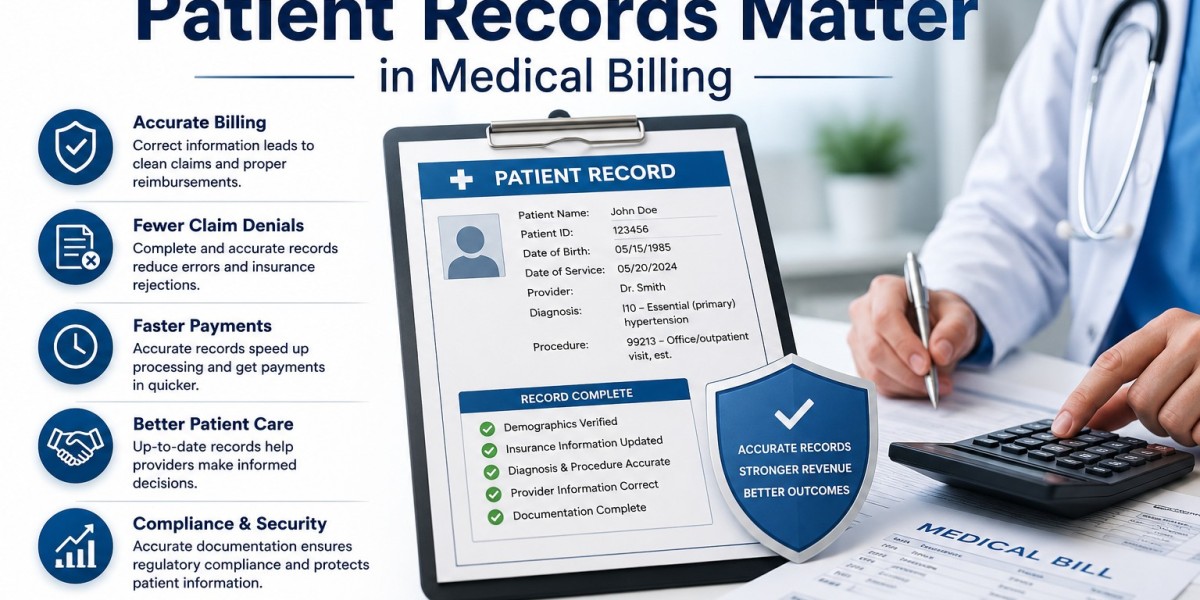
Patient documentation includes demographics, insurance information, patient’s medical history, diagnostic codes, and treatment details. This information is utilized for the creation of claims, verifying insurance coverage, and justifying the service provided in billing. The billing department cannot make claims that are accepted by payers in the very first attempt without having proper information in records.
Most healthcare providers make use of software based medical billing system that record this data in digital form rather than using outdated methods which included paper records.
The Link Between Patient Data and Billing Accuracy
Accuracy of billing is highly dependent on the quality of the information provided during patient registration. Even one wrong figure in the policy number or one spelling mistake in the patient's name may cause the bill to be bounced back by the insurance company. For this reason, most medical billing firms consider data validation to be the first step in the revenue cycle.
Whenever there is seamless integration between patient information and billing systems, any change made to the patient's insurance information or contact details is immediately reflected on all future claims.
Common Issues Caused by Inaccurate Patient Records
Inaccurate patient records create a ripple effect across the entire billing process. Some of the most frequent issues include:
Duplicates created by separating billing data into different patient profiles
Out-of-date insurance information resulting in claims being sent to the wrong payor
Inaccurate demographic information creating discrepancies when performing eligibility determination
Lack of proper documentation that does not support billing codes
Errors made during data entry process
Impact of Record Errors on Claim Denials
Claim denials are among the costliest results of bad record keeping. Whenever the claim is denied due to discrepancies in patient information, there will be an investigation process followed by correction and re-submission of the claim, which delays the payment.
With time, multiple denials arising from the same preventable record discrepancy can have an impact on the financial health of the organization. Modern billing software systems used by many hospitals have the built-in functionality that detects such problems prior to claim submission.
Key Benefits of Maintaining Accurate Patient Records
Maintaining an up-to-date and accurate record of patients’ information has the following benefits for healthcare providers:
Fewer delays in claims processing and rejection by insurers
Better financial management due to faster reimbursement cycles
Greater regulatory and audit compliance
More credibility among patients through proper billings
Less need to fix mistakes that may arise during submissions
Essential Features for Patient Record Management
However, not all systems can manage patients’ information efficiently. In considering whether a platform meets the required standards, healthcare professionals must identify functionalities that will help maintain accuracy of the records and retrieve them easily.
Data Validation Tools
This functionality runs automated tests on fields such as format of the insurance ID and date of birth of the patient to identify any mistakes immediately.
Patient Database
This functionality creates a single database where only one patient record can be created, eliminating the possibility of having duplicates.
Best Practices for Keeping Records Updated and Accurate
Record keeping is an ongoing process. There are several steps that healthcare organizations should undertake to improve the quality of their information:
Checking out patients' and insurers' information at each visit, rather than just at initial registration
Educating front-desk and billing staff members about correct information entry
Performing periodic reviews of patients' duplicates or outdated records
Using uniform formats for names, addresses, and ID numbers
Role of Medical Billing Software in Record Accuracy
Modern Hospital Billing Software plays a central role in keeping patient data consistent across departments. By linking registration, clinical documentation, and billing into one system, errors that once went unnoticed until claim submission can now be caught much earlier.
Many Medical Billing Software Solutions also offer real-time synchronization, meaning that any update made by front-desk staff is immediately available to the billing team, eliminating the lag that often causes outdated information to slip through.
Steps to Improve Patient Record Management
Efficient record keeping needs to be done through a systematic process rather than piecemeal improvements. Providers can improve their record-keeping through these measures:
Conduct an audit of current record-keeping procedures to discover repeated errors
Adopt a standardized Medical Billing System that integrates all patient records
Develop data entry policies for all personnel managing patient records
Perform regular audits to check on outdated or duplicated records
Common Challenges in Maintaining Data Accuracy
However, even with the necessary tools being in place, some of the common difficulties that healthcare providers encounter with regards to maintaining accurate records are the high turnover of staff, which results in inconsistency in data entry procedures, as well as a high volume of patients that prevents data from being thoroughly verified.
Dealing with such problems generally takes proper training and software solutions that promote record accuracy.
The Role of AI in Detecting Record Errors
The growing use of AI in Hospital Billing Systems is changing how errors are identified before they affect revenue. AI-driven tools can scan large volumes of patient records to detect anomalies, such as mismatched insurance details or inconsistent demographic entries, far faster than manual review.
Beyond detection, predictive algorithms can flag patterns that historically lead to claim denials, allowing billing teams to correct issues proactively rather than reactively.
Future Trends in Patient Data Management
For the future, management of patient information will evolve to be more automated and interactive. It is becoming increasingly possible with cloud-based systems to link the medical billing software used in hospitals to electronic health records, pharmacies, and insurance portals. With the advancement of artificial intelligence, it is likely that error detection and data verification will be standard capabilities.
Conclusion
Accurate patient records are not just an administrative detail, they are the backbone of a healthy revenue cycle. From reducing claim denials to improving patient trust, the value of precise data touches every part of the billing process. As more Billing Hospital Services adopt smarter, AI-supported systems, healthcare providers that prioritize record accuracy today will be better positioned for efficient, error-free billing in the future.