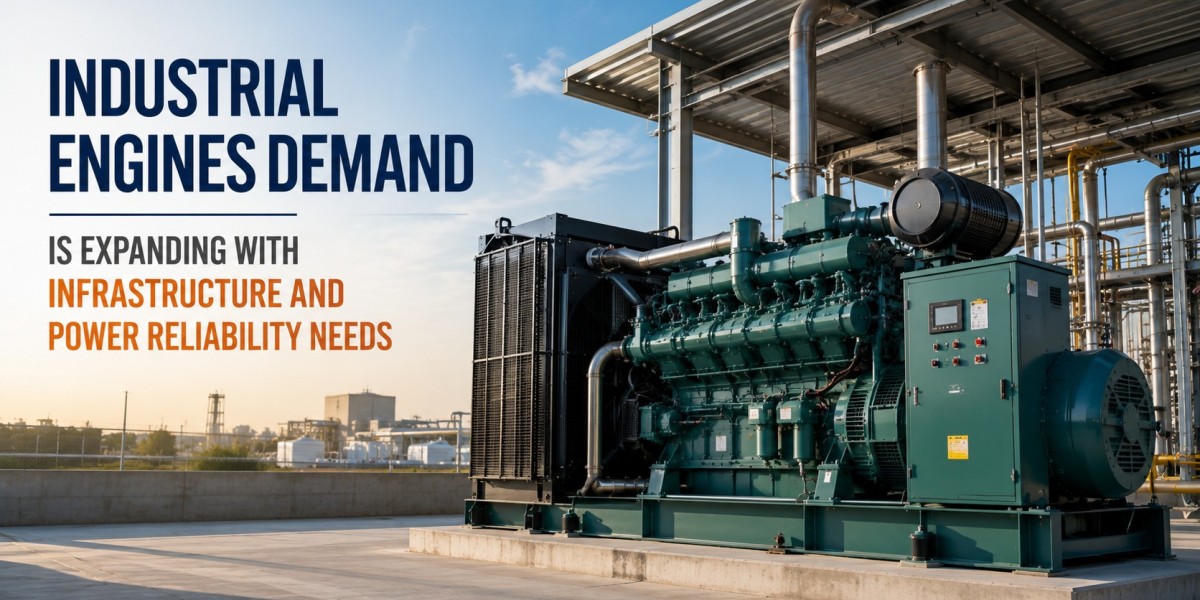

Industrial engines remain essential across power generation, construction, mining, agriculture, oil and gas, marine operations, manufacturing, and heavy equipment applications. These engines provide mechanical or electrical power for machines that operate in demanding environments where durability, torque, and reliability are critical. As infrastructure projects expand and industries require dependable power for continuous operations, industrial engines continue to support both mobile machinery and stationary power systems.
According to MarkNtel Advisors, the global industrial engines sector was valued at around USD 58.9 billion in 2025 and is projected to reach USD 90.33 billion by 2032. The industry growth trends indicate a CAGR of around 6.3% during 2026–2032, supported by construction activity, power generation requirements, heavy machinery deployment, Asia-Pacific’s leading share, and continued demand for diesel-powered systems.
Infrastructure Development Is Driving Engine Use
Infrastructure expansion is one of the strongest demand drivers for industrial engines. Construction equipment such as excavators, loaders, graders, cranes, compactors, and concrete machinery depends on high-performance engines to operate reliably at project sites. Roads, bridges, ports, airports, rail systems, energy projects, and urban development all create demand for engine-powered machinery.
The World Bank highlights infrastructure as a key factor in productivity, connectivity, and economic development. As countries invest in transport networks, energy systems, and urban facilities, industrial engines remain important for powering equipment used during construction, maintenance, and site operations.
Power Generation Remains a Core Application
Industrial engines are also widely used in generator sets for backup, prime, and distributed power. Factories, hospitals, data centers, telecom towers, commercial buildings, mining sites, and remote facilities rely on engine-driven generators where grid supply is unavailable, unstable, or insufficient.
The International Energy Agency emphasizes the importance of secure and reliable energy supply for economic and social systems. Industrial engines support this need by providing standby and off-grid power, especially in regions where electricity reliability remains a challenge or where critical facilities require redundancy.
Diesel Engines Continue to Hold a Strong Position
Diesel engines account for about 47% share of the global industrial engines sector in 2025. Their dominance is linked to high torque, fuel efficiency, durability, wide service availability, and suitability for heavy-duty applications. Diesel engines are common in construction equipment, mining machinery, agricultural vehicles, marine engines, and generator sets.
However, emissions regulations are reshaping engine design. Manufacturers are developing lower-emission engines, hybrid-compatible systems, aftertreatment technologies, and fuel-flexible platforms. The U.S. Environmental Protection Agency regulates emissions from nonroad engines and equipment, reflecting the growing pressure on industrial engine producers to improve environmental performance.
Asia-Pacific Leads Regional Demand
Asia-Pacific holds around 38.5% share of the global industrial engines sector. This leadership is supported by large construction activity, industrial growth, manufacturing expansion, mining, agriculture, and rising power demand across China, India, Southeast Asia, Japan, South Korea, and Australia.
The Asian Development Bank supports infrastructure development across Asia and the Pacific, including transport, energy, and urban systems. This regional investment environment supports demand for industrial engines used in construction equipment, backup power, agriculture, logistics, and industrial facilities.
The 201–500 HP Range Serves Broad Applications
The 201–500 HP segment accounts for about 32% share of the global industrial engines sector. This range is widely used because it offers a balance of power, efficiency, size, and cost. Engines in this category are suitable for medium construction equipment, agricultural machinery, generators, marine support vessels, pumps, compressors, and industrial vehicles.
This horsepower range is also attractive because manufacturers can use modular platforms and standardized components, improving cost efficiency and serviceability. For end users, the segment provides enough power for demanding applications without the higher fuel consumption and maintenance cost of larger engines.
Looking Ahead
Industrial engines are expected to remain important as infrastructure development, power reliability needs, mining activity, construction equipment use, and industrial production continue to expand. With the sector projected to reach USD 90.33 billion by 2032 at a CAGR of around 6.3%, demand is likely to remain strongest in Asia-Pacific, diesel systems, 201–500 HP engines, power generation, and construction applications. The long-term direction will depend on emission rules, fuel flexibility, hybridization, maintenance networks, and the ability of engine manufacturers to deliver durable power with improved efficiency and lower environmental impact.