
The Complete Guide to IT Outsourcing in 2026: Strategy, Models, Costs, and What Actually Works
There is a moment in the life of almost every growing business when the gap between the technology it needs and the team it has becomes impossible to ignore. Deadlines slip. Development backlogs piled up. The competitor who launched six months ago is already on version three of their product. Hiring takes months, costs a fortune, and still doesn't guarantee you get the right people.
This is the moment most companies discover IT outsourcing—not as a compromise, but as a strategic advantage.
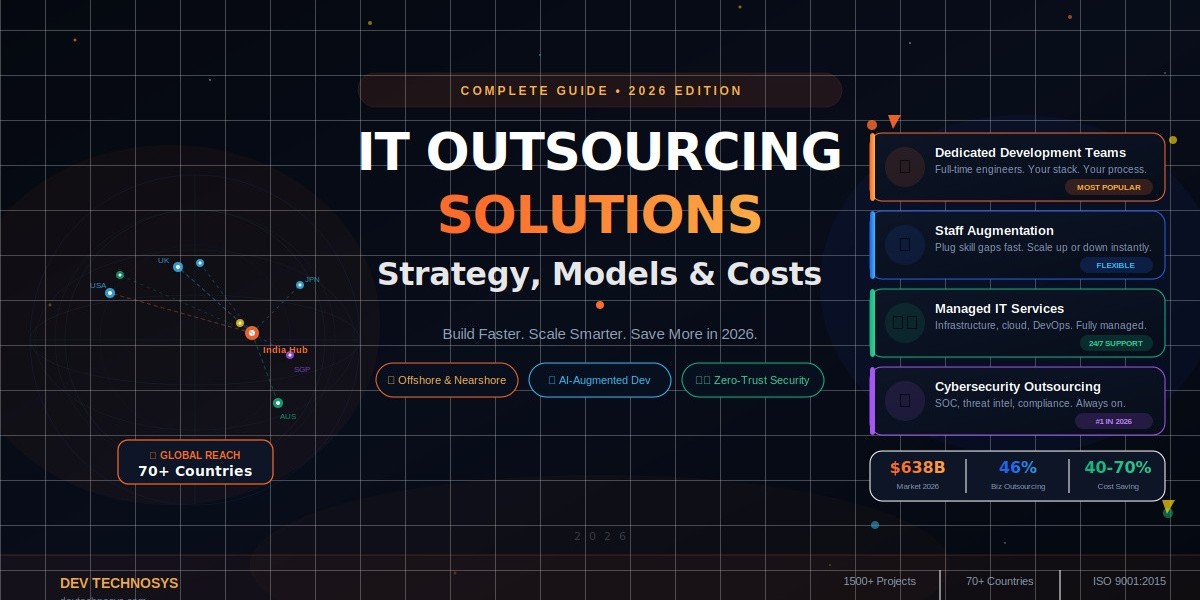
The global IT outsourcing market reached $638.65 billion in 2026, growing toward $752 billion by 2031. More telling than the size is the shift in why companies outsource. Cost reduction as the primary outsourcing driver fell from 70% in 2020 to just 34% in 2026, replaced by talent access and speed to market as the dominant motivators. What started as a cost-cutting measure has evolved into a model for accessing expertise, accelerating innovation, and building competitive technology capabilities that would take years to assemble in-house.
If you are evaluating outsourcing for the first time or reassessing an existing approach that isn't delivering results, this guide gives you the complete picture—models, functions, costs, vendor selection criteria, and what the best-run outsourcing relationships actually look like.
Why Businesses Outsource IT in 2026
The motivations for IT outsourcing have matured considerably. Today's decision-makers are not simply asking, "Can we reduce costs?" They are asking, "Can we build better and faster and with less risk?"
Access to specialized talent. Fifty-seven percent of recruitment managers report that finding skilled IT staff is genuinely difficult. The global talent shortage in areas like AI engineering, cloud architecture, cybersecurity, and full-stack development is acute. Outsourcing partners in established delivery hubs—India, Eastern Europe, and Southeast Asia—have deep talent pools that take years to build internally.
Speed to market. An outsourced team can be operational in weeks, not months. For startups racing to launch and enterprises managing digital transformation timelines, that speed differential is a genuine competitive asset.
Cybersecurity capability. Cybersecurity went from one of the least-outsourced IT functions in 2023 to the most-outsourced function in 2026, tied with IT infrastructure at 72%. The expertise required to build and maintain an effective security posture is too specialized and too expensive for most organizations to maintain entirely in-house.
AI and automation access. Eighty percent of organizations are now asking their outsourcing partners for GenAI capabilities and agentic solutions, and 70% are asking for advanced automation capabilities. Outsourcing has become a primary route to accessing AI expertise without building it from scratch.
Operational focus. When internal engineering teams are not buried in infrastructure maintenance, legacy system support, and IT operations, they focus on the product and innovation work that actually differentiates the business.
The Four Outsourcing Models: Which One Fits Your Situation
Not all outsourcing relationships look the same. The model you choose depends on your goals, the nature of the work, your internal capabilities, and your appetite for control versus flexibility.
Offshore outsourcing work is delegated to a partner in a different country—typically one with significantly lower labor costs and strong technical talent. India, Ukraine, Poland, Vietnam, and the Philippines have established themselves as offshore destinations. Cost savings of 40–70% compared to domestic hiring are common, and the talent quality at leading offshore firms is world-class. The offshore outsourcing segment currently holds the largest share of the global market. The tradeoff is time zone overlap and the cultural and communication discipline required for it to work well.
Nearshore outsourcing work is outsourced to a partner in a neighboring or nearby country, often sharing or partially overlapping time zones. US companies frequently nearshore to Mexico, Colombia, or Argentina. European companies work with teams in Poland, Romania, or the Czech Republic. Nearshore models reduce the communication friction of offshore arrangements while still delivering meaningful cost advantages.
Onshore outsourcing work is outsourced to an external partner within the same country. Eliminates time zone, language, and cultural gaps entirely. The most expensive model, but appropriate for highly regulated industries, sensitive data handling, or projects requiring deep client-site collaboration.
Hybrid / Multi-Shore Outsourcing Combines two or more of the above—typically a strategic and client-facing layer onshore or nearshore and a delivery and engineering layer offshore. Fifty-four percent of companies are now adopting hybrid cloud delivery models in their outsourcing arrangements. This model captures the communication benefits of proximity with the cost and talent benefits of offshore delivery.
What Functions Are Being Outsourced Most in 2026
Understanding which IT functions are most commonly and successfully outsourced helps you identify where your own organization can benefit most quickly.
Software Development and Engineering Custom application development, web and mobile development, API design, and product engineering are the backbone of IT outsourcing. Development outsourcing is well-established, with mature methodologies, standardized contracts, and a deep global talent supply.
IT Infrastructure and Cloud Management Infrastructure outsourcing — server management, cloud migration, DevOps, network operations — represents 45% of the total IT outsourcing market by value. Cloud-native services are the fastest-growing segment, with companies achieving over 30% improvement in deployment frequencies when outsourcing to specialist cloud partners.
Cybersecurity The complexity and cost of building internal security operations centers (SOCs), threat intelligence capabilities, and compliance management programs make cybersecurity outsourcing highly compelling. Managed security service providers (MSSPs) offer 24/7 monitoring, incident response, and compliance expertise that few internal teams can match.
Quality Assurance and Testing Dedicated QA and testing teams provide objective, thorough coverage of products that internal development teams—too close to their own code—often miss. Automated testing infrastructure, performance testing, and security testing are all common outsourcing candidates.
AI and Data Engineering: Machine learning model development, data pipeline engineering, MLOps, and AI integration work are increasingly outsourced as internal teams lack the specialized expertise, and the cost of building it in-house is prohibitive. Forty-four percent of outsourcing contracts now include AI and automation components.
Managed IT Services Help desk, end-user support, device management, and IT operations are core managed services offerings — predictable, well-priced, and freeing internal teams from reactive work.
UI/UX Design Product design, user research, prototyping, and design systems work are commonly outsourced—particularly to partners in markets with strong design cultures and lower hourly rates.
IT Outsourcing Models by Engagement Type
Beyond geography, outsourcing relationships are also defined by their commercial and operational structure:
Project-Based Outsourcing A defined scope of work is delivered for an agreed fixed price. Clean, low-overhead, and easy to budget. Best for well-defined projects with stable requirements — a specific application build, a platform migration, or a system integration.
Dedicated Team / Team Extension A team of developers, designers, or engineers works exclusively on your product as an extension of your internal organization. You direct the work; the outsourcing partner handles HR, facilities, and administration. Best for ongoing product development where requirements evolve. Increasingly the preferred model for companies building long-term technology capabilities.
Staff Augmentation: Individual specialists are placed into your existing team to fill specific skill gaps. You manage them directly. Maximum flexibility, minimum overhead. Best for short-term capacity needs or niche expertise requirements.
Managed Services: The outsourcing partner takes full operational responsibility for a function—cloud infrastructure, cybersecurity, IT support—and is accountable to agreed service level agreements (SLAs). You buy outcomes, not hours. Best for mature, stable operational functions where internal ownership is not a strategic priority.
Outcome-Based Contracts An emerging and increasingly popular model where the partner is compensated based on measurable business outcomes—system uptime, deployment frequency, and defect reduction rates—rather than time and materials. The expansion of outcome-based outsourcing contracts is identified as a key growth driver for the market through 2030.
How to Evaluate and Select an IT Outsourcing Partner
The quality of your outsourcing relationship is largely determined before the contract is signed. Choosing poorly costs far more than choosing well — in wasted time, rework, missed deadlines, and lost institutional knowledge.
Technical depth that matches your stack. Review portfolios, case studies, and GitHub repositories. Ask about their experience with your specific technologies — not just general claims of expertise, but evidence of shipping production-grade applications on the stack that matters to your project.
Domain and industry experience. A fintech platform has fundamentally different requirements — in compliance architecture, security posture, and data handling — than an e-commerce application. A partner with relevant domain experience brings patterns, pitfalls, and compliance knowledge that a generalist agency simply does not have.
Communication and process maturity. Ask how they handle sprint reviews, requirements changes, escalation paths, and knowledge documentation. Poor communication is the single most cited cause of outsourcing relationship failure. Look for partners who can demonstrate clear, consistent communication habits — not just promise them.
Security and compliance certifications. ISO 27001, SOC 2 Type II, GDPR compliance frameworks, and PCI-DSS capability are indicators of mature security practice. For regulated industries, these are non-negotiable.
Retention and team stability. High developer turnover at an outsourcing firm means your institutional knowledge walks out the door repeatedly. Ask about average tenure and retention rates. Stable, experienced teams deliver better work.
Reference calls with current clients. Any credible partner can provide references. Call them. Ask specifically about how the partner handled problems, miscommunications, and scope changes—not just the success stories.
IT Outsourcing Cost: What to Budget in 2026
IT outsourcing costs vary enormously depending on the engagement model, function, geography of the delivery team, and seniority level of the talent involved. Here is a practical reference framework:
Hourly Rates by Geography (Senior Developer, 2026)
| Region | Hourly Rate (USD) |
|---|---|
| United States / Canada | $100 – $200 |
| Western Europe | $70 – $150 |
| Eastern Europe (Poland, Ukraine, Romania) | $35 – $75 |
| India | $20 – $55 |
| Southeast Asia (Vietnam, Philippines) | $20 – $50 |
| Latin America (Argentina, Colombia, Mexico) | $35 – $70 |
Monthly Cost by Model (Mid-Level Developer)
| Engagement Model | Estimated Monthly Cost (USD) |
|---|---|
| Staff Augmentation (India) | $3,000 – $6,000 |
| Dedicated Team — 5 developers (India) | $18,000 – $35,000 |
| Project-Based — Full MVP | $25,000 – $120,000+ |
| Managed IT Services (Infrastructure) | $2,000 – $15,000/mo |
| Managed Security Services (MSSP) | $3,000 – $20,000/mo |
Key Cost Drivers
Seniority mix. A team of senior architects and lead engineers costs two to three times more than a team of mid-level developers. Right-size the seniority for the work at hand.
Technology specialization. AI/ML engineers, blockchain architects, and cloud specialists command a 30–50% premium over general full-stack developers.
Engagement duration. Longer-term dedicated team engagements typically come with lower effective rates than short-term project work. Partners price stability and reduced sales overhead into long-term contracts.
Scope management. Poorly defined requirements lead to scope creep, which is the single biggest driver of projects exceeding budget. Investment in a thorough discovery phase consistently pays for itself.
Time zone overlap requirements. If you require significant real-time collaboration, nearshore models cost more than offshore but reduce the hidden costs of asynchronous communication friction.
Common Pitfalls That Derail Outsourcing Relationships
Understanding why outsourcing relationships fail helps you avoid the same mistakes.
Choosing based on price alone. The cheapest vendor is rarely the best value. A team that delivers at $20/hour but requires two rounds of rework for every sprint ends up costing more than a $40/hour team that gets it right the first time. Evaluate the total cost of engagement, not the hourly rate.
Treating outsourcing as a set-and-forget arrangement. Outsourcing transfers execution, not accountability. Successful outsourcing clients stay engaged—clear briefs, regular reviews, fast feedback cycles, and decisive escalation when problems emerge.
Underinvesting in the knowledge transfer phase. The onboarding and knowledge transfer period is where outsourcing relationships succeed or fail. Rushing it to save time costs far more in misaligned expectations and rework.
Ignoring time zone and communication architecture. A 10-hour time zone gap between client and delivery team is manageable with good process design. It becomes catastrophic with poor communication discipline. Define overlap hours, communication protocols, and escalation paths before work begins.
Starting with insufficient documentation. "Build me something like Airbnb" is not a brief. Outsourcing partners cannot read minds, and vague requirements produce vague results. Investment in detailed product requirements — user stories, wireframes, acceptance criteria — is the single highest-leverage input to outsourcing quality.
No IP protection framework. NDAs, IP assignment clauses, and data handling agreements must be in place before a single line of code is written. This is non-negotiable regardless of geography or relationship warmth.
Building a Successful Outsourcing Strategy: A Practical Framework
For organizations making a serious, strategic commitment to outsourcing, a structured approach produces dramatically better outcomes than ad hoc vendor selection.
Step 1 — Define what you are outsourcing and why. Be specific about the function, the outcome you expect, the internal capability you are replacing or supplementing, and the success metrics you will use to evaluate the relationship.
Step 2 — Select the right model. Project-based for defined scope. Dedicated team for ongoing product development. Staff augmentation for targeted skill gaps. Managed services for operational functions. Matching model to need is critical.
Step 3 — Run a structured vendor evaluation. Define your evaluation criteria before approaching vendors — not during. Technical capability, domain experience, communication maturity, security certifications, pricing, and references should all carry defined weightings.
Step 4 — Start with a pilot engagement. Before committing to a large, long-term contract, run a bounded pilot — a six-week sprint on a real but non-critical piece of work. It reveals communication patterns, code quality, responsiveness, and cultural fit in a way that no RFP or sales process can.
Step 5 — Invest in relationship infrastructure. Dedicated internal ownership of the outsourcing relationship. Regular structured reviews — not just status updates but strategic alignment conversations. Clear escalation paths. Documentation standards that protect against team changes on either side.
Step 6 — Evolve the model over time. The best outsourcing relationships are not static. As trust is established, partners take on more responsibility. As your own capabilities develop, the nature of what you outsource may shift. Build the relationship for where you want to be in three years, not just for the immediate project.
What the Best IT Outsourcing Relationships Look Like
The organizations that get the most from IT outsourcing share a set of consistent practices that distinguish them from those who have disappointing experiences.
They treat outsourcing partners as genuine collaborators, not interchangeable commodity vendors. They invest in onboarding, context-sharing, and relationship-building as seriously as they invest in contract terms. They give feedback early and directly — a problem identified at the end of sprint two is recoverable; the same problem identified at the end of month six is not.
They measure what matters—not hours logged but outcomes delivered: deployment frequency, defect rates, customer satisfaction scores, and time-to-feature. And they share those metrics openly with their partners, creating shared accountability for results rather than blame dynamics when things go wrong.
The market is evolving in the same direction. Providers are expected to offer not just technical execution but strategic guidance through complex transformations—agent workflows, DevSecOps, site reliability engineering, and AI integration. The best outsourcing partnerships are not vendor-client relationships. They are strategic alliances.
The Future of IT Outsourcing
The outsourcing industry of 2030 will look different from today's in several important ways.
AI-augmented delivery. Development teams that use AI coding assistants, automated testing frameworks, and AI-driven code review deliver faster and with higher quality. Partners who have integrated these tools into their delivery process command a premium — and earn it.
Zero-trust security models. As zero-trust outsourcing models are adopted for heightened security, partners will be expected to operate within client security architectures rather than creating separate trust perimeters. Security-by-design in outsourcing relationships will become a baseline expectation.
Sovereign cloud compliance. Data residency mandates — requirements to keep data within specific geographic or jurisdictional boundaries — are increasingly a boardroom-level concern that shapes outsourcing strategy. Partners who can demonstrate compliant, sovereign cloud infrastructure for regulated industries will have a structural advantage.
Outcome-based pricing at scale. As measurement tools improve and trust in delivery models deepens, outcome-based contracts will become the norm rather than the exception. Partners who can confidently price outcomes — and deliver them — will displace those who only compete on hourly rates.
Final Thoughts
IT outsourcing has crossed a threshold. It is no longer a tactical response to budget pressure or a short-term fix for a hiring gap. For the most competitive organizations in 2026, it is a deliberate, strategic capability — one that gives them access to world-class talent, accelerated delivery timelines, and technology expertise that would take years and tens of millions of dollars to build internally.
The difference between outsourcing that delivers and outsourcing that disappoints comes down to three things: choosing the right model, selecting the right partner, and investing in the relationship with the same discipline you would bring to any other strategic function.
Get those three things right, and outsourcing becomes one of the most powerful levers for growth available to a technology-driven business.