
You open your chemistry assignment, finish writing everything, and then you hit the citation part. That’s where things slow down.
ACS citation style can look messy if you’re seeing it for the first time. Numbers, commas, initials, and strange abbreviations all show up together.
I’ve faced the same thing. It felt like solving a puzzle without instructions.
But once you break ACS reference style into small parts, it starts making sense. You don’t need to memorize everything. You just need to follow a pattern.
What Does ACS Reference Style Mean?
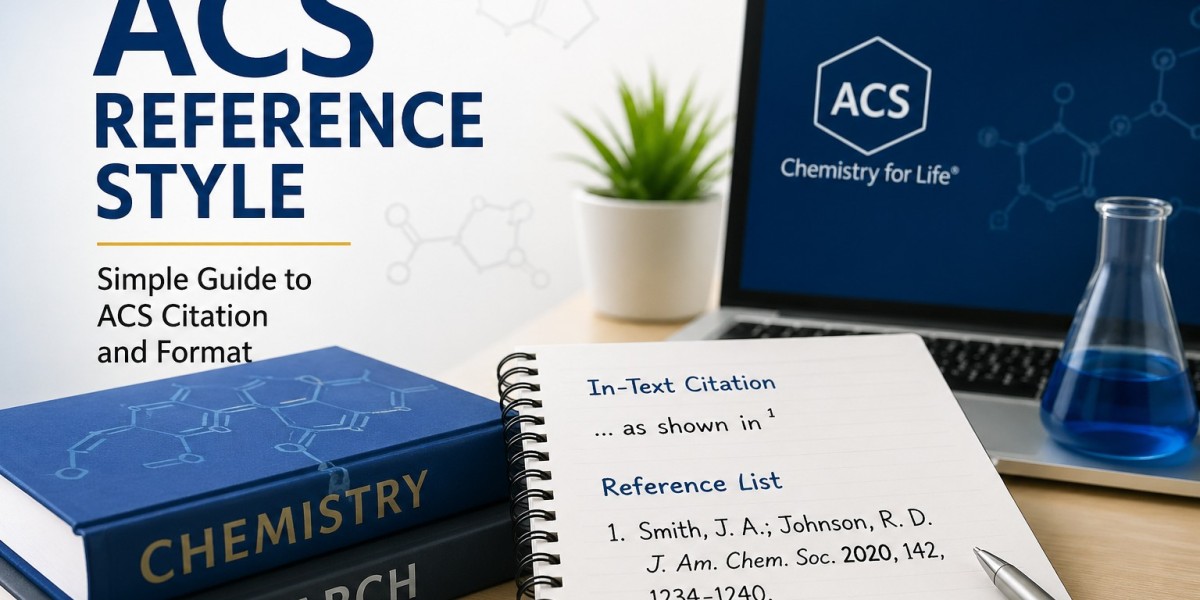
ACS reference style is a structured method used in chemistry writing to cite sources through numbered, superscript, or author-date systems, linking each in-text citation to a full reference entry so readers can verify and trace the original source easily and accurately.
That’s the core idea. You’re giving credit in a clear and organized way.
Nothing more. Nothing less.
Understanding ACS Citation Style in Daily Writing
Let’s make this simple.
When you add information from a book or article, you need to show where it came from. That’s where ACS citation comes in.
Instead of long explanations, ACS format uses short signals like numbers or names.
It’s like tagging your sources so anyone reading your work can follow along.
The Three Formats of ACS Citation
ACS style citation gives you three options. You only need one.
Superscript Style
You place a small number at the end of your sentence.
Example:
Chemical balance depends on pressure.¹
This is the cleanest format. Most students prefer it.
Numbered ACS Format
Here, the number appears in brackets.
Example:
Chemical balance depends on pressure (1).
It looks slightly heavier but works the same way.
Author-Date Format
This one includes the author name and year.
Example:
Chemical balance depends on pressure (Ahmad, 2020).
It’s less common in chemistry but still valid.
Which ACS Format Works Best?
The best ACS format is the superscript or numbered system because it keeps the text clean, avoids repetition of author names, and connects directly to the ACS reference format without interrupting the flow of scientific writing.
If you want a safe option, go with superscripts.
How ACS Citation Connects to Your References
Here’s where everything links together.
When you add a citation like (1) or ¹ in your text, that number points to a full reference at the end.
So your reader can scroll down and find:
Full author name
Title
Source
Year
Page numbers
It’s like a map. The number shows the path.
Writing ACS Reference Format Without Confusion
Let’s break this into steps you can follow anytime.
Start With the Author
Write last name first, then initials.
Example:
Hassan, A. R.
If there are multiple authors, separate them with semicolons.
Add the Title Properly
Article titles stay simple
Journal names are shortened and italic
This is where many students slip up.
Include Publication Details
Always add:
Year
Volume number
Page range
Without these, your ACS reference format looks incomplete.
Example of ACS Citation (Journal)
Hassan, A. R.; Lee, D. Study on Catalysts. J. Chem. Sci. 2022, 50, 100-110.
Example for Books
Clark, J. Basic Organic Chemistry; McGraw-Hill: New York, 2017.
Example for Online Sources
American Chemical Society. ACS Style Guide. https://www.acs.org (accessed 2024-03-10).
Mistakes That Can Ruin Your ACS Citation
Let me point out the common ones.
Switching Between Formats
Using superscript in one place and author-date in another breaks consistency.
Skipping Important Details
Leaving out the year or page numbers makes your reference weak.
Wrong Author Format
Writing full names instead of initials.
Ignoring Punctuation
ACS format depends heavily on commas, semicolons, and periods.
Miss one, and it looks off.
ACS Style Citation vs Other Styles
It helps to know how ACS stands apart.
APA uses author and year
MLA uses author and page number
ACS focuses on numbers or short references
ACS is built for science writing. It keeps things short and direct.
How to Practice ACS Citation the Smart Way
I didn’t learn ACS citation by reading rules. I learned by doing.
Here’s what worked for me:
Copy One Correct Example
Keep it as your template. Use it again and again.
Write One Reference Daily
Even one example a day builds confidence.
Check Your Work Twice
First for content, second for format.
Avoid Blind Trust in Tools
Citation tools help, but they often miss small details.
Always review manually.
When Should You Use ACS Reference Style?
You’ll need ACS reference style in:
Chemistry assignments
Lab reports
Research papers
Scientific publications
If your subject deals with chemicals or reactions, ACS format is expected.
Quick Revision Checklist for ACS Format
Before you submit, run through this:
One citation style used throughout
All in-text citations match references
Author names are correctly written
Year and pages included
Proper punctuation followed
This takes two minutes but saves marks.
A Simple Way to Think About ACS Citation
I see ACS citation like labeling boxes.
Each box has a number. That number tells you what’s inside.
Your reference list is the storage area where all details sit.
If labels are clear, finding anything becomes easy.
Final Thoughts
ACS citation style doesn’t need to feel stressful.
Once you understand how ACS reference format works, everything starts falling into place.
Focus on the structure. Keep your format consistent. Pay attention to small details.
That’s enough to handle any assignment using ACS citation style without confusion.