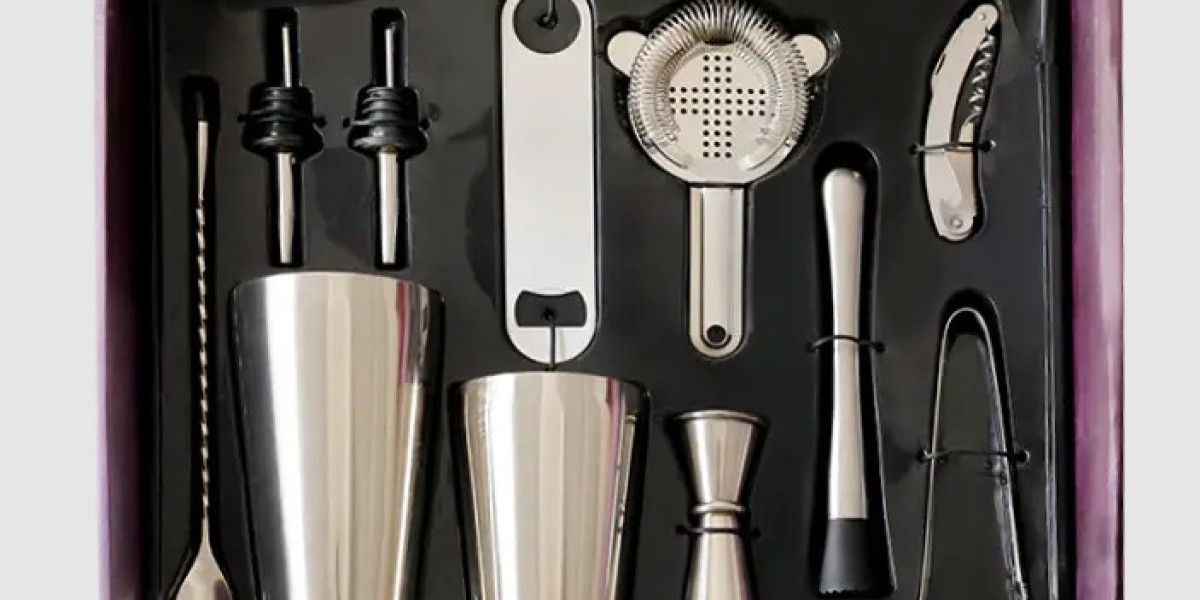

A barware kit is not only defined by its tool combination but also by the material system behind each component. Among different options, a stainless steel bartender kit has gradually become a standard reference in both retail and OEM manufacturing due to its mechanical stability and predictable processing behavior.
Material selection directly influences product lifespan. Stainless steel grades such as 304 and 201 are commonly used in barware production. 304 stainless steel offers stronger corrosion resistance, particularly in environments involving acidic liquids like citrus juice or vinegar-based mixers. In contrast, 201 stainless steel is often chosen for cost-sensitive projects, though it may show earlier surface changes under frequent washing cycles. This material differentiation allows manufacturers to adjust product positioning without changing core structural design.
In OEM production, consistency is a key requirement. A barware kit usually includes multiple components—shaker, jigger, strainer, spoon, and sometimes pourers. Even minor dimensional deviations can affect assembly compatibility, especially when kits are packaged with holders or stands. CNC stamping and deep drawing processes are often used to maintain uniformity across batches. Tolerance control within ±0.2 mm is commonly targeted for shaker lids and strainers to ensure proper sealing and fit.
Surface treatment is another factor influencing performance. Polishing levels such as mirror finish or brushed finish not only affect visual appearance but also cleaning behavior. A smoother surface reduces residue retention, making it easier to rinse after use. However, overly polished surfaces may show fingerprints more clearly, which is why some OEM buyers prefer brushed finishes for commercial distribution.
Ergonomics also plays a role in product development. The design of a stainless steel bartender kit often considers weight distribution and grip comfort. For example, a shaker typically weighs between 200–350 grams depending on wall thickness. If the weight is too low, stability during shaking may be compromised; if too high, user fatigue increases during repeated use. Balancing these factors is part of iterative prototyping in OEM projects.
Quality control processes in manufacturing go beyond visual inspection. Leak testing for shakers, mesh uniformity checks for strainers, and calibration verification for jiggers are standard procedures in many production lines. A deviation in jigger volume of more than 3–5% can lead to noticeable recipe inconsistency, which is critical for both home users and commercial bartenders.
Packaging design also contributes to perceived value. A barware kit intended for retail often includes foam inserts or molded trays to prevent movement during transport. This reduces the risk of scratches and deformation. In OEM customization, packaging is frequently adjusted according to branding requirements, including logo printing, color boxes, or gift-ready configurations.
As global demand for home bartending tools expands, manufacturers are focusing more on modular production systems. This allows different components of a stainless steel bartender kit to be mixed and matched depending on market needs. For example, European markets may prefer minimalist 3–5 piece sets, while North American buyers often request expanded kits with additional accessories.
The relationship between material engineering and user experience continues to shape product evolution. A well-designed barware kit reflects not only aesthetic choices but also controlled manufacturing precision, material selection logic, and practical usability considerations.