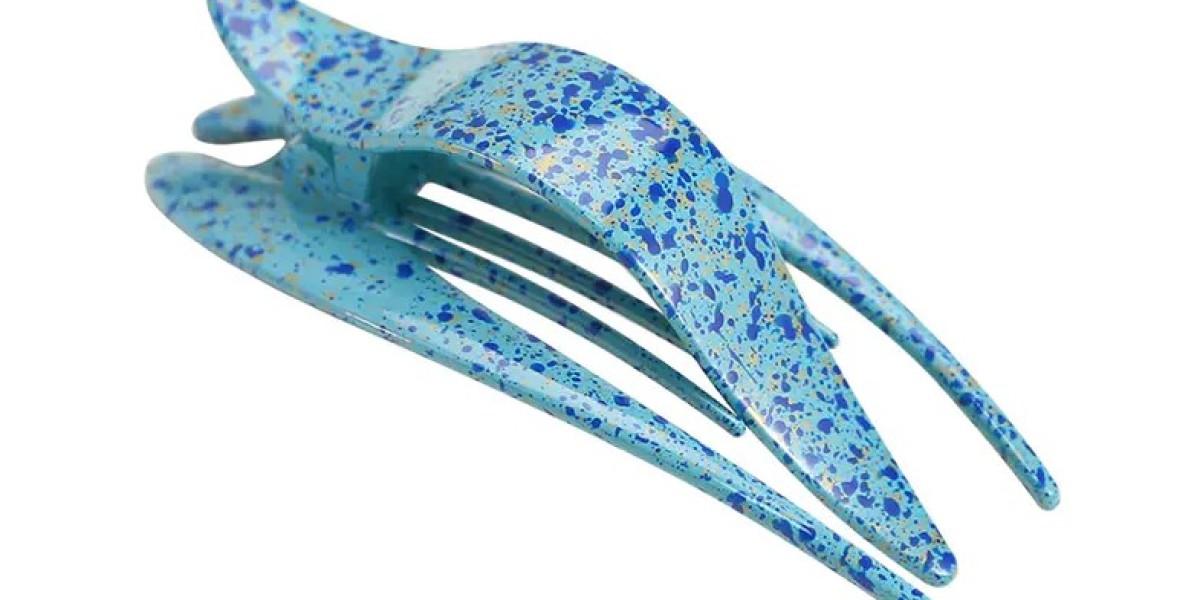

Custom Hair Claws Clips Manufacturer and Injected Plastic Hair Claw Clip production are closely tied to material performance, especially as buyers place more attention on durability and user experience. Many common issues, such as brittle clips, weak hinges, or surface scratches, can often be traced back to material selection rather than design alone. This makes material engineering a central part of product development.
Hair claw clips operate under repeated mechanical stress. Opening, closing, and holding hair tension require a balance between flexibility and strength. Achieving this balance depends largely on how materials are selected and processed during manufacturing.
Comparing common plastics used in hair claw clips
Several types of plastics are commonly used in injected hair claw clips, including ABS, polycarbonate (PC), and blends such as PC+ABS. Each material offers different properties that influence product performance.
ABS is widely used due to its ease of processing and moderate cost. It provides decent impact resistance and surface finish, making it suitable for standard designs. However, ABS may become less durable under repeated stress if not reinforced properly.
Polycarbonate offers higher impact resistance and better toughness. Clips made from PC are less likely to crack under pressure, which makes them suitable for users with thicker hair. However, PC is typically more expensive and requires stricter processing conditions.
Blended materials combine the advantages of both. For example, PC+ABS can improve strength while maintaining processing flexibility. Custom Hair Claws Clips Manufacturer facilities often choose material blends to achieve a balance between cost and performance.
Material flow and injection molding behavior
Material behavior during injection molding also affects product quality. Different plastics have varying flow characteristics, which influence how evenly the mold is filled.
If the material flow is uneven, it can create weak points within the structure, especially around thin sections such as clip teeth or hinge joints. To address this, manufacturers adjust injection speed, pressure, and temperature to ensure proper mold filling.
Cooling behavior is equally important. Uneven cooling can lead to internal stress, which may not be visible immediately but can cause cracks after repeated use. Controlled cooling systems help maintain structural integrity and reduce deformation.
Surface finish and user perception
Material choice also influences the final appearance of the product. Smooth surfaces, consistent color distribution, and resistance to scratches all contribute to how users perceive quality.
Injected plastic hair claw clips can be finished using techniques such as matte texturing, polishing, or coating. Each method interacts differently with the base material. For instance, ABS is easier to texture, while PC provides a clearer, glossier finish.
Surface durability matters in everyday use. Clips are often carried in bags or exposed to friction, which can lead to visible wear. Materials with higher abrasion resistance help maintain appearance over time.
Balancing flexibility and rigidity
One of the key design challenges is achieving the right balance between flexibility and rigidity. A clip must open easily while still providing enough force to hold hair securely.
This balance is influenced by both material properties and structural design. Flexible materials reduce the risk of breakage but may weaken grip strength. More rigid materials improve holding force but increase the risk of cracking.
Manufacturers often test different material combinations and structural adjustments to find the optimal balance. This iterative process ensures that the final product performs reliably under various conditions.