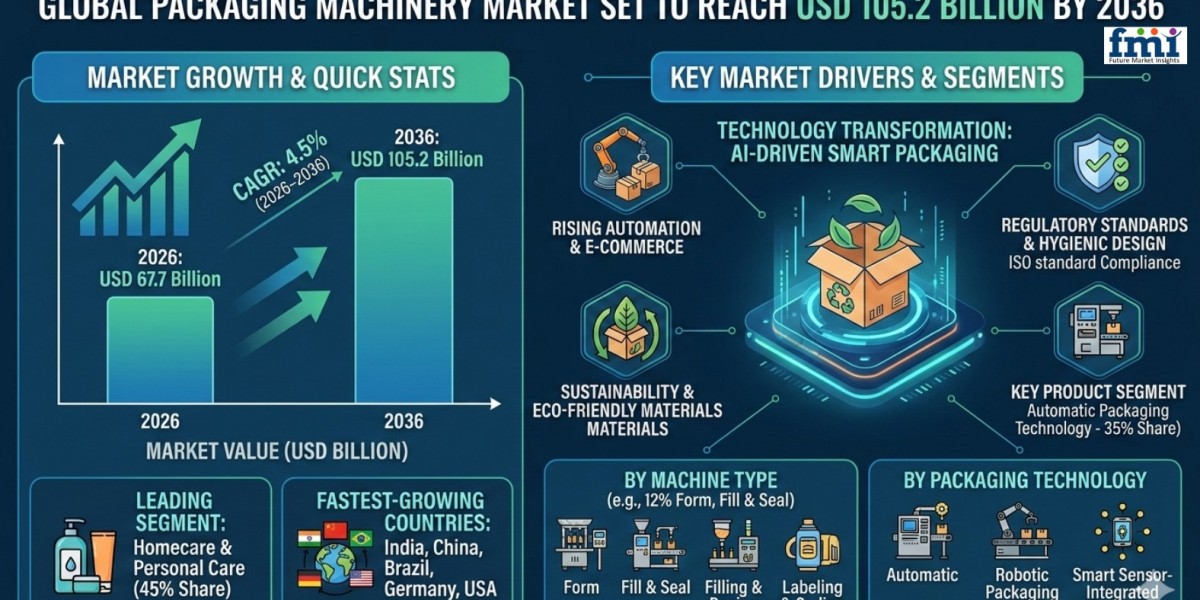

The global Packaging Machinery Market is experiencing steady expansion as manufacturers across food, pharmaceutical, and consumer goods industries invest heavily in automated production infrastructure. The market is valued at USD 67.7 billion in 2026 and is projected to reach USD 105.2 billion by 2036, expanding at a CAGR of 4.5% during the forecast period. The rising complexity of packaging requirements, particularly across pharmaceutical and food processing sectors, is driving demand for highly advanced machinery capable of handling diverse packaging formats with improved operational efficiency.
Quick Stats: Packaging Machinery Market (2026–2036)
• Market Value (2026): USD 67.7 Billion
• Forecast Value (2036): USD 105.2 Billion
• CAGR: 4.5%
• Leading Segment: Homecare & Personal Care End-Use (45% share)
• Key Product Segment: Automatic Packaging Technology (35% share)
• Fastest-Growing Countries: India, China, Brazil, Germany, United States
• Key Growth Driver: Rising demand for automated, AI-enabled packaging production lines
Structural Growth Driver: Expansion of Automated Manufacturing and E-Commerce Packaging
The rapid expansion of global manufacturing output and e-commerce logistics has fundamentally increased demand for high-speed, automated packaging equipment. Companies across food processing, pharmaceuticals, and consumer goods manufacturing are deploying advanced machinery to accommodate large-volume production while ensuring packaging precision, product protection, and compliance with safety regulations.
Regulatory developments are also accelerating the adoption of modern packaging machinery. Updated safety and hygiene standards such as ISO 14159:2024 require improved machine design that prevents contamination and enables efficient cleaning processes in food and pharmaceutical production facilities. These standards compel machinery manufacturers to redesign frame structures, improve material contact surfaces, and integrate sanitation-friendly components.
Environmental pressures are also encouraging machinery upgrades, particularly as brands transition toward recyclable and biodegradable packaging materials. Equipment capable of handling thinner, eco-friendly materials while maintaining structural integrity is becoming a priority across global packaging operations.
Key regulatory and industry frameworks influencing the market include:
• International hygienic design standards for food-contact machinery
• Recycling and circular economy packaging regulations
• Certification requirements for pharmaceutical manufacturing equipment
• Sustainability guidelines for packaging materials
• Manufacturing safety and contamination-control standards
From Compliance to Industry Transformation
The packaging machinery sector is shifting from compliance-focused equipment manufacturing toward a technology-driven integrated solutions industry. Machinery manufacturers are increasingly providing complete packaging line systems that integrate filling, sealing, labeling, inspection, and palletizing operations into a single automated platform.
Companies are also adopting new service-based business models. Instead of simply selling machines, equipment suppliers now offer performance-based contracts, predictive maintenance services, and real-time monitoring systems designed to ensure high operational efficiency. AI-enabled analytics platforms allow operators to monitor machine performance continuously, reducing downtime and maximizing productivity.
Packaging machinery manufacturers are prioritizing:
• Sustainability performance in packaging operations
• Cost-efficient automation and high-speed throughput
• Recyclable and eco-compatible packaging processes
• Operational compatibility with diverse packaging formats
Technology Transformation: AI-Driven Smart Packaging Machinery
Technological innovation is reshaping the packaging machinery industry as manufacturers adopt advanced automation and intelligent production monitoring systems. Modern packaging equipment is increasingly equipped with sensors, AI-driven analytics, and digital twin technologies that simulate production lines and predict operational disruptions.
Predictive maintenance powered by machine learning algorithms allows manufacturers to identify potential mechanical failures before they cause downtime. These capabilities are particularly critical in pharmaceutical and food processing facilities where production interruptions can result in substantial financial losses.
Key innovation areas driving technological progress include:
• Advanced material compatibility development
• Automation integration across packaging lines
• Lightweight packaging design support
• Sustainable material processing engineering
• Manufacturing efficiency optimization technologies
Segment Highlights
By Machine Type
• Form, Fill & Seal Machines (12% share): Integrated packaging systems that automate the entire packaging process from material forming to sealing, significantly increasing manufacturing throughput.
• Filling & Dosing Equipment: Widely used in pharmaceutical and food industries to ensure precise product measurement and contamination control.
• Labeling and Coding Machines: Critical for product traceability, regulatory compliance, and branding across consumer goods industries.
• Cartoning Machines: Used extensively for secondary packaging in pharmaceuticals and consumer products.
• Palletizing and Depalletizing Systems: Enable high-speed warehouse automation and logistics efficiency.
By Packaging Technology
• Automatic Packaging Systems (35% share): High-speed automated equipment capable of processing large packaging volumes with minimal human intervention.
• Semi-Automatic Packaging Systems: Offer a balance between automation and manual flexibility for mid-scale production facilities.
• Manual Packaging Systems: Typically used by small manufacturers with lower production requirements.
• Robotic Packaging Lines: Increasingly adopted for precision handling and collaborative automation.
• Smart Sensor-Integrated Systems: Enable real-time monitoring and quality inspection.
Regional Outlook: Emerging Economies Drive Adoption
Global demand for packaging machinery is expanding across both mature and emerging economies. Developed regions continue to invest in automation upgrades and compliance-driven machinery replacement, while emerging markets are witnessing new manufacturing infrastructure development across food processing, pharmaceutical production, and consumer goods sectors.
• India (5.7% CAGR): Rapid growth in food processing, pharmaceutical manufacturing, and e-commerce logistics is driving large-scale machinery investments.
• China (5.6% CAGR): The country’s massive manufacturing ecosystem and export-oriented production industries sustain strong packaging automation demand.
• Brazil (4.3% CAGR): Expanding consumer goods production and agricultural processing sectors support machinery adoption.
• Germany (4.1% CAGR): A global hub for packaging machinery manufacturing and innovation with strong export activity.
• United States (3.4% CAGR): Market growth is supported by e-commerce expansion and automation upgrades across food and pharmaceutical industries.
Risk Landscape: Market Constraints and Challenges
Despite steady growth, the packaging machinery market faces several structural challenges that can impact capital investment decisions and supply chain efficiency.
Key risks include:
• Raw material price volatility
• Supply chain disruptions affecting machinery components
• Infrastructure limitations in emerging markets
• Regulatory complexity across international markets
• High manufacturing and installation costs
Competitive Landscape: Key Market Players
The global packaging machinery market is highly competitive and technology-driven, with manufacturers focusing on innovation, automation, and strategic acquisitions to expand their global presence. Leading companies are investing heavily in AI-enabled machinery, modular production lines, and sustainable packaging technologies to meet evolving industry requirements.
Top key companies include:
• MULTIVAC Sepp Haggenmueller GmbH & Co. KG
• OPTIMA Packaging Group GmbH
• Tetra Pak International S.A.
• Syntegon Technology GmbH
• I.M.A. Industria Macchine Automatiche S.p.A.
Other notable companies include Krones AG, ProMach, GEA Group, Sacmi, Bradman Lake Ltd., SIG Combibloc Group Ltd., and Barry-Wehmiller Companies, Inc.
Outlook: Future of the Packaging Machinery Market
The future of the packaging machinery industry will be shaped by automation, sustainability, and digital manufacturing integration. As manufacturers across food, pharmaceutical, and consumer goods sectors continue modernizing production facilities, demand for intelligent, flexible packaging lines will increase steadily.
Future growth drivers include:
• Advanced AI-enabled packaging technologies
• Sustainable packaging initiatives
• Manufacturing capacity expansion in emerging markets
• Supply chain digitization and automation
For an in-depth analysis of evolving industry trends and to access the complete strategic outlook for the market through 2036, visit the official report page at: https://www.futuremarketinsights.com/reports/packaging-machinery-market