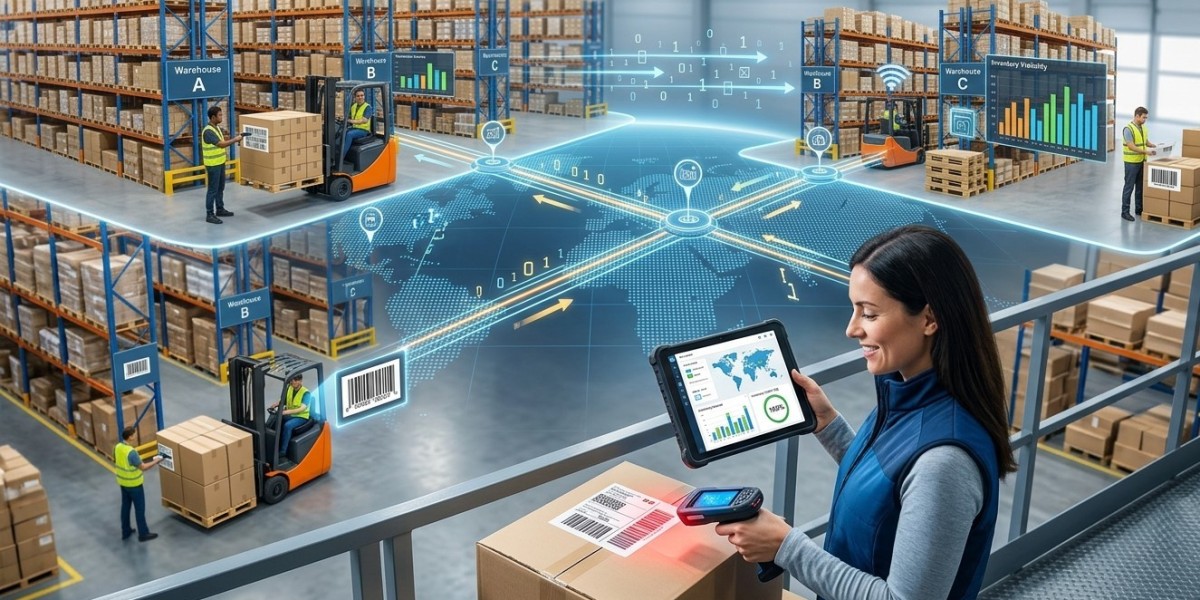

Managing inventory across multiple warehouses can become increasingly complex as a business grows. Different locations may handle thousands of products, frequent stock movements, incoming shipments, transfers, returns, and customer orders every day. Without an accurate way to track these activities, businesses can struggle to determine where inventory is located, how much stock is available, and when replenishment is required.
Modern barcode solutions provide a practical way to improve inventory visibility across multiple warehouses. By combining barcode labels, scanners, mobile devices, software, and printing systems, businesses can capture inventory information quickly and connect warehouse activities with centralized business systems.
Pointus Solutions helps businesses implement technology-driven identification and inventory workflows that support better operational control. Organizations can Shop Barcode equipment and related Printing Products to build barcode-based processes that make inventory tracking faster, more consistent, and easier to manage across different warehouse locations.
What Is Inventory Visibility?
Inventory visibility refers to the ability to know what products a business has, where those products are located, and how inventory is moving through the supply chain.
For a company operating one warehouse, inventory visibility is already important. For businesses managing multiple warehouses, it becomes even more critical because stock is distributed across several locations.
Effective inventory visibility allows businesses to answer questions such as:
- How much inventory is currently available?
- Which warehouse has a particular product?
- What products are running low?
- Which items have been received but not yet put away?
- Where are customer orders being picked?
- How much stock has been transferred between warehouses?
- Which products are reserved for pending orders?
- What inventory is damaged, returned, or awaiting inspection?
Barcode technology helps answer these questions by creating a consistent identification system for products, locations, storage areas, and transactions.
Why Inventory Visibility Is Challenging Across Multiple Warehouses
As the number of warehouse locations increases, inventory management becomes more difficult. Each warehouse may have different employees, storage layouts, product volumes, and operating procedures.
Manual inventory processes can create several challenges.
Inconsistent Data
When warehouse employees enter product information manually, different locations may record information in different ways. This can make it difficult to combine data into a single reliable inventory view.
Delayed Updates
If inventory transactions are recorded later rather than at the point of activity, the central system may not reflect the actual stock position.
Stock Transfer Problems
Products frequently move between warehouses. Without accurate scanning and transfer records, businesses may have difficulty tracking inventory while it is moving between locations.
Picking and Receiving Errors
Incorrect product identification during receiving or picking can cause inventory quantities to become inaccurate.
Limited Real-Time Information
Managers need timely information to make decisions about purchasing, replenishment, fulfillment, and warehouse capacity. Delayed information can make those decisions more difficult.
Barcode solutions address many of these issues by automating product identification and data capture.
How Barcode Solutions Improve Multi-Warehouse Inventory Visibility
A barcode system creates a digital connection between physical inventory and business software. Each product or inventory unit receives a unique barcode that can be scanned whenever an important inventory activity occurs.
Here are several ways barcode technology can improve visibility across multiple warehouses.
1. Creates Consistent Product Identification
A standardized barcode system ensures that the same products can be identified consistently across every warehouse.
Instead of relying on product names or manually entered descriptions, employees can scan a barcode to retrieve the correct product information from the inventory system.
This reduces confusion caused by:
- Similar product names
- Different product descriptions
- Manual typing errors
- Incorrect product codes
- Duplicate inventory records
A standardized identification system is particularly useful when several warehouses share inventory or serve different geographic markets.
2. Provides More Accurate Stock Counts
Barcode scanners allow employees to capture inventory quantities quickly during receiving, picking, put-away, transfers, and stock counts.
When a product is scanned, the system can automatically record the transaction and update the inventory database.
This reduces the dependence on handwritten records and manual spreadsheet updates.
Accurate stock counts help businesses understand actual inventory levels at each warehouse and across the entire organization.
3. Tracks Inventory by Warehouse Location
Barcode systems can identify more than products. Businesses can also use barcodes for warehouses, aisles, shelves, bins, racks, and storage zones.
For example, a warehouse can assign barcode identifiers to:
- Warehouse A
- Receiving Area
- Aisle 5
- Rack 12
- Shelf B
- Bin 24
When employees scan both the product and location, the system can maintain a more detailed record of where inventory is stored.
This makes it easier to locate products and reduces time spent searching for stock.
4. Improves Warehouse-to-Warehouse Transfers
Inventory transfers are common in multi-location operations. A product may move from one warehouse to another because of demand, replenishment requirements, or customer orders.
Barcode scanning can record the transfer at each stage.
A typical workflow may include:
- Scan the product at the source warehouse.
- Create the transfer transaction.
- Scan the shipment before dispatch.
- Record the inventory as in transit.
- Scan the products when they arrive.
- Confirm receipt at the destination warehouse.
- Update the destination inventory.
This creates a traceable record of the movement and helps reduce discrepancies between warehouse locations.
5. Supports Faster Receiving Processes
Receiving is one of the most important points for inventory accuracy.
When products arrive, employees can scan the barcodes on cartons, pallets, or individual products. The system can compare scanned information against purchase orders or expected shipments.
This can help employees identify:
- Correct products
- Incorrect products
- Missing quantities
- Unexpected items
- Damaged shipments
Faster and more accurate receiving means inventory becomes visible in the system sooner.
6. Improves Picking and Packing Accuracy
Inventory visibility is not only about knowing how much stock exists. Businesses also need to know whether the correct inventory is being used to fulfill orders.
Barcode scanning can guide warehouse workers through the picking process. Employees can scan the product and location to confirm that they are selecting the correct item.
During packing, another scan can verify the products before shipment.
This creates additional checkpoints that can reduce product selection errors and improve order accuracy.
7. Enables Better Cycle Counting
Traditional physical inventory counts can take significant time, especially across multiple warehouses.
Barcode systems support cycle counting, allowing businesses to count selected products or storage locations regularly instead of waiting for a large annual inventory count.
Employees can scan inventory and locations during the counting process, while the software records the results.
Businesses can use cycle counting to focus more frequently on:
- High-value products
- Fast-moving inventory
- Frequently picked items
- Products with previous discrepancies
- Critical components
This can help maintain inventory accuracy without unnecessarily interrupting warehouse operations.
8. Connects Warehouses to Centralized Inventory Systems
One of the biggest advantages of barcode technology is its ability to connect physical warehouse activities with inventory management software.
Depending on the business system, barcode scanners can integrate with ERP, WMS, inventory management, retail, or order management platforms.
When transactions are captured electronically, management teams can gain a consolidated view of inventory across different warehouse locations.
Instead of asking each warehouse to provide separate stock reports, decision-makers can use centralized information to understand inventory distribution.
9. Helps Prevent Overstocking and Stockouts
Poor inventory visibility can lead to two common problems: holding too much inventory or running out of important products.
With better visibility, businesses can identify where stock is available and where demand is highest.
For example, if Warehouse A has excess inventory while Warehouse B is approaching a stockout, management may be able to transfer products before placing a new purchase order.
This can improve inventory utilization and help businesses make more informed replenishment decisions.
10. Improves Inventory Traceability
Barcode systems create transaction records whenever inventory is scanned.
This can provide useful information about the movement of products throughout the warehouse network.
Depending on the system configuration, businesses may be able to trace:
- When inventory was received
- Where it was stored
- When it was picked
- When it was transferred
- When it was packed
- When it was shipped
- When it was returned
Traceability becomes especially important for businesses handling regulated, serialized, batch-controlled, or time-sensitive products.
Key Components of a Multi-Warehouse Barcode Solution
A successful barcode inventory system usually combines several technologies rather than relying on scanners alone.
Barcode Labels
Labels provide the identification attached to products, cartons, pallets, shelves, bins, and other assets.
Barcode Printers
Barcode printers produce durable, readable labels in the required sizes and formats. Businesses may select direct thermal or thermal transfer printing depending on their application.
Barcode Scanners
Scanners capture product information quickly and accurately. Handheld, cordless, fixed, and industrial scanners can be used for different warehouse environments.
Mobile Computers
Mobile computers combine scanning capabilities with screens and software, allowing warehouse workers to access inventory information while moving through the facility.
Warehouse Management Software
A WMS or integrated inventory system stores transaction information and provides visibility into inventory quantities, locations, movements, and warehouse activities.
Best Practices for Implementing Barcode Technology Across Multiple Warehouses
Technology alone does not guarantee accurate inventory information. Businesses should also establish standardized processes.
Standardize Barcode Formats
Use consistent product identification and barcode standards across all warehouse locations.
Label Locations Clearly
Assign barcode labels to racks, shelves, bins, zones, and other storage areas so employees can identify inventory locations quickly.
Train Employees
Employees should understand when and how to scan products, locations, transfers, and transactions.
Integrate With Business Software
Connect barcode scanning with the company's inventory, ERP, WMS, or order management system whenever possible.
Monitor Data Quality
Regularly review inventory discrepancies, duplicate product records, unreadable labels, and scanning failures.
Maintain Equipment
Clean scanners, inspect printers, replace damaged labels, and maintain devices to keep barcode operations reliable.
Measuring the Impact of Barcode Inventory Visibility
Businesses can evaluate their barcode implementation using operational metrics such as:
| Metric | Potential Benefit |
|---|---|
| Inventory accuracy | Better understanding of actual stock |
| Receiving time | Faster availability of incoming inventory |
| Picking accuracy | Fewer product selection errors |
| Stockout frequency | Better replenishment planning |
| Transfer accuracy | Improved warehouse-to-warehouse tracking |
| Cycle count time | Faster inventory verification |
| Order accuracy | More reliable fulfillment |
| Inventory search time | Faster product location |
Monitoring these metrics can help businesses identify areas where barcode automation is delivering measurable improvements and where processes may need further optimization.
Conclusion
Managing inventory across multiple warehouses requires accurate identification, timely data capture, and reliable communication between physical operations and business systems. Barcode solutions provide a practical foundation for achieving these goals by making inventory easier to identify, locate, count, transfer, and trace.
From receiving and put-away to picking, packing, stock transfers, and cycle counting, barcode scanning can create consistent inventory records across multiple facilities. When barcode printers, labels, scanners, mobile computers, and inventory software work together, businesses can develop a more connected and transparent warehouse operation.
For organizations looking to modernize their inventory processes, Pointus Solutions can support technology-driven identification and tracking workflows. Businesses can Shop Barcode equipment and explore suitable Printing Products to build scalable barcode solutions that improve inventory visibility and support more efficient warehouse management.
With the right combination of technology, standardized processes, and employee training, barcode solutions can help businesses maintain better control over inventory as their warehouse network continues to grow.