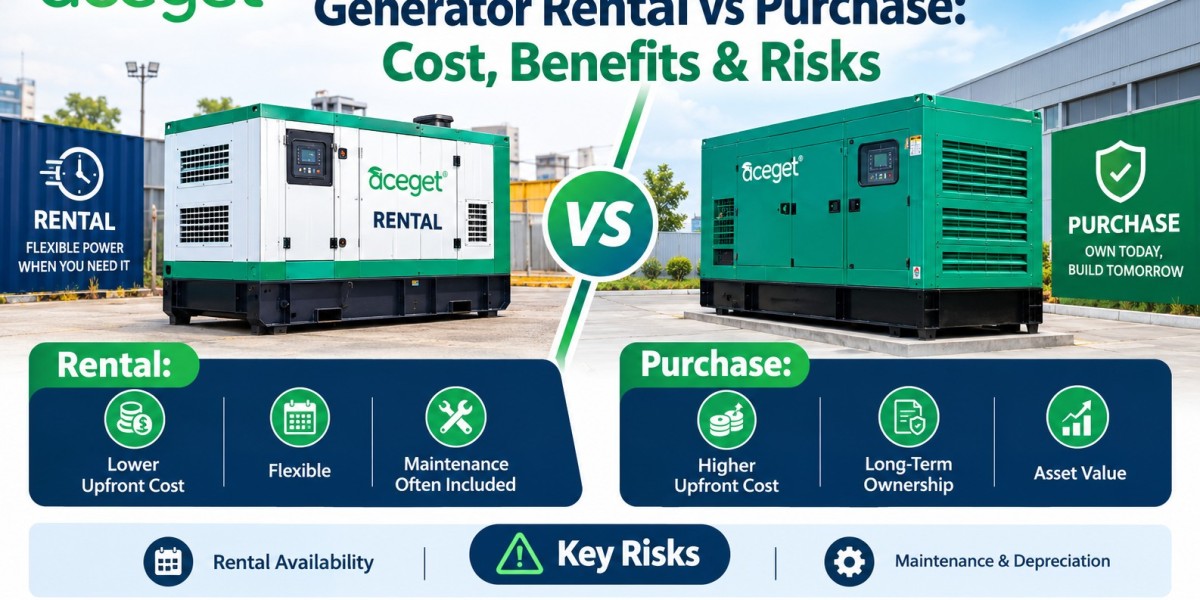

A reliable generator can provide essential backup power for businesses, construction sites, events, factories, offices, and other facilities. However, one important question comes before getting a generator: Should you rent a generator or purchase one?
Both options have their own advantages and limitations. Generator rental can be useful for short-term or temporary power requirements, while purchasing a generator may make more sense for businesses that need regular backup power for many years.
Understanding the cost, maintenance responsibilities, flexibility, and long-term value can help you make a better decision.
What Is the Difference Between Generator Rental and Purchase?
With generator rental, you pay a rental fee to use a generator for a specific period. Depending on the agreement, the rental provider may handle transportation, installation, servicing, maintenance, and breakdown support.
When you purchase a generator, the equipment becomes your responsibility. You pay the initial purchase price and then manage fuel, servicing, repairs, maintenance, and other operating expenses.
The right choice depends mainly on how frequently you need the generator and how long you expect to use it.
What Are the Benefits of Generator Rental?
Generator rental can be a practical solution when your power requirement is temporary.
1. Lower Initial Investment
Renting a generator usually requires less upfront investment than purchasing one. Instead of paying the full equipment cost, you pay according to the rental agreement.
This can be helpful for businesses that need backup power without making a large capital investment.
2. Suitable for Temporary Projects
Generator rental is particularly useful for:
Construction projects
Outdoor events
Temporary offices
Emergency power requirements
Seasonal operations
Short-term industrial projects
Testing and commissioning
Once the project is complete, the generator can be returned to the rental provider.
3. Maintenance May Be Easier
Depending on the rental agreement, routine maintenance and breakdown support may be handled by the rental company. This can reduce the maintenance responsibilities of the customer.
However, always check the rental contract to understand exactly what services are included.
4. Flexible Generator Selection
Rental companies may offer generators with different power capacities. This allows you to select equipment according to your temporary power requirement instead of purchasing a generator that may not be needed later.
What Are the Benefits of Purchasing a Generator?
Buying a generator can be more suitable when backup power is required regularly for a long period.
1. Long-Term Ownership
When you purchase a generator, you own the equipment. You can use it whenever required without depending on generator availability from a rental provider.
2. Better for Regular Usage
Businesses that operate generators frequently may find ownership more convenient. A purchased generator can remain installed and ready for use whenever there is a power interruption.
3. Greater Control
With ownership, you have more control over:
Maintenance schedules
Installation
Generator operation
Servicing
Replacement parts
Operating procedures
You can also select the generator based specifically on your site's long-term requirements.
4. Potential Long-Term Value
Although purchasing requires a higher initial investment, the equipment remains an asset. If maintained properly, a generator can provide useful service for many years.
Generator Rental vs Buying Cost Comparison
A generator rental vs buying cost comparison should consider more than just the initial price.
For rental, consider:
Rental charges
Transportation
Installation
Fuel
Operator charges, if applicable
Maintenance charges
Breakdown support
Rental duration
For purchase, consider:
Generator purchase price
Installation
Fuel
Maintenance
Spare parts
Repairs
Insurance or other ownership expenses
Depreciation
Long-term operating costs
A rental generator may appear cheaper initially, but long rental periods can increase the total cost. Similarly, purchasing may involve a higher upfront expense but could provide better value when the generator is used regularly for many years.
When Is Generator Rental a Better Option?
Rental is generally worth considering when the generator is needed for a limited period.
For example, suppose a construction company needs backup power for a six-month project. Purchasing a generator may involve significant capital expenditure, installation, maintenance, and eventual relocation. Renting may provide greater flexibility for this temporary requirement.
Rental can also be useful when you need additional capacity temporarily or require emergency power while your existing generator is being repaired.
When Is Purchasing a Generator Better?
Purchase may be more suitable when:
You need backup power throughout the year
The generator will operate regularly
Your facility has a long-term power requirement
You want complete control over the equipment
You have suitable space for permanent installation
You are prepared to manage maintenance
Long-term ownership provides better financial value
For factories, hospitals, commercial buildings, data centers, and other facilities with ongoing backup requirements, ownership may be worth considering.
How to Choose Between Generator Rental and Purchase?
Knowing how to choose between generator rental and purchase becomes easier when you evaluate a few important factors.
1. Determine the Usage Period
Start by estimating how long you need the generator.
Short-term requirements often favor rental, while long-term requirements may favor purchase.
2. Calculate Your Power Requirement
Determine the required generator capacity based on your connected and starting loads. Choosing the wrong capacity can result in poor performance or unnecessary fuel consumption.
3. Compare Total Costs
Do not compare only the rental fee with the purchase price. Calculate the expected total cost over the entire period you plan to use the generator.
4. Consider Maintenance
Ask who will handle preventive maintenance, repairs, spare parts, and emergency breakdowns.
5. Check Installation Requirements
Permanent generator installation may involve additional work such as electrical connections, exhaust arrangements, ventilation, foundation, acoustic treatment, and safety considerations.
6. Consider Future Requirements
Your current power requirement may not remain the same. If your business is expanding, consider whether the generator will still meet your future requirements.
What About Emission Control and RECD?
Emission control should also be considered when evaluating diesel generators, especially for applicable existing DG sets.
An RECD for DG set can be part of an emission-control strategy for certain in-use generator applications where applicable requirements call for a certified retrofit solution. The suitability of an RECD depends on the generator, engine family, applicable requirements, and technical compatibility.
Therefore, emission-control requirements should be considered alongside the generator's purchase or rental decision rather than treated as a completely separate issue.
Common Mistakes When Choosing Between Rental and Purchase
Some common mistakes include:
Comparing only the upfront price
Ignoring fuel costs
Not checking maintenance responsibilities
Choosing an incorrect generator capacity
Ignoring installation costs
Not reviewing rental contract terms
Overlooking long-term operating requirements
Failing to consider applicable emission requirements
A complete cost and requirement analysis can help prevent these mistakes.
Rental vs Purchase: Quick Comparison
Factor | Generator Rental | Generator Purchase |
Initial investment | Lower | Higher |
Ownership | No | Yes |
Short-term use | Excellent option | May not be economical |
Long-term use | Can become expensive | Often more suitable |
Maintenance | May be included | Owner's responsibility |
Flexibility | High | Moderate |
Equipment availability | Depends on rental provider | Always available after installation |
Asset value | No ownership asset | Owned equipment |
FAQs
Is it cheaper to rent or buy a generator?
It depends on how long and how frequently the generator will be used. Rental can be economical for short-term requirements, while purchasing may provide better value for long-term use.
Is generator rental good for construction projects?
Yes. Generator rental can be useful for construction sites because power requirements may be temporary and can change as the project progresses.
What should I include in a generator rental cost comparison?
Consider rental charges, fuel, transportation, installation, maintenance, operator costs, breakdown support, and the total rental period.
How do I choose between generator rental and purchase?
Consider your usage duration, power requirement, total cost, maintenance responsibilities, installation needs, and future power requirements before deciding.
Does purchasing a generator include maintenance?
Normally, maintenance is the owner's responsibility unless a separate maintenance agreement or AMC is purchased.
Can RECD be used with a rented or purchased DG set?
RECD applicability depends on the specific DG set, engine family, applicable requirements, and certified technical compatibility. It should be evaluated before installation rather than assumed to apply to every generator.
Conclusion
Choosing between generator rental and purchase depends on your power requirements, usage period, budget, maintenance capability, and long-term plans.
Rental can be a flexible solution for temporary projects, emergency requirements, and short-term power needs. Purchasing may provide better long-term value when a generator is required regularly for several years.
Before making a decision, compare the complete cost of both options and carefully review maintenance, installation, fuel, breakdown support, and emission-control requirements.
For a detailed guide on this topic, you can also refer to Generator Rental vs Purchase: Making the Right Call:
https://aceget.in/blog/generator-rental-vs-purchase-making-the-right-call/