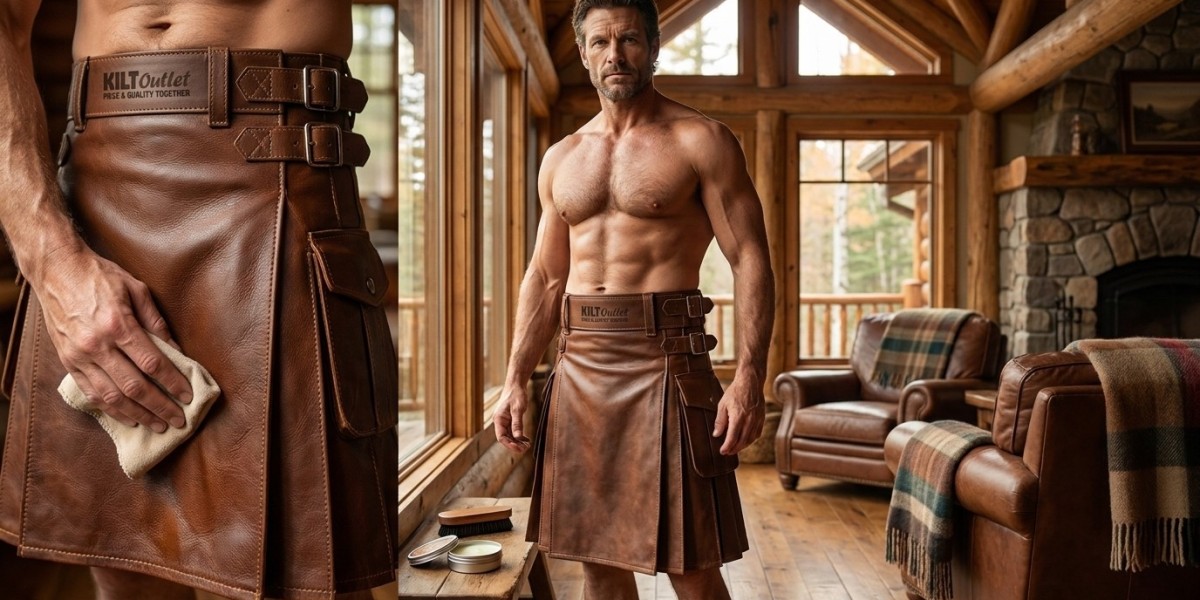

Cheap leather kilts arrive stiff as cardboard, smell like chemicals, and crack across the pleats within a season. You paid real money and now the thing hangs in the closet. The problem is almost never the style. It is the hide, the weight, and the fit. Here is how to get all three right.
Real Leather Versus Bonded
Full-grain and top-grain leather age well. They soften with wear, take on a patina, and hold pleats once broken in.
Bonded leather is ground scrap glued to a backing. It looks convincing in photos and flakes apart at the fold lines, which on a kilt means the pleats.
Ask what hide the maker uses. Cowhide gives durability and structure. Lambskin gives softness and drape at the cost of abrasion resistance. Buffalo sits in between with a heavier grain.
Suede is a finish, not a lower grade, but it stains easily and needs more care than smooth leather.
Weight and Drape
Leather weight decides how the kilt hangs. Heavier hides hold a strong, architectural pleat and swing less when you walk.
Lighter hides move more and feel closer to fabric. They suit warm weather and long days on your feet.
Pick up the garment if you can. A leather kilt should feel substantial without pulling on your hips when you stand.
Consider the pleats specifically. Some makers cut real folded pleats. Others stitch flat panels to imitate them. Folded pleats move properly. Panels do not.
Hardware and Construction
Straps and buckles carry the entire weight, so they take the most stress. Look for reinforced anchor points with stitching, not just rivets.
Solid brass and stainless hardware survives weather and years of use. Painted zinc chips and then rusts.
Check the stitching along the apron edge. Even, tight stitching in a heavy thread signals a maker who finished the piece properly.
A quality Mens leather kilt uses lined or edge-finished apron borders rather than raw-cut edges that stretch and curl over time.
Getting the Size Right
Measure your natural waist where you would wear a belt, then your hips at the widest point. Leather has almost no stretch, so precision matters more here than with cotton.
Do not order by jeans size. Jeans sizing runs small against true waist measurement, and a tight leather kilt has nowhere to give.
For length, measure from the waist to the middle of the knee. Most men look best with the hem at or just above the kneecap.
If you sit between sizes, size up. Straps take in a loose waist. A tight leather waistband stays tight forever.
Breaking It In
New leather feels stiff. That is normal, and it changes with wear rather than with any shortcut.
Wear it for short stretches at first. A few hours at a time lets the hide learn your shape without rubbing you raw.
Work the pleats gently with your hands. Opening and closing the folds a few times helps them settle into their natural line.
Skip the internet tricks involving water, heat, or oven drying. They damage the finish and stiffen the hide permanently.
What to Wear With It
Boots anchor the look. Engineer boots, combat boots, or heavy work boots all sit right against leather.
Keep the top simple. A plain tee, a fitted henley, or a dark button-down lets the kilt do the work. Loud graphics fight it.
Match your leathers loosely rather than exactly. A black kilt with brown boots looks intentional. Trying to match two different blacks rarely works.
A wide belt through the loops finishes the waist and gives you somewhere to hang a pouch or chain.
Care That Actually Works
Never machine wash leather. Water swells the fibers, and machine agitation cracks the finish.
Wipe dust off with a slightly damp cloth and let it air dry away from heat.
Condition once or twice a year with a leather conditioner made for garments. Apply thinly, work it in, and buff off the excess.
Hang it on a wide hanger or a kilt hanger, never folded. Folds become permanent creases in leather.
If it gets soaked, blot it, hang it, and let it dry slowly at room temperature. A radiator or hair dryer will stiffen and crack it.
Where a Leather Kilt Works
Motorcycle rallies and biker events are the natural home. The wind resistance and durability both make sense there.
Concerts, festivals, and club nights suit it well, especially in darker finishes.
Renaissance fairs and themed events welcome it, though check the period expectations if the event runs strict.
Everyday wear works if you want it to. Pair it with plain clothing and boots and it reads as a garment rather than a costume.
Frequently Asked Questions
Is a leather kilt hot to wear?
It runs warmer than cotton in high summer but stays cooler than trousers because air still moves underneath.
How long does a leather kilt last?
Genuine full-grain or top-grain leather with quality hardware lasts many years with basic conditioning and proper hanging.
Can you get a leather kilt with pockets?
Yes. Many makers add cargo pockets, and custom makers will fit them to your specification before cutting.
What do you wear underneath?
Fitted shorts are the practical choice, especially in warm weather, since leather sits against the skin differently than cotton.