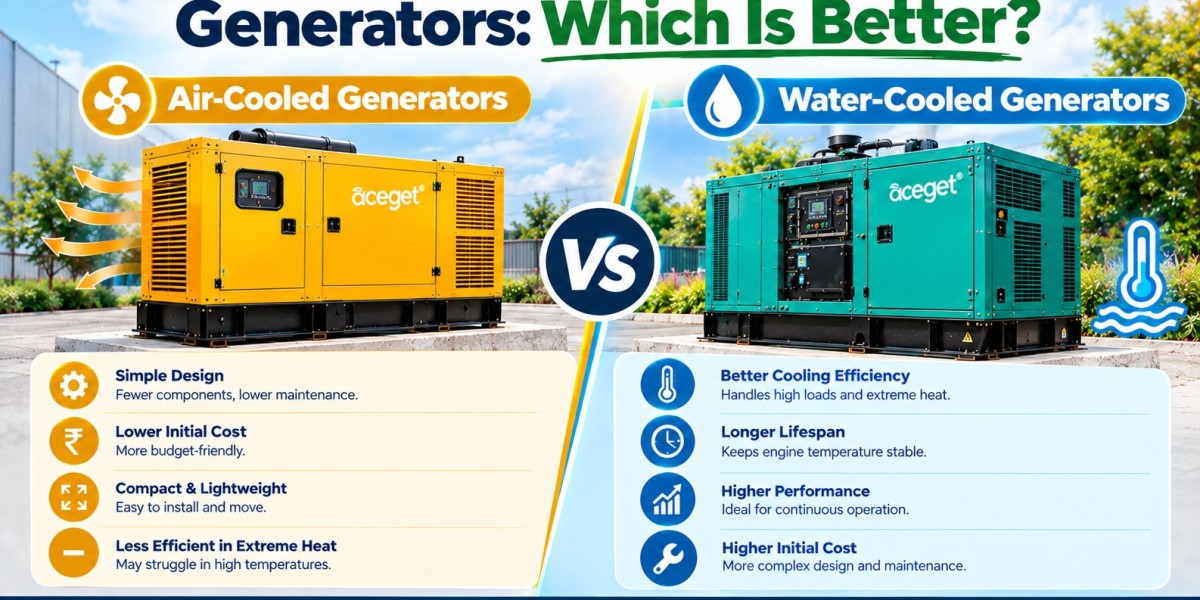

Choosing the right generator depends on several factors, including power requirement, operating conditions, maintenance needs, and budget. One important factor is the type of engine cooling system used by the generator.
When comparing an air-cooled vs water-cooled generator, the main difference is how the engine removes excess heat. Air-cooled generators use airflow to cool the engine, while water-cooled generators use coolant circulating through the engine.
Understanding these differences can help you choose the right generator for home, commercial, or industrial applications.
What Is an Air-Cooled Generator?
An air-cooled generator uses air to remove heat from the engine. A fan moves air around the engine and cooling fins, helping maintain a suitable operating temperature.
Air-cooled systems are generally simpler because they do not require a radiator, water pump, or coolant circulation system.
Advantages of Air-Cooled Generators
Simple cooling system
Fewer cooling components
Easier routine maintenance
Compact and lightweight design
No coolant replacement required
Suitable for smaller power applications
Disadvantages of Air-Cooled Generators
Cooling performance depends on airflow and ambient temperature
May be less suitable for very high loads
Engine temperature can increase in extremely hot conditions
Not always ideal for long continuous operation
What Is a Water-Cooled Generator?
A water-cooled generator uses coolant to absorb heat from the engine. The heated coolant moves through a radiator, where the heat is released before the coolant circulates back through the engine.
Water-cooled systems are commonly used in larger diesel generators because they provide effective temperature control during extended operation.
Advantages of Water-Cooled Generators
Better heat management
Suitable for high-load operation
Good for continuous or long-duration use
More stable engine temperature
Suitable for larger diesel generator sets
Can perform well in demanding operating conditions
Disadvantages of Water-Cooled Generators
More components require maintenance
Coolant levels need regular inspection
Radiator cleaning is important
Water pump and hoses can require servicing
Usually more complex than air-cooled systems
Air-Cooled vs Water-Cooled Generator: Key Differences
The biggest difference between these systems is the method used to remove engine heat.
Feature | Air-Cooled Generator | Water-Cooled Generator |
Cooling method | Airflow | Coolant and radiator |
System complexity | Lower | Higher |
Maintenance | Generally simpler | Requires more checks |
Heat management | Suitable for moderate loads | Better for high loads |
Continuous operation | More limited | Better suited |
Size | Usually compact | Generally larger |
Coolant | Not required | Required |
Common use | Small and medium applications | Commercial and industrial applications |
Air-Cooled vs Water-Cooled Generator Which Is Better?
The answer depends on your application.
If you need a compact generator for backup power and your operating hours are relatively limited, an air-cooled model may be a practical choice. It has a simpler design and can be easier to maintain.
For heavy-duty applications, frequent operation, or long periods of high-load running, a water-cooled generator is generally more suitable because its cooling system provides better control of engine temperature.
So, when asking air-cooled vs water-cooled generator which is better, consider your required load, operating hours, environment, maintenance capability, and budget rather than choosing based on cooling type alone.
Which Generator Is Better for Continuous Operation?
Water-cooled generators are generally better suited to continuous and extended operation. The radiator and coolant system help remove engine heat effectively during prolonged use.
Air-cooled generators can work well for shorter backup periods, but their cooling performance can be more affected by high ambient temperatures and demanding loads.
For applications such as factories, commercial buildings, hospitals, data centers, and other facilities requiring long operating periods, a properly sized water-cooled diesel generator can be a better option.
Which Generator Requires Less Maintenance?
Air-cooled generators usually have simpler cooling systems, which means there are fewer components to inspect. There is no radiator, coolant pump, or coolant hose system to maintain.
Water-cooled generators require additional maintenance, including:
Checking coolant levels
Inspecting radiator condition
Cleaning radiator fins
Checking hoses and connections
Inspecting the water pump
Replacing coolant according to the manufacturer's schedule
However, regular maintenance is important for both types of generators.
Which One Is Better for Hot Weather?
Hot weather can increase the cooling demands on a generator. Air-cooled engines may experience greater temperature stress when operating under heavy loads in high ambient temperatures.
Water-cooled systems can provide more consistent engine temperature control when properly maintained. However, radiator cleanliness, coolant condition, ventilation, and correct generator sizing are still important.
The operating environment should therefore be considered before selecting a cooling system.
How to Choose Between Air-Cooled and Water-Cooled Generators
Before purchasing a generator, consider these factors:
1. Power Requirement
Determine the total electrical load you need to support. Larger power requirements often make water-cooled generators more suitable.
2. Operating Hours
If the generator will run only occasionally for short backup periods, an air-cooled model may be sufficient. For extended operation, water cooling can offer better heat management.
3. Maintenance
Consider how much routine maintenance your team can perform. Air-cooled systems are generally simpler, while water-cooled systems require additional cooling-system checks.
4. Installation Environment
The generator room, ventilation, ambient temperature, and available space can influence your choice.
5. Total Operating Cost
Do not compare only the initial purchase price. Consider fuel consumption, maintenance, service requirements, component replacement, and expected operating life.
Maintenance Tips for Both Cooling Systems
Regardless of the cooling method, regular maintenance helps prevent overheating and performance problems.
For air-cooled generators:
Keep cooling fins clean
Ensure proper airflow
Check the cooling fan
Keep the generator area free from dust and debris
Avoid operating the generator beyond its rated load
For water-cooled generators:
Check coolant levels regularly
Clean the radiator
Inspect hoses and connections
Check for coolant leaks
Maintain the water pump
Replace coolant as recommended by the manufacturer
Proper maintenance can improve generator reliability and help extend engine life.
RECD for DG Set and Generator Emissions
Cooling system selection and emission control are two different aspects of generator operation. An RECD for DG set is an emission-control solution designed to help reduce particulate emissions from diesel generator exhaust.
Installing a suitable emission-control system can support cleaner generator operation and help with applicable emission-control requirements. However, RECD should not be considered a replacement for regular engine maintenance or proper cooling-system servicing.
A generator must first be correctly maintained, loaded, and operated for reliable performance.
FAQs
Is an air-cooled generator better than a water-cooled generator?
Neither is always better. Air-cooled generators are suitable for simpler, smaller, and shorter-duration applications, while water-cooled generators are generally better for larger loads and extended operation.
What is the main difference between air-cooled and water-cooled generators?
Air-cooled generators remove engine heat using airflow, while water-cooled generators use coolant, a water pump, and a radiator to control engine temperature.
Which generator is better for industrial use?
Water-cooled generators are generally preferred for many industrial applications because they provide effective heat management during high-load and extended operation.
Are air-cooled generators easier to maintain?
Yes. Air-cooled generators generally have simpler cooling systems because they do not use radiators, coolant pumps, or coolant hoses.
Does a water-cooled generator require more maintenance?
It can require more cooling-system maintenance because the radiator, coolant, hoses, water pump, and coolant condition need to be checked regularly.
Can an air-cooled generator overheat?
Yes. Poor airflow, blocked cooling fins, excessive load, high ambient temperature, or inadequate maintenance can cause an air-cooled generator to overheat.
Conclusion
When comparing an air-cooled vs water-cooled generator, there is no single solution that is best for every application. Air-cooled generators are simple, compact, and suitable for many backup-power requirements. Water-cooled generators provide stronger heat management and are generally better suited to high loads and long operating periods.
Before making a decision, consider your power requirement, operating hours, environment, maintenance needs, and overall operating cost. Choosing the correct cooling system and maintaining the generator properly can improve reliability, performance, and engine life. An appropriate RECD for DG set can also support emission control as part of a complete generator maintenance and compliance strategy.