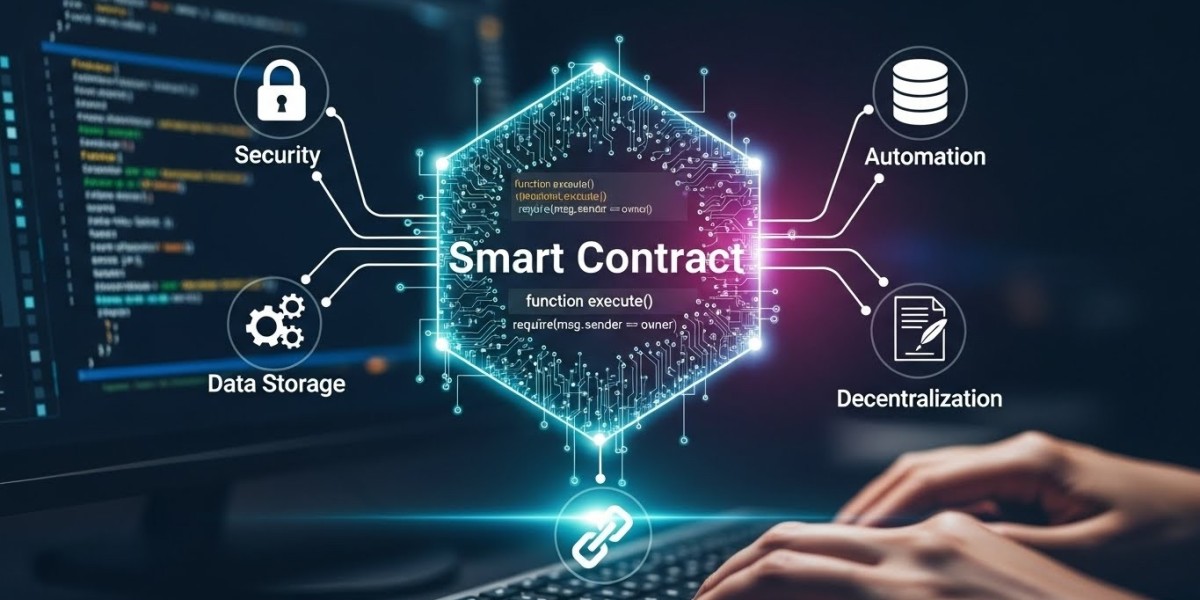

The emergence of Web3 represents a fundamental shift in how the internet is built and used. Moving away from centralized platforms controlled by a few entities, Web3 emphasizes decentralization, user ownership, transparency, and trust-minimized interactions. At the core of this transformation are smart contracts self-executing programs deployed on blockchains that automatically enforce agreements and business logic without relying on intermediaries.
Smart contracts are not just a technical feature of blockchain; they are the operational backbone of Web3. From decentralized finance (DeFi) and NFTs to DAOs and tokenized real-world assets, smart contracts enable systems that operate autonomously, transparently, and globally. This article provides a detailed, research-backed exploration of smart contracts in Web3, examining their core concepts, technical capabilities, and real-world use cases, while also highlighting the role of smart contract developers, custom smart contract development, and professional Web3 smart contract development companies in bringing these systems to life.
Understanding Smart Contracts in the Web3 Context
A smart contract is a program stored and executed on a blockchain that automatically performs actions when predefined conditions are met. Unlike traditional contracts, which require interpretation and enforcement by humans or institutions, smart contracts rely on deterministic code. Once deployed, they operate exactly as programmed and cannot be altered unilaterally.
In Web3, smart contracts act as trust engines. They replace centralized authorities with verifiable logic, ensuring that rules are enforced transparently and consistently. This is critical in decentralized ecosystems where participants may not know or trust one another.
For example, instead of trusting a platform to hold funds and release them fairly, users can rely on a smart contract that enforces the same rules for everyone. This shift from institutional trust to cryptographic and programmatic trust is a defining characteristic of Web3.
Core Concepts Behind Smart Contracts
To understand the importance of smart contracts in Web3, it is essential to grasp the foundational concepts that govern their behavior.
At their core, smart contracts consist of business logic, state, and execution rules. Business logic defines what the contract does such as transferring tokens, verifying ownership, or distributing rewards. State variables store critical data like balances, permissions, or voting outcomes. Execution rules determine who can trigger functions and under what conditions.
Another crucial concept is immutability. Once a smart contract is deployed to the blockchain, its code cannot be changed. This ensures predictability and trust but also places a strong emphasis on careful design, testing, and auditing before deployment.
Smart contracts are also transparent by default. Their code and transaction history are publicly accessible, allowing anyone to inspect how they function. This transparency strengthens accountability and enables community-driven verification.
Smart Contract Architecture in Web3
Smart contract architecture refers to how contracts are designed, structured, and interconnected within a decentralized application (dApp). In Web3, architecture decisions directly affect scalability, security, and user experience.
Most Web3 applications rely on modular contract design, where responsibilities are separated across multiple contracts. For instance, one contract may handle token issuance, another governance, and another treasury management. This modularity improves maintainability and reduces risk by isolating critical functions.
Modern Web3 architectures often include:
Core logic contracts that define essential rules and workflows
Upgradeable proxy patterns that allow logic upgrades without changing contract addresses
Access control layers that restrict sensitive operations
Oracle integrations that bring verified off-chain data on-chain
Designing such architectures requires deep expertise, which is why businesses often work with an experienced smart contract development firm or Web3 smart contract development company to ensure long-term reliability and security.
Capabilities of Smart Contracts in Web3
Smart contracts unlock a wide range of capabilities that are foundational to Web3 innovation.
One of the most powerful capabilities is automation. Smart contracts execute actions instantly when conditions are met, without delays or manual intervention. This enables real-time settlement, automated compliance, and continuous operation.
Another key capability is composability, often described as “money legos.” Smart contracts can interact seamlessly with other contracts, allowing developers to build complex systems by combining existing components. For example, a DeFi application can integrate lending, trading, and staking protocols into a single user experience.
Smart contracts also enable permissionless participation. Anyone with a compatible wallet can interact with Web3 applications without needing approval from a central authority. This openness drives innovation and global accessibility.
Finally, smart contracts provide verifiable execution. Every action is recorded on-chain, creating an immutable audit trail that enhances trust, compliance, and accountability.
Real-World Use Cases of Smart Contracts in Web3
Decentralized Finance (DeFi)
DeFi is one of the most mature and impactful use cases of smart contracts. Lending, borrowing, trading, and yield generation are all governed by automated contracts rather than centralized institutions.
Platforms like Aave and Compound use smart contracts to manage collateral, calculate interest, and enforce liquidation rules. These systems operate continuously and transparently, managing billions of dollars in value without traditional banks.
NFTs and Digital Ownership
Non-fungible tokens rely entirely on smart contracts to define ownership, transfer rules, and creator royalties. Smart contracts ensure that NFTs are unique, verifiable, and transferable without intermediaries.
Artists benefit from embedded royalty logic, which automatically pays them a percentage each time their NFT is resold. This has introduced sustainable revenue models that were difficult to enforce in traditional digital marketplaces.
DAOs and Decentralized Governance
Decentralized Autonomous Organizations (DAOs) use smart contracts to manage governance processes such as proposal submission, voting, and treasury management.
Instead of relying on centralized leadership, DAOs enforce rules through code. Token holders can vote on decisions, and smart contracts execute outcomes automatically. This model is redefining how organizations coordinate and govern themselves in Web3.
Supply Chain and Real-World Asset Tokenization
Smart contracts are increasingly used to tokenize real-world assets such as real estate, commodities, and intellectual property. Ownership, revenue distribution, and compliance can all be managed on-chain.
In supply chains, smart contracts automate verification and payment processes, reducing delays and fraud while improving transparency across stakeholders.
The Role of Smart Contract Developers and Custom Development
While the potential of smart contracts is vast, realizing it requires specialized expertise. Smart contract developers must combine blockchain knowledge, programming skills, security awareness, and an understanding of business logic.
Custom smart contract development is particularly important in Web3, where applications often have unique requirements related to governance, tokenomics, or regulatory compliance. Generic templates may not account for edge cases, scalability needs, or integration with other protocols.
A professional smart contract development firm or Web3 smart contract development company provides end-to-end services, including architecture design, secure coding, testing, auditing coordination, and post-deployment support. This expertise significantly reduces risk and ensures that smart contracts can scale as ecosystems grow.
Challenges and Considerations
Despite their advantages, smart contracts also introduce challenges. Bugs or vulnerabilities can lead to financial losses, as seen in several high-profile exploits. Network congestion and transaction fees can affect performance and user experience. Legal recognition of smart contracts also varies across jurisdictions.
These challenges underscore the importance of rigorous testing, security audits, and thoughtful architectural design. As Web3 matures, best practices and standards are emerging, but professional expertise remains essential.
The Future of Smart Contracts in Web3
As Web3 continues to evolve, smart contracts will become more sophisticated and user-friendly. Advances in layer-2 scaling, cross-chain interoperability, and AI-assisted development are expanding what smart contracts can achieve.
In the future, smart contracts are likely to power everything from decentralized identity systems to automated compliance frameworks and global digital marketplaces. Their role as programmable trust mechanisms will only grow as Web3 adoption accelerates.
Conclusion
Smart contracts are the foundation upon which Web3 is built. By enabling automation, transparency, and trust-minimized interactions, they transform how value is exchanged, governed, and managed online. From DeFi and NFTs to DAOs and real-world asset tokenization, smart contracts demonstrate the practical power of decentralized systems.
To harness this potential, organizations must rely on skilled smart contract developers, invest in custom smart contract development, and partner with experienced smart contract development firms or Web3 smart contract development companies. With the right expertise and strategy, smart contracts become more than code they become the infrastructure for the decentralized digital economy.