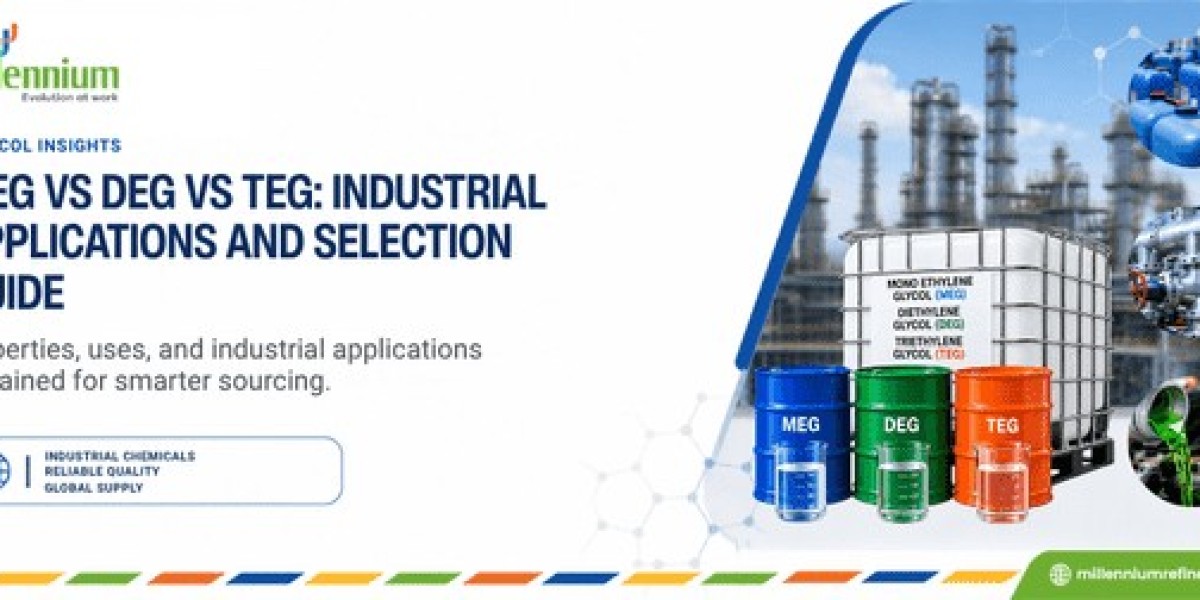

Glycols play a vital role in modern manufacturing, energy, automotive, polymer, and chemical processing industries. Among the most commercially important glycol compounds are Mono ethylene glycol (MEG), Diethylene glycol (DEG), and Triethylene glycol (TEG). While these chemicals belong to the broader ethylene glycol family, each has a different molecular structure, boiling range, moisture affinity, and industrial purpose.
For chemical manufacturers and industrial buyers, choosing the correct glycol is not simply a matter of availability or cost. The selection can influence production efficiency, product quality, equipment performance, and process safety. MEG is commonly associated with polyester and coolant production, DEG is valued in resins and chemical formulations, and TEG is particularly important in dehydration processes.
This guide explores the individual applications and technical characteristics of MEG, DEG, and TEG to help industries understand where each product performs best.
MEG Applications
Mono ethylene glycol is one of the highest-volume products within the global glycol market. Its physical properties make it especially useful where temperature control and polymer production are required.
A major use of MEG is as a raw material in the manufacture of polyester fibers. These fibers are used extensively in clothing, upholstery, industrial fabrics, and other textile products. MEG is also an essential component in producing polyethylene terephthalate (PET), which is widely used for beverage bottles, packaging materials, and containers.
Another important area is the automotive sector. Mono ethylene glycol is commonly used in antifreeze and coolant formulations because it helps protect systems against extremely low temperatures while also supporting efficient heat management. Industrial cooling circuits and closed-loop heat-transfer systems may also use MEG-based fluids.
Beyond these applications, MEG serves as an intermediate in several chemical manufacturing processes. Its combination of water solubility and thermal performance makes it suitable for a broad range of industrial formulations. Companies requiring a glycol primarily for polymer manufacturing or temperature-control applications often consider MEG a practical choice.
DEG Applications
Diethylene glycol has different performance characteristics that make it suitable for specialty industrial processes. Compared with MEG, it has a higher molecular weight and different solvent behavior, allowing it to perform effectively in chemical formulations where moisture retention and processing stability are important.
One significant application of DEG is in the production of unsaturated polyester resins. These resins are used in composites, construction materials, coatings, and various molded products. DEG can also be used during the manufacturing of plasticizers and other chemical intermediates.
The solvent properties of Diethylene glycol make it useful in processing inks, dyes, and certain specialty formulations. It is also used in industries where controlled moisture retention is required. In some manufacturing processes, DEG can act as a humectant, helping maintain the desired moisture characteristics of a product.
Additional industrial uses include textile processing, paper manufacturing, adhesives, and selected lubricant formulations. Due to its physical characteristics, DEG is often chosen when manufacturers require a balance between solvent performance, thermal stability, and hygroscopic behavior.
TEG Applications
Triethylene glycol is known for its strong ability to attract and absorb water. This property makes TEG particularly valuable in industries where moisture must be removed from gases or process streams.
One of the most important applications of Triethylene glycol is natural gas dehydration. Natural gas often contains water vapor, which can create problems such as pipeline corrosion and hydrate formation. TEG-based dehydration systems help remove moisture before gas transportation or further processing.
TEG is also used in industrial air-drying and dehumidification applications. Manufacturing facilities that need controlled humidity may utilize systems based on hygroscopic materials such as Triethylene glycol.
Because of its relatively high boiling point, TEG can also be used in applications involving elevated processing temperatures. It may be found in lubricant production, plasticizer manufacturing, textile processing, and specialty chemical formulations.
In comparison with other forms of ethylene glycol, TEG is generally selected when moisture removal is the primary objective. Its performance in gas processing has made it an important chemical for the energy and petrochemical industries.
Technical Comparison
The key difference between MEG, DEG, and TEG is related to their molecular composition. As the glycol chain becomes longer, the molecular weight and boiling characteristics generally increase.
MEG has the simplest structure among the three and is particularly effective in applications involving heat transfer and freezing-point reduction. This makes it highly suitable for coolants, antifreeze products, and polymer manufacturing.
Diethylene glycol has a larger molecular structure and higher boiling characteristics than MEG. It offers useful solvent and moisture-retention properties, making it more appropriate for resins, adhesives, plasticizers, and specialty chemical production.
Triethylene glycol has an even higher molecular weight and is particularly recognized for its hygroscopic performance. It can efficiently absorb moisture, which explains its widespread use in gas dehydration and industrial drying operations.
Another important difference is the end-use focus of each product. MEG is strongly connected to polyester and PET manufacturing, DEG is frequently used in chemical processing and resin production, while TEG is closely associated with moisture control and gas treatment.
Selection Criteria
Industries should evaluate several factors before selecting the appropriate ethylene glycol for their operations.
End-use requirements: The intended application should guide the decision. Polyester manufacturing and coolant formulations may require MEG, while resin and solvent applications may benefit from DEG. Gas dehydration operations generally rely on TEG.
Thermal properties: Processing temperature is an important consideration. Higher-temperature operations may require a glycol with suitable boiling and stability characteristics.
Moisture management: Companies dealing with water vapor or humidity control should carefully evaluate hygroscopic properties. TEG is especially effective in applications requiring significant moisture absorption.
Chemical compatibility: The selected product should be compatible with the other chemicals, additives, storage systems, and processing equipment involved in the operation.
Product specifications: Buyers should check purity, technical specifications, and consistency before purchasing industrial glycol products. Reliable suppliers should provide documents such as COA, TDS, and SDS.
Supply and logistics: For large industrial operations, dependable supply capacity and flexible packaging options are also important. Bulk availability can be essential for maintaining uninterrupted production schedules.
Conclusion
MEG, DEG, and TEG each serve a unique purpose across the industrial chemical sector. Although all three belong to the ethylene glycol family, their differences in molecular structure and performance make them suitable for distinct applications.
Mono ethylene glycol is widely used in polyester production, PET manufacturing, and heat-transfer fluids. Diethylene glycol offers valuable properties for resins, solvents, and specialty chemical formulations. Triethylene glycol stands out for its exceptional moisture-absorption capabilities and plays a major role in natural gas dehydration and industrial drying.
Understanding these differences enables manufacturers, distributors, and industrial buyers to make more informed purchasing decisions. By evaluating technical requirements, operating conditions, and application needs, businesses can select the glycol that delivers the most effective and reliable performance for their specific process.