
Comparing Two of the Most In-Demand Engineering Branches
Picking an engineering college is only half the decision. The other half — which branch to actually study — matters just as much, and it's the part students often rush through after spending months researching rankings and fee structures. Two branches that come up constantly in this conversation right now are computer science and artificial intelligence with machine learning, and they're close enough in subject matter that a lot of students genuinely struggle to tell them apart.
That confusion is understandable. Both branches involve programming, both lead to tech-sector jobs, and both show up on similar college brochures side by side. But the actual curriculum, and the kind of work each one prepares you for, diverges more than the overlapping buzzwords suggest.
Anyone shortlisting B.Tech colleges in Lucknow for either of these branches should start by understanding what each program actually teaches, rather than assuming they're interchangeable versions of the same degree.
What a Computer Science Program Actually Covers
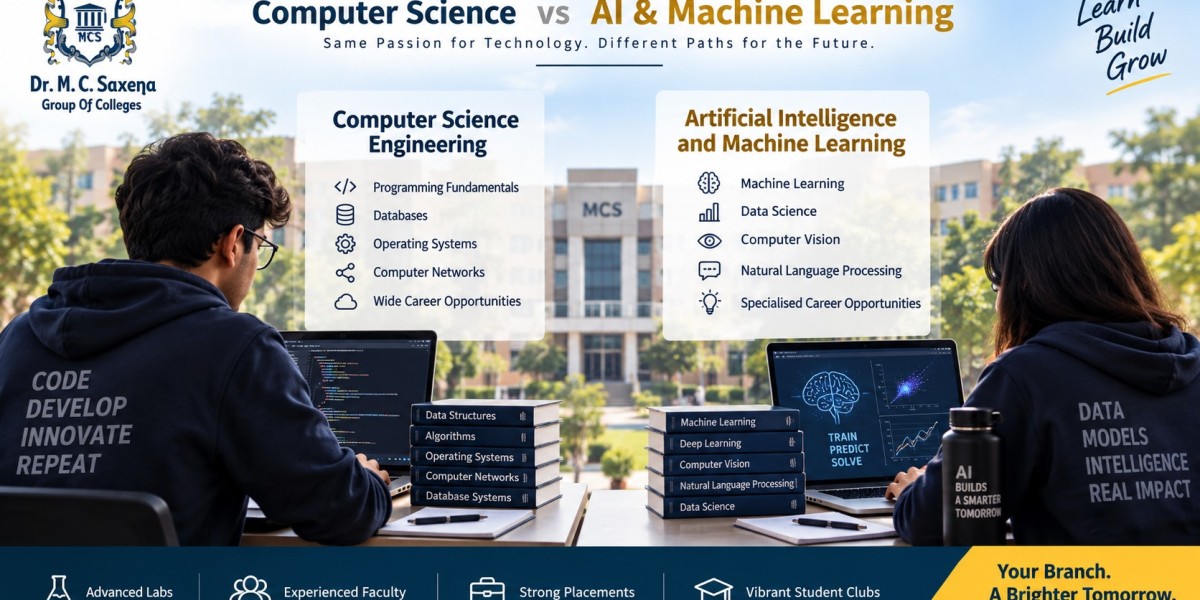
A B.Tech in Computer Science Engineering builds from general programming fundamentals — data structures, algorithms, and discrete math in the first two years — before branching into databases, operating systems, computer networks, and electives that can include AI, cybersecurity, or cloud computing depending on the college. It's a broad foundation, designed to prepare graduates for a wide range of software roles rather than one specific specialisation.
This breadth is part of the appeal. Computer science graduates end up across nearly every industry that touches software, from fintech to healthtech to automotive tech, since the core skill set transfers easily regardless of the specific product a company builds.
What AI and Machine Learning Actually Focuses On
A B.Tech in Artificial Intelligence and Machine Learning starts from a similar base of programming and mathematics, but narrows its focus much earlier. Rather than moving broadly through databases and networks, the curriculum concentrates on machine learning, deep learning, data science, computer vision, and natural language processing from a fairly early stage. Students spend more time working directly with data and building models than a general computer science student typically does in the same year.
This specialisation cuts both ways. Graduates come out with deeper, more immediately applicable skills for AI-focused roles, but the career path is narrower than computer science's broad reach — better suited to students who already know they want to work specifically in machine learning, data science, or applied AI rather than software development generally.
Why Placement Numbers Tell Part of the Story
Placement data offers a useful, if incomplete, way to compare programs. At Dr. M.C. Saxena College of Engineering and Technology, the AI and Machine Learning department has placed students at DRDO, HCL, Infosys, TCS, Wipro, and IBM, with the highest package touching 15 LPA at DRDO. These numbers sit close to what the computer science department reports through similar recruiters, which suggests both branches are landing students in comparable roles right now, even if the day-to-day work differs once they're actually hired.
What placement numbers don't capture is fit. A student who finds data modelling genuinely engaging will likely outperform one who chose AI/ML purely because the acronym sounded current, regardless of how similar the placement statistics look on paper.
What to Check Beyond the Curriculum
Lab access matters more for AI and Machine Learning than for a general computer science program, since so much of the coursework involves working directly with data and models rather than pure theory. It's worth asking specifically what tools and datasets students actually get hands-on time with, rather than assuming every AI/ML program offers the same depth of practical exposure.
Student clubs are a smaller but genuinely useful signal too. Departments that run active clubs — coding competitions, AI innovation challenges, data science hackathons — tend to give students more practice outside the formal syllabus, which shows up later in how confidently they handle technical interviews.
Making the Actual Choice
There's no universally correct pick between these two branches. A student who enjoys broad problem-solving across different kinds of software will likely get more out of computer science's wider scope. A student already drawn specifically to data, models, and prediction problems will probably find AI and Machine Learning more engaging from day one, since the curriculum leans into that focus much earlier.
For students weighing both options, B.Tech colleges in Lucknow like Dr. M.C. Saxena College of Engineering and Technology run both programs within the same campus, which makes it possible to sit in on a class or talk to current students in each department before committing. That kind of first-hand comparison, more than any prospectus, tends to make the actual decision clearer.
Whichever path a student leans toward, it's worth treating the choice with real seriousness rather than picking based on which acronym sounds more current. Four years spent studying B.Tech in Computer Science Engineering or B.Tech in Artificial Intelligence and Machine Learning is a real commitment, and MCSGOC structures both around lab access, faculty support, and placement outcomes built to make that commitment worthwhile.