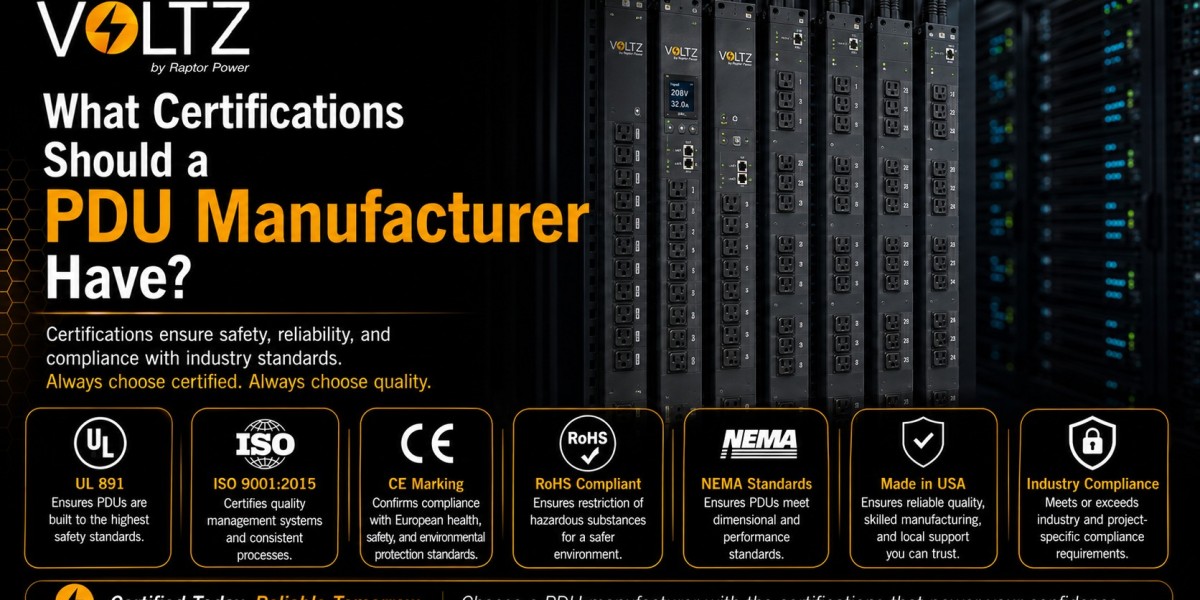

Deploying power distribution hardware into a data center, enterprise server hall, or remote edge facility requires absolute trust in electrical engineering. Situated at the final stage of power distribution before energy enters server power supplies, a Power Distribution Unit (PDU) operates continuously under intense electrical loads and elevated ambient temperatures.
If an uncertified or poorly tested strip experiences an internal electrical short, an uncalibrated circuit breaker trip, or a thermal overload, the consequences can be catastrophic—leading to unmetered downtime, fried server components, or severe electrical fires.
However, navigating manufacturer compliance claims can be confusing. Buzzwords like "engineered to standard" or "built with certified components" do not mean the completed unit was independently tested or certified as an assembly. Partnering with an enterprise PDU Manufacturer like Voltz requires verifying that the supplier holds comprehensive, third-party safety, environmental, quality, and cybersecurity certifications. Evaluating a PDU Manufacturer effectively means looking for six core compliance pillars across global markets.
1. Primary Electrical Safety Certifications
Electrical safety compliance guarantees that a distribution strip will not shock operators, overheat under continuous load, or ignite during electrical faults. A reputable manufacturer must hold third-party safety marks issued by Nationally Recognized Testing Laboratories (NRTLs) such as UL, Intertek (ETL), or CSA.
UL 62368-1 / IEC 62368-1 (Audio/Video & ICT Safety)
UL 62368-1 is the gold standard for IT equipment and server rack power hardware. Replacing legacy standards (UL 60950-1 and UL 60065), this hazard-based safety standard evaluates potential energy sources—electrical, thermal, mechanical, and fire—and requires multi-layered safeguards inside the chassis.
UL 1363 (Relocatable Power Taps)
For basic pluggable distribution strips, UL 1363 verifies that internal wiring, receptacle contacts, housing materials, and cord strain relief meet strict fire and shock prevention standards.
CE Marking & Low Voltage Directive (LVD)
For European and international deployments, the CE mark indicates compliance with the EU Low Voltage Directive (2014/35/EU). It certifies that the equipment meets international safety thresholds across operating voltages ranging from 50V to 1000V AC.
2. Electromagnetic Compatibility (EMC) and Telecommunications Standards
Monitored and switched units house digital microprocessors, network cards, and electrical current sensors. These sensitive electronics must operate cleanly without broadcasting electromagnetic interference (EMI) that degrades nearby server performance or succumb to external electrical noise.
FCC Part 15 (Class A)
In North America, FCC Part 15 Class A certification ensures that the digital display screens, microcontrollers, and Ethernet ports inside the unit do not generate harmful radio frequency interference in commercial computing environments.
EN 55032 & EN 55035 (European EMC Compliance)
EN 55032: Governs electromagnetic emission limits, ensuring the unit operates quietly across the RF spectrum.
EN 55035: Governs electromagnetic immunity, verifying that the unit's onboard network card and microcontrollers will not lock up or reset during nearby power surges, electrostatic discharge (ESD), or radio frequency spikes.
Manufacturer Certification Checklist
| Certification / Standard | Regulatory Scope | What It Protects Your Facility Against |
| UL 62368-1 / IEC 62368-1 | Global Electrical Safety | Thermal ignition, insulation breakdown, and high-voltage shock |
| ISO 9001:2015 | Factory Quality Management | Manufacturing defects, uncalibrated wiring, and loose terminal assembly |
| FCC Part 15 / EN 55032 | Electromagnetic Compatibility | Electromagnetic noise interfering with adjacent network gear and server telemetry |
| RoHS & REACH Compliance | Hazardous Chemical Restriction | Toxic heavy metal off-gassing under high-density rear-rack exhaust heat |
| ISO/IEC 27001 | Cybersecurity & Data Security | Remote hacking, network breaches, and unauthorized IP controller access |
| EIA-310-E | Physical Frame Dimensions | Mounting rail mismatches and physical obstruction of cabinet airflow channels |
3. Environmental and Hazardous Substance Regulations
Modern server cabinets generate immense exhaust heat, with rear-rack hot aisles reaching 45°C to 55°C. Power hardware must be constructed using environmentally safe, heat-resilient materials that do not release hazardous gases or degrade under thermal stress.
RoHS (Restriction of Hazardous Substances)
RoHS certification verifies that internal circuit boards, solder joints, copper conductors, and plastic housings are free from dangerous concentrations of hazardous materials—including lead, mercury, cadmium, hexavalent chromium, and specific flame retardants.
REACH (Registration, Evaluation, Authorization, and Restriction of Chemicals)
REACH compliance ensures that every raw chemical compound used in manufacturing—from outer powder coatings to internal wire insulation—is registered and certified safe under European Union environmental standards.
4. Factory Quality Management Systems (ISO Standards)
Holding individual product safety certifications is useless if the factory assembling the hardware lacks strict quality control. An enterprise manufacturer must demonstrate robust manufacturing processes through ISO accreditations.
ISO 9001:2015 (Quality Management Systems)
ISO 9001 certification verifies that the factory operates under documented quality workflows. This guarantees calibrated assembly tools, strict component sourcing audits, standardized wiring procedures, and 100% end-of-line electrical testing for every unit built.
ISO 14001:2015 (Environmental Management)
ISO 14001 ensures the manufacturing facility minimizes environmental impact through sustainable waste handling, energy-efficient production lines, and responsible raw material recycling.
5. Cybersecurity Compliance for Intelligent Units
Switched and monitored units connect directly to enterprise IP networks, allowing administrators to reboot servers and track power remotely. However, an uncertified Network Management Card (NMC) represents a dangerous backdoor entry point for cyberattacks aimed at taking down infrastructure.
IEC 62443 / FIPS 140-2 Standards
Look for manufacturers offering NMCs certified or designed to IEC 62443 cyber-risk standards. Key features include support for encrypted network protocols (HTTPS, SSH, SNMPv3), secure boot firmware, and multi-factor authentication (MFA) to prevent unauthorized network access.
6. Real-World Field Scenarios
Scenario A: Navigating a Failed Municipal Building Inspection
The Incident: A financial firm installed fifty unbranded, low-cost power strips in a new corporate data center row. During final sign-off, the local electrical inspector halted site energization because the installed units lacked a recognized NRTL (UL/ETL) mark, threatening a multi-week project delay.
Root Cause Analysis: The equipment buyer mistook a "CE self-declaration" document for a recognized North American NRTL safety certification.
The Resolution: The facility replaced the uncertified strips with UL 62368-1 listed hardware, passing inspection within 48 hours and securing municipal operating permits.
Scenario B: Preventing Network Downtime Caused by Electromagnetic Noise
The Incident: An enterprise server rack experienced random top-of-rack switch port drops whenever high-density server power supplies throttled up under processing loads.
Root Cause Analysis: An uncertified power strip lacked proper internal electromagnetic shielding. Microcontroller switching noise from its digital display radiated directly into adjacent, unshielded network cables.
The Resolution: Upgrading to FCC Part 15 Class A compliant hardware with shielded internal electronics eliminated the electromagnetic interference, stabilizing network port performance across the row.
Frequently Asked Questions (FAQs)
1. What is the difference between a self-declared compliance claim and a third-party certification?
A self-declaration means the manufacturer claims their product meets a standard without independent verification. A third-party certification (such as a UL, ETL, or CSA mark) proves that an independent, accredited testing laboratory subjected the physical product to rigorous electrical, thermal, and mechanical stress tests to verify safety compliance.
2. Why was UL 60950-1 replaced by UL 62368-1?
UL 60950-1 (for IT equipment) and UL 60065 (for audio/visual gear) were replaced by UL 62368-1 to establish a unified, hazard-based safety standard. Rather than prescribing rigid design rules, UL 62368-1 evaluates potential energy hazards (electrical, thermal, kinetic) and requires manufacturers to engineer proven protective safeguards into the product chassis.
3. Does a CE mark guarantee that a unit is safe for North American data centers?
No. A CE mark is a European self-declaration of compliance with EU health, safety, and environmental protection standards. North American building inspectors and municipal authorities require a mark from a Nationally Recognized Testing Laboratory (NRTL)—such as UL, ETL, or CSA—to pass electrical safety codes.
4. Why are ISO 9001 factory certifications important for buyers?
Product safety certifications prove that a prototype passed lab tests, but ISO 9001 certification proves that the factory builds every single production unit with identical quality control. It ensures standardized assembly, torque-tested terminal connections, and 100% end-of-line electrical testing across every manufacturing run.
5. How do RoHS and REACH certifications protect server room operations?
RoHS and REACH restrict toxic heavy metals and dangerous chemical compounds in electrical hardware. In hot rear-rack server aisles (45°C to 55°C), certified units ensure that plastics, wire insulation, and internal solder joints will not off-gas toxic fumes or degrade under sustained high temperatures.
6. What cybersecurity certifications should an intelligent PDU hold?
Intelligent units with IP network management cards should support encrypted management protocols (SNMPv3, HTTPS, SSH) and align with IEC 62443 cyber-defense standards or FIPS 140-2 encryption validation to prevent unauthorized network entry and remote tampering.
Making the Right Certification Choice for Your Facility
Evaluating hardware compliance requires looking past basic marketing claims to inspect verified safety marks, quality control standards, environmental ratings, and cybersecurity protocols.
By demanding third-party safety listings, ISO-certified factory quality, and robust network security features, project leaders protect their infrastructure from unexpected electrical failures, fire hazards, and costly regulatory delays.
Partnering with an industry-leading PDU Manufacturer like Voltz guarantees access to fully certified, enterprise-grade power distribution units built to the highest safety, compliance, and performance standards. Discover how collaborating with a trusted PDU Manufacturer can simplify compliance, safeguard your IT assets, and deliver dependable power across your server cabinets.