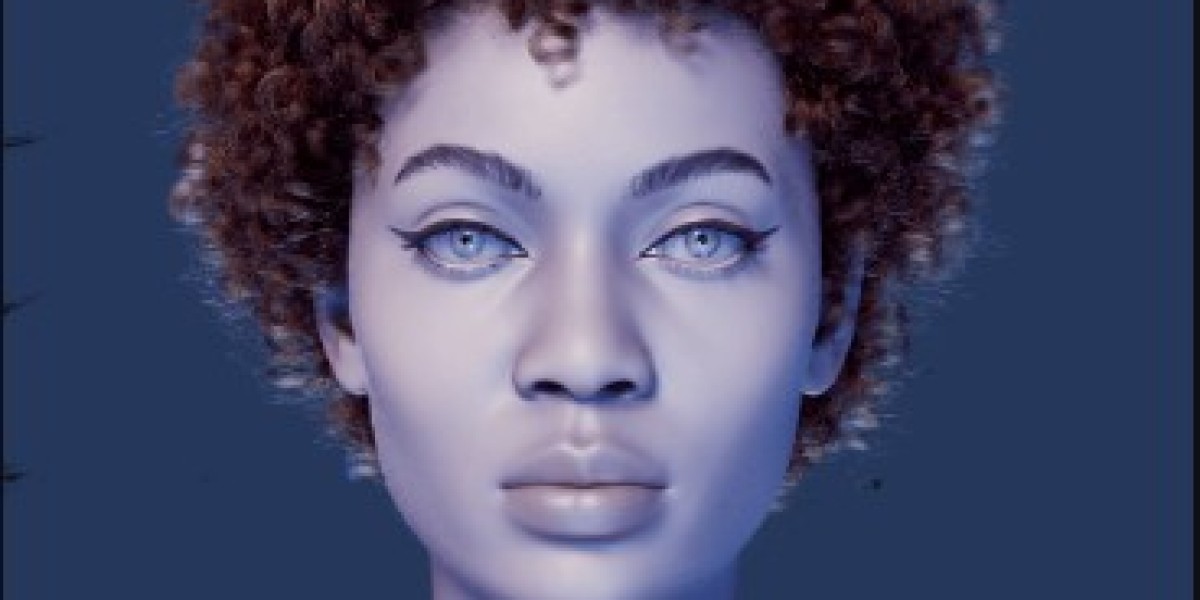

An afro hairstyle can dramatically change the silhouette and personality of a digital character. However, creating realistic afro hair in 3D requires careful control over volume, density, curl structure, and strand direction.
For artists developing a MetaHuman afro, the challenge is to reproduce the natural fullness and irregularity of tightly curled hair while keeping the asset practical for rendering and animation.
Understanding Afro Hair in 3D
Afro hairstyles have a distinctive volumetric appearance created by dense collections of tightly curled strands.
The hairstyle should not be treated as a simple spherical mass. Realistic results require variation throughout the volume.
Important characteristics include:
- Dense strand distribution
- Small curl formations
- Irregular silhouette
- Natural volume
- Uneven strand lengths
- Subtle flyaways
Building the Base Volume
Start by establishing the overall silhouette.
Before worrying about individual strands, determine how large the hairstyle should be relative to the character's head.
The base volume provides the foundation for the detailed hair system.
Creating Tight Curls
Blender's curve-based hair tools can be useful for generating repeated curl structures.
Instead of manually modeling every curl, artists can create procedural patterns and distribute them across the scalp.
Geometry Nodes can provide additional control over distribution, orientation, density, and variation.
Avoiding the "Hair Ball" Problem
One of the biggest problems with procedural afro hair is creating a shape that looks like a solid ball.
This happens when the strands are too dense, too uniform, or lack visible separation.
To avoid it, introduce:
- Different strand lengths
- Uneven density
- Small gaps
- Directional changes
- Fine flyaway hairs
Lighting should also reveal some of the individual strands rather than producing one continuous surface.
MetaHuman Integration
The hairstyle needs to fit the MetaHuman's head and work with the intended Unreal Engine workflow.
Before final export, test the hair from multiple camera angles and during facial or head movement.
This helps identify clipping around the ears, forehead, neck, and shoulders.
Final Thoughts
A convincing MetaHuman afro depends on balancing density and randomness. The hairstyle should feel full without becoming an indistinguishable mass.
For Blender character artists, procedural hair systems offer an efficient way to create the dense curl patterns required for realistic afro hairstyles while retaining the ability to customize the final look.