
Choosing the right restaurant location requires more than finding an attractive property or a busy street. Restaurant owners need to understand who lives and works nearby, how customers move through the area, what competitors are operating close to the site, and whether the market can support the restaurant concept. This is where trade area analytics becomes an important part of restaurant site selection.
Trade area analytics uses geographic, demographic, competitive, traffic, and market information to understand the area from which a restaurant is likely to attract customers. By studying this information, restaurant operators can identify promising markets, compare potential sites, understand customer behavior, and make more informed investment decisions.
A strong trade area analysis can be particularly useful when opening a new restaurant, expanding an existing brand, relocating a restaurant, or deciding between multiple properties.
In this guide, we will explain what trade area analytics is, why it matters, what data restaurants should analyze, and how businesses can use these insights to improve location decisions.
What Is Trade Area Analytics?
trade area analytics is the process of collecting and analyzing data about the geographic area surrounding a business to understand its potential customer market.
For restaurants, the trade area may include customers who:
Live nearby
Work nearby
Shop in the area
Visit surrounding businesses
Travel through the location
Attend nearby schools or entertainment venues
Visit the area for tourism or other activities
Trade area analytics goes beyond simply drawing a radius around a restaurant. It examines the characteristics of the people and businesses within that geographic area.
For example, two locations may each have a five-mile trade area, but the markets inside those areas could be completely different. One may have higher household incomes, strong population growth, and limited restaurant competition, while the other may have lower demand and a highly saturated restaurant market.
Analytics helps reveal these differences.
Why Trade Area Analytics Matters for Restaurants
Restaurants operate in highly competitive environments, making location quality extremely important.
1. Helps Understand the Customer Base
Trade area analytics provides insight into the potential customers surrounding a location.
Restaurant operators can examine:
Population
Age groups
Household income
Family composition
Employment
Lifestyle characteristics
Population growth
Consumer spending
This information helps determine whether a market fits the restaurant's target customer.
For example, a premium restaurant may need a trade area with enough consumers who can support higher menu prices. A quick-service concept may place greater importance on population density, traffic, convenience, and frequent customer visits.
2. Identifies Market Opportunities
trade area analytics can help identify areas where customer demand may not be fully served.
Suppose a neighborhood has experienced significant population growth but has relatively few restaurants serving a particular cuisine. This could indicate an opportunity for a new concept.
However, restaurant owners should investigate the market carefully before making a decision. Limited competition can indicate an opportunity, but it can also indicate weak demand.
3. Supports Competitive Analysis
Understanding competitors is a major part of trade area analytics.
Restaurant operators can identify:
Direct competitors
Indirect competitors
Restaurant density
Cuisine categories
Price levels
Competitor locations
Market clusters
Analyzing competitors can help determine whether a restaurant market is crowded or whether there are gaps that a new concept could fill.
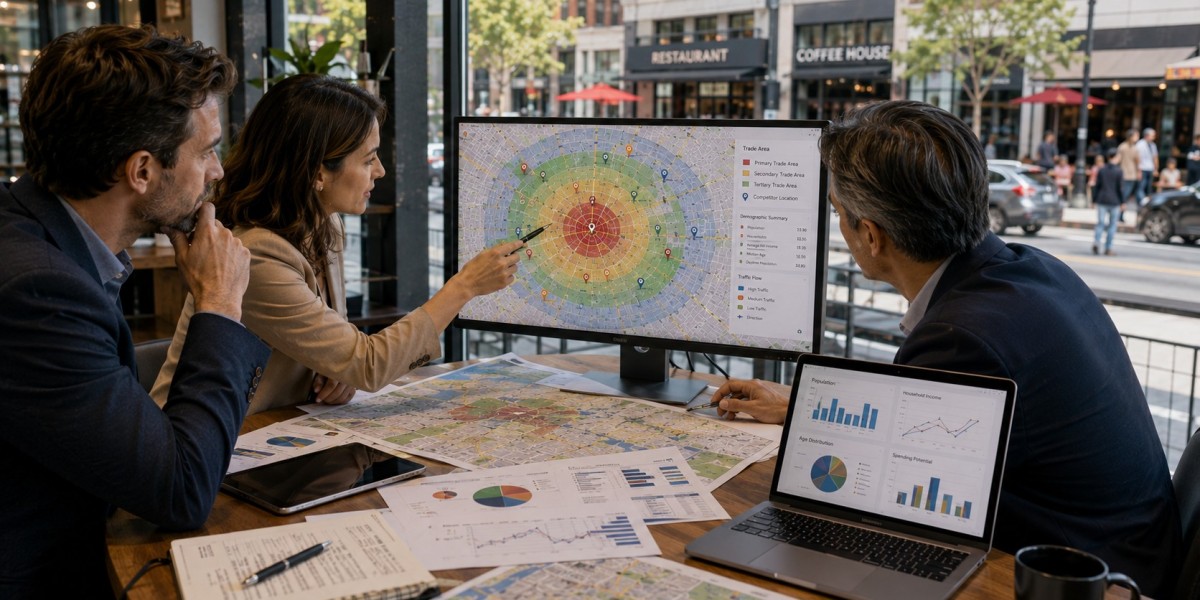
Primary, Secondary, and Tertiary Trade Areas
A restaurant's customer market can be divided into different geographic zones.
Primary Trade Area
The primary trade area generally contains the customers most likely to visit the restaurant frequently.
These customers may live or work close to the property and value convenience.
For a neighborhood restaurant, the primary trade area may consist largely of nearby residential communities.
Secondary Trade Area
The secondary trade area extends beyond the primary area.
Customers here may visit less frequently but can still contribute meaningful sales. They may travel farther because of the restaurant's reputation, menu, pricing, or unique experience.
Tertiary Trade Area
The tertiary trade area represents a broader market.
Customers from this area may visit occasionally, particularly when the restaurant has a strong brand, specialty cuisine, unique experience, or destination appeal.
Understanding all three areas can provide a more complete picture of potential customer reach.
Important Data Used in Trade Area Analytics
Effective trade area analytics combines multiple types of information.
Demographic Data
Demographics help restaurant owners understand the population surrounding a potential site.
Common metrics include:
Population size
Age
Household income
Education
Household size
Employment
Population growth
These metrics should be compared with the restaurant's target customer profile.
Traffic Data
Traffic patterns can influence visibility and convenience.
Analyze:
Vehicle traffic volume
Peak traffic periods
Major roads
Intersections
Traffic direction
Road accessibility
A high-traffic location may provide excellent exposure, but it may not perform well if customers cannot easily turn into the property or find parking.
Foot Traffic
Foot traffic can be especially valuable for restaurants in:
Downtown districts
Shopping areas
Entertainment zones
Tourist destinations
Urban neighborhoods
Transit-oriented locations
Understanding pedestrian activity can help determine whether a site has enough walk-in potential.
Competitive Data
Competitor information can show how many restaurants are already serving the local market.
Restaurant owners should examine competitors based on concept, price, cuisine, customer ratings, location, and positioning rather than simply counting the number of restaurants.
Commercial and Residential Development
Future development can significantly change a trade area.
New apartment buildings, office developments, retail centers, hotels, schools, and transportation projects can introduce new customers and increase activity around a location.
Restaurants should consider both current conditions and expected future changes.
How Trade Area Analytics Helps Compare Locations
One of the biggest advantages of trade area analytics is the ability to compare multiple restaurant properties.
Imagine a restaurant owner is evaluating three potential locations.
Location A has high traffic and strong visibility but significant competition.
Location B has moderate traffic, strong demographics, good parking, and fewer direct competitors.
Location C has inexpensive rent but limited population growth and weak customer activity.
Without detailed analysis, the lowest-rent property might appear to be the safest choice.
Trade area analytics provides a broader perspective by comparing customer demand, competition, accessibility, demographics, and financial considerations.
This helps restaurant owners evaluate the overall opportunity instead of focusing on a single factor.
Matching Trade Area Analytics to the Restaurant Concept
Different restaurant concepts require different market characteristics.
Quick-Service Restaurants
Quick-service concepts often prioritize:
High traffic
Convenience
Population density
Visibility
Easy access
Parking
Delivery demand
Fast-Casual Restaurants
Fast-casual restaurants may focus on:
Office workers
Residential neighborhoods
Walkability
Parking
Lunch demand
Daytime population
Fine-Dining Restaurants
Fine-dining concepts may place greater emphasis on:
Higher household incomes
Destination appeal
Entertainment
Customer experience
Parking
Accessibility
Family Restaurants
Family restaurants may benefit from:
Residential density
Family households
Parking
Easy vehicle access
Nearby retail and entertainment
The same trade area may therefore produce very different results for different restaurant concepts.
How Restaurant Site Finder Supports Trade Area Analytics
Technology can make trade area research faster and more structured.
trade area analytics is an AI-powered platform designed to help restaurant owners discover and evaluate potential locations using market and location insights.
Using Restaurant Site Finder, restaurant operators can incorporate location-related information into their site selection process and investigate factors such as demographics, competition, market opportunities, and surrounding conditions.
This type of location intelligence can help operators compare potential markets and identify locations that better match their restaurant concept.
Rather than relying entirely on intuition, restaurant owners can combine data-driven insights with financial projections, local knowledge, and on-site observations.
How to Perform Trade Area Analytics
A practical trade area analytics process can follow several steps.
Step 1: Define Your Target Customer
Identify the customer you want to attract.
Consider age, income, lifestyle, dining habits, location, and spending behavior.
Step 2: Define the Trade Area
Determine the geographic market around each potential site.
Depending on the concept, this could be based on driving distance, travel time, walking distance, or another relevant measure.
Step 3: Analyze Demographics
Study population, income, age, employment, household characteristics, and population growth.
Step 4: Analyze Competition
Map direct and indirect competitors and examine their positioning, pricing, reviews, and customer base.
Step 5: Evaluate Traffic and Accessibility
Analyze vehicle traffic, pedestrian activity, parking, road access, visibility, and public transportation.
Step 6: Examine Nearby Activity Generators
Look for offices, shopping centers, hotels, schools, residential developments, entertainment venues, and other businesses that can generate customer activity.
Step 7: Evaluate Future Growth
Investigate planned developments and infrastructure changes that could affect the market.
Step 8: Compare Locations
Score each potential site based on the factors most important to your restaurant concept.
Common Trade Area Analytics Mistakes
Focusing on One Metric
High population or traffic does not guarantee success. Multiple data categories should be evaluated together.
Ignoring the Restaurant Concept
A location can be excellent for one concept and unsuitable for another.
Looking Only at Current Conditions
Future development can change the size and characteristics of a trade area.
Ignoring Accessibility
A location with strong demographics may still struggle if customers cannot conveniently reach it.
Assuming Low Competition Is Always Good
Few competitors may represent an opportunity, but it could also mean limited demand.
Treating Analytics as a Guarantee
Data helps reduce uncertainty, but it cannot guarantee restaurant success. Food quality, service, pricing, marketing, management, and execution remain important.
Benefits of Using Trade Area Analytics
A data-driven trade area strategy can provide several benefits.
Better location decisions: Restaurant owners can evaluate sites using measurable information.
Improved customer targeting: Demographic data helps identify markets that match the restaurant concept.
Competitive insight: Competitor analysis reveals market saturation and potential gaps.
Reduced location risk: Analytics can identify potential problems before a lease is signed.
More efficient expansion: Restaurant brands can use trade area information to identify promising markets for additional locations.
Stronger business planning: Location insights can support sales projections, marketing decisions, and operational planning.
Conclusion
trade area analytics is a valuable tool for restaurant owners who want to make smarter location decisions. By analyzing demographics, population, income, traffic, foot traffic, competition, accessibility, nearby businesses, and future development, restaurant operators can gain a deeper understanding of the markets surrounding potential sites.
The most effective approach is to connect these insights with the restaurant's specific concept and target customer. A location with high traffic is not necessarily the best choice, just as a location with low rent is not automatically a profitable one.
Using technology such as Restaurant Site Finder can make location research more organized and data-driven. When combined with financial analysis, competitor research, on-site observations, and knowledge of the local market, trade area analytics can provide a stronger foundation for restaurant site selection.
Ultimately, the goal is to identify a trade area where the right customers are present, the competition is manageable, accessibility is strong, and the restaurant concept has a realistic opportunity to generate sustainable demand.