
Choosing the right location is one of the most important decisions a restaurant owner can make. A restaurant may have an excellent menu, attractive interior, talented staff, and strong marketing, but the business can still struggle if it is located in a market that does not provide enough potential customers.
This is where trade area analysis becomes valuable.
So, what is trade area analysis In simple terms, trade area analysis is the process of studying the geographic area from which a business is likely to attract customers. For restaurants, it helps owners understand where customers live, work, shop, travel, and spend time around a potential location.
A detailed trade area analysis can provide insights into population, demographics, income, competition, traffic, accessibility, consumer behavior, and market demand. These insights help restaurant operators compare potential locations and determine whether a site fits their concept.
In this guide, we will explain what trade area analysis means, why it matters for restaurants, what factors should be evaluated, and how to use it when selecting a restaurant location.
What Is Trade Area Analysis?
what is trade area analysis is a method used to evaluate the geographic market surrounding a business and understand its potential customer base.
A restaurant's trade area can include:
Residential neighborhoods
Office districts
Shopping centers
Schools and universities
Hotels
Entertainment venues
Tourist attractions
Industrial areas
Transportation hubs
Other activity centers
The size of the trade area depends on the restaurant concept and the characteristics of the market.
A fast-food restaurant may primarily depend on customers within a short drive because convenience is important. A destination restaurant with a unique concept may attract customers from a much larger area.
Trade area analysis helps determine how far customers are likely to travel and whether enough potential customers exist within that market.
Why Is Trade Area Analysis Important for Restaurants?
Restaurants depend heavily on location. Unlike online businesses, restaurants generally need customers to physically visit a property or live close enough to order delivery.
Trade area analysis helps restaurant owners make decisions based on evidence rather than assumptions.
1. Identifies Potential Customers
The first purpose of trade area analysis is understanding who is located within the potential customer market.
You can study factors such as:
Population
Age
Household income
Household size
Employment
Lifestyle
Education
Consumer spending
This helps determine whether the market matches your restaurant's target audience.
For example, a premium restaurant may require a trade area with sufficient higher-income households, while a budget-friendly restaurant may prioritize population density and convenience.
2. Measures Market Potential
A trade area can help estimate whether enough customers are available to support a restaurant.
However, population size should not be considered by itself.
You should also evaluate whether people in the area have an interest in your restaurant category and whether existing restaurants already satisfy the demand.
3. Understands Competition
Competition is another important part of trade area analysis.
Mapping competitors within the trade area can show:
Number of competing restaurants
Restaurant categories
Price ranges
Competitor locations
Market saturation
Customer reviews
Potential market gaps
A market with competitors is not necessarily a bad market. Several successful restaurants may indicate strong demand.
The key is determining whether your concept can offer something different or better.
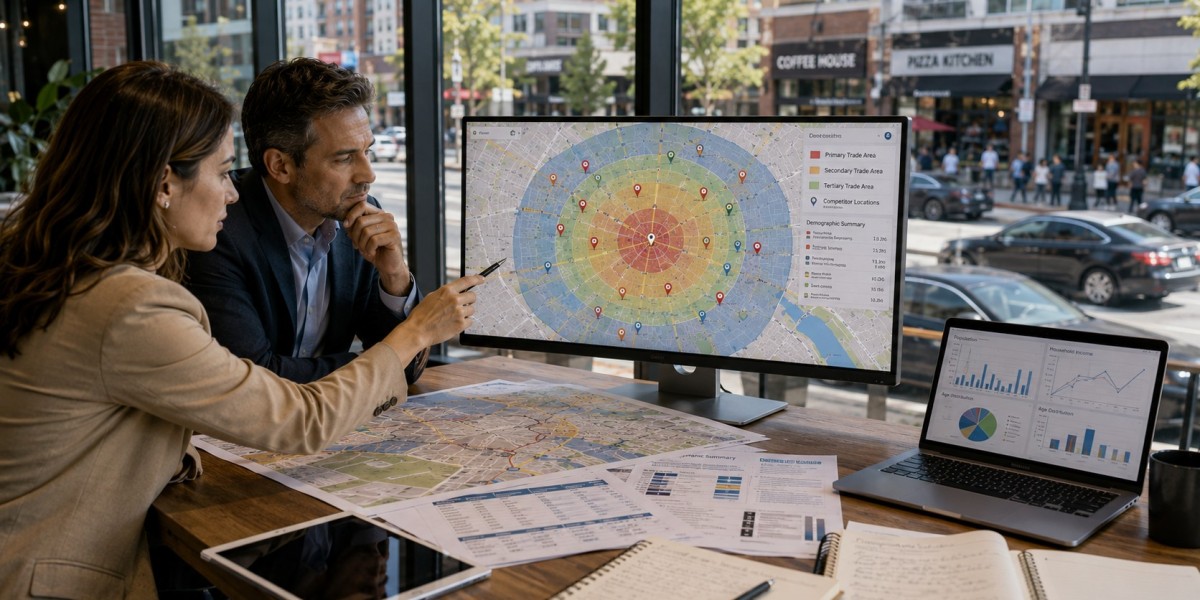
Primary, Secondary, and Tertiary Trade Areas
Restaurant trade areas are often divided into different levels based on customer distance and frequency.
Primary Trade Area
The primary trade area is the area closest to the restaurant and generally represents the largest share of expected customers.
For many restaurants, this includes nearby residential neighborhoods, offices, and commercial areas.
Customers in the primary trade area are more likely to become repeat customers because visiting the restaurant is convenient.
Secondary Trade Area
The secondary trade area extends beyond the primary market.
Customers from this area may visit less frequently but can still contribute meaningful revenue.
They may travel farther because of the restaurant's reputation, menu, location, or unique experience.
Tertiary Trade Area
The tertiary trade area is the broader market beyond the primary and secondary areas.
Customers from this area may visit occasionally, especially if the restaurant has a distinctive concept or strong brand recognition.
Understanding these different areas provides a more complete view of potential customer reach.
Key Factors in Trade Area Analysis
A strong analysis should evaluate multiple factors instead of relying on one metric.
Population Density
Population density helps estimate the number of potential customers within a geographic area.
A densely populated neighborhood may provide a strong customer base, particularly for restaurants that depend on frequent local visits.
Demographics
Demographic information helps determine whether the population matches the restaurant's target customer.
Important factors can include:
Age
Household income
Family composition
Employment
Education
Population growth
For example, a restaurant targeting young professionals may benefit from a trade area with apartments, offices, and a large working-age population.
Household Income
Income can influence restaurant spending.
A higher-income market may provide more opportunities for premium dining, while a value-focused concept may target customers who prioritize affordability.
The important consideration is whether local income levels align with your expected menu pricing.
Traffic Patterns
Traffic can significantly affect restaurant visibility and accessibility.
Analyze:
Vehicle traffic
Peak traffic times
Major roads
Intersections
Traffic direction
Road accessibility
A high-traffic location can be attractive, but only if customers can conveniently enter, park, and leave the property.
Foot Traffic
For restaurants in urban areas, shopping districts, downtown locations, and entertainment zones, pedestrian activity can be especially important.
High foot traffic can generate visibility and spontaneous visits.
Accessibility
A restaurant may have an attractive trade area but still perform poorly if customers have difficulty reaching it.
Consider:
Parking
Public transportation
Pedestrian access
Road connections
Entrance and exit points
Traffic congestion
Visibility
Accessibility should always be evaluated alongside population and competition.
How to Conduct a Trade Area Analysis
Restaurant owners can follow a structured process when evaluating a potential site.
Step 1: Define Your Restaurant Concept
Start by identifying the type of restaurant you plan to operate.
Consider:
Cuisine
Price level
Service style
Target customer
Average check
Dining occasion
Your concept determines what type of trade area you need.
Step 2: Establish the Trade Area
Create a geographic boundary around the potential restaurant location.
This can be based on driving distance, travel time, walking distance, or other relevant geographic measurements.
Step 3: Study the Population
Analyze the number of people living and working within the trade area.
Look at both residential and daytime populations where appropriate.
Step 4: Analyze Demographics
Compare local demographic characteristics with your target customer profile.
Determine whether the surrounding market contains enough potential customers who match your concept.
Step 5: Map Competitors
Identify restaurants offering similar products or targeting similar customers.
Evaluate their locations, pricing, reviews, popularity, and positioning.
Step 6: Examine Traffic and Accessibility
Study vehicle traffic, foot traffic, parking, road access, public transportation, and visibility.
Step 7: Evaluate Market Opportunities
Look for underserved customer groups, cuisine gaps, or locations where demand may exceed existing supply.
Step 8: Compare Potential Locations
Repeat the same analysis for each potential property and compare the results.
This makes the final site selection more objective.
Using Trade Area Analysis for Different Restaurant Concepts
Different restaurant formats require different trade area characteristics.
Quick-Service Restaurants
Quick-service restaurants often prioritize:
High traffic
Population density
Visibility
Easy access
Parking
Delivery opportunities
Fast-Casual Restaurants
Fast-casual restaurants may benefit from:
Office workers
Residential neighborhoods
Walkability
Parking
Strong daytime activity
Fine-Dining Restaurants
Fine-dining restaurants may focus more on:
Higher household incomes
Destination appeal
Entertainment districts
Parking
Accessibility
Customer experience
Family Restaurants
Family restaurants may benefit from:
Residential density
Family households
Parking
Easy vehicle access
Nearby retail and entertainment
This demonstrates why trade area analysis should always be connected to the restaurant's specific concept.
How Restaurant Site Finder Can Help
Technology has made restaurant location research more accessible and data-driven.
what is trade area analysis is designed to help restaurant owners discover and evaluate potential locations using market and site-selection insights.
Using a platform such as Restaurant Site Finder can help operators investigate factors such as demographics, competition, market opportunities, and characteristics of potential restaurant locations.
Instead of evaluating a property based only on appearance, rental price, or personal preference, restaurant owners can combine location intelligence with financial and operational research.
This can make the site selection process more structured and help identify locations that better match the restaurant's target market.
Common Trade Area Analysis Mistakes
Looking Only at Population
A large population does not guarantee restaurant success. The population must also match the restaurant's target market.
Ignoring Daytime Population
Office workers, students, tourists, and visitors can significantly affect restaurant demand.
Focusing Only on Competitor Numbers
A high number of competitors may indicate strong demand rather than simply market saturation.
Ignoring Accessibility
A location may have excellent demographics but poor parking or difficult road access.
Not Considering Future Development
New housing, offices, retail centers, roads, and other developments can change the trade area over time.
Using Data Without Local Validation
Data is valuable, but restaurant owners should also visit the location, observe traffic patterns, examine neighboring businesses, and understand the physical environment.
Benefits of Trade Area Analysis
A well-developed trade area analysis can provide several benefits:
Better site selection: Restaurant owners can compare potential properties using measurable factors.
Customer insight: Demographic research helps identify the people most likely to become customers.
Competitive understanding: Mapping competitors provides a clearer picture of the local market.
Risk reduction: Research can reveal potential problems before signing a lease.
Improved marketing: Understanding the target market can help restaurants create more effective marketing strategies.
Expansion planning: Existing restaurant brands can use trade area analysis to identify promising markets for new locations.
Conclusion
So, what is trade area analysis It is the process of studying the geographic market surrounding a business to understand its potential customers, competition, accessibility, and overall business opportunity.
For restaurants, trade area analysis is especially important because location directly influences customer access, visibility, convenience, and sales potential.
A strong analysis should examine population, demographics, household income, traffic, foot traffic, competition, accessibility, nearby businesses, and future development. These factors should then be evaluated against the restaurant's concept and target customer.
Using data-driven tools such as Restaurant Site Finder can make this process more efficient and help restaurant owners evaluate potential locations with greater confidence.
Ultimately, trade area analysis is not about finding the location with the biggest population or highest traffic. It is about identifying a market where the right customers are available, competition is manageable, accessibility is strong, and the restaurant concept has a realistic opportunity to succeed.