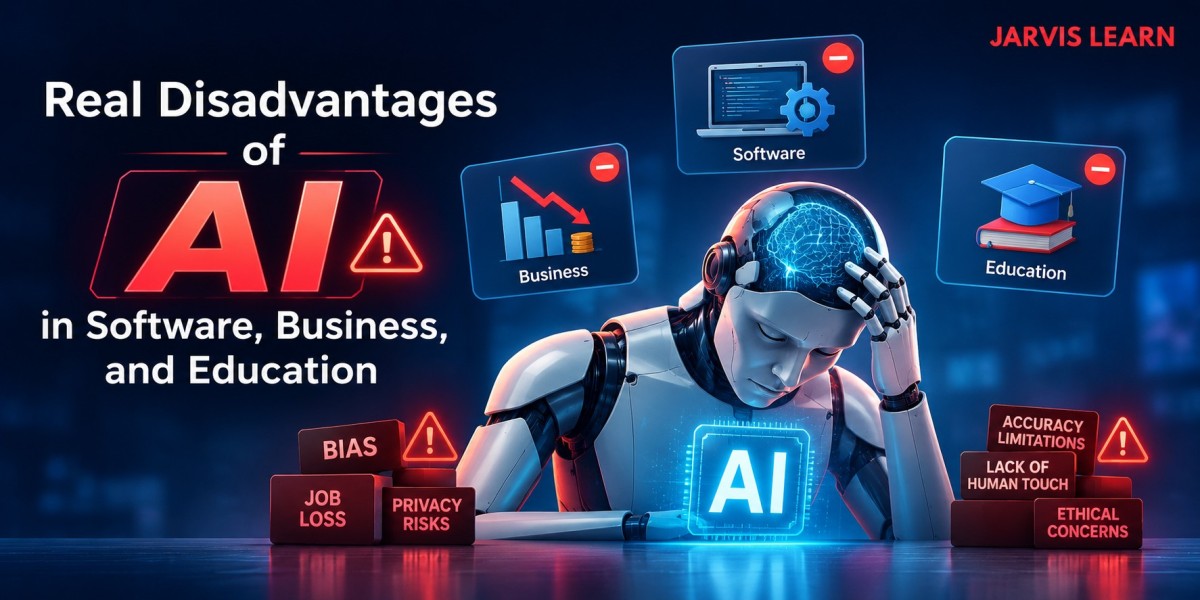

Artificial intelligence can produce an answer in seconds, write code on demand, summarize documents, and automate routine decisions. That speed makes AI attractive to businesses and individuals alike. Yet the same technology can create a difficult problem: an AI system can produce a convincing answer that is incorrect.
Traditional software generally follows explicit rules. If the same input reaches the same deterministic function, the expected output should remain consistent. Generative AI works differently. Its responses are influenced by statistical patterns, context, model behavior, and other variables. Anyone researching the Disadvantages of Artificial Intelligence quickly encounters this distinction.
The problem becomes serious when an organization treats an AI response as though it were guaranteed to be accurate. An incorrect chatbot response may frustrate a customer. An incorrect financial recommendation, medical explanation, security decision, or piece of production code can have much greater consequences.
Why AI Can Produce Uncertain Answers
Large language models generate responses by identifying patterns learned from extensive datasets. They do not approach every question like a human expert consulting a verified database.
That distinction helps explain why an AI system can:
- State incorrect information with confidence
- Invent citations or sources
- Misinterpret ambiguous instructions
- Generate inconsistent answers to similar prompts
- Produce code that appears functional but contains subtle flaws
- Struggle when presented with information outside its learned patterns
This behavior is often described through the concept of AI hallucination. The output may look polished and logical while lacking factual reliability.
For casual brainstorming, an occasional mistake may be manageable. In a business workflow, however, every uncertain output introduces another verification requirement.
The Hidden Work Behind AI Automation
AI demonstrations often focus on what the system can generate. Production environments require a different perspective: What happens when the system generates something wrong?
Imagine an organization deploying an AI assistant to process thousands of customer requests. The system may successfully handle routine questions, but some responses will require review.
That creates a second workflow around the first:
- AI generates an output.
- Software checks whether the response meets defined requirements.
- A human reviews uncertain cases.
- Incorrect outputs are corrected.
- Recurring failures are analyzed.
- The system is adjusted and tested again.
The organization has not necessarily eliminated human work. It has changed where that work occurs.
This is one reason AI implementation should be evaluated on the entire operating process rather than the model's impressive output during a demonstration.
Why Traditional Testing Is Not Enough
Software teams are accustomed to writing tests for predictable behavior. A function that should return a particular value can be tested against that expectation.
AI systems require additional layers of evaluation because the same prompt may not always produce identical wording or reasoning.
Testing Needs to Focus on Outcomes
Organizations deploying AI should establish measurable requirements around accuracy, consistency, safety, and acceptable failure rates.
Useful safeguards can include:
- Structured output validation
- Human review for high-risk decisions
- Test datasets representing real-world edge cases
- Monitoring for unexpected behavior
- Clear escalation procedures
- Logging and audit trails
- Restrictions on what the model is allowed to decide independently
The goal is not to eliminate every AI error. That is unrealistic. The goal is to ensure that an inevitable error does not automatically become a business failure.
Context Can Change the Quality of an Answer
AI output is heavily influenced by the information supplied to the system.
A vague prompt can produce a generic response. A carefully constructed prompt containing relevant background, constraints, examples, and source material can produce a much more useful result.
But even detailed instructions cannot guarantee correctness.
This creates an important distinction between contextual accuracy and factual accuracy. An AI system may follow the instructions correctly while still relying on an incorrect assumption or generating unsupported information.
That is why users should verify important claims against authoritative sources rather than assuming that fluent language represents factual certainty.
AI Risk Depends on the Consequence of Failure
Not every AI application requires the same level of oversight.
Using AI to brainstorm headlines is fundamentally different from using it to approve a financial transaction. The acceptable error threshold changes according to the consequences of a mistake.
Organizations can therefore classify AI applications according to risk.
Lower-risk uses may include:
- Brainstorming
- Drafting internal notes
- Summarizing non-sensitive material
- Generating preliminary ideas
Higher-risk uses may involve:
- Financial decisions
- Employment decisions
- Security operations
- Legal analysis
- Medical recommendations
- Critical infrastructure
As the consequences increase, human oversight, validation, documentation, and testing should become more rigorous.
Treat AI as a System, Not an Oracle
The most useful mindset is to stop thinking of AI as an infallible source of answers.
AI is a component within a larger system. That system includes the model, data, prompts, software controls, users, monitoring processes, and escalation mechanisms.
A responsible implementation therefore asks several questions before deployment:
- What happens when the model is wrong?
- Can the output be independently verified?
- Who is accountable for the final decision?
- Can failures be detected quickly?
- What information should never be exposed to the system?
- How will performance be monitored after deployment?
These questions shift attention away from demonstrations and toward operational reality.
AI can deliver substantial value, but its probabilistic nature means organizations must design around uncertainty rather than ignore it. The strongest implementations are not those that assume machines will never make mistakes. They are those that anticipate mistakes, contain their impact, and keep meaningful human judgment in the loop.
For more practical perspectives on artificial intelligence, technology, and digital learning, visit Jarvis Learn.