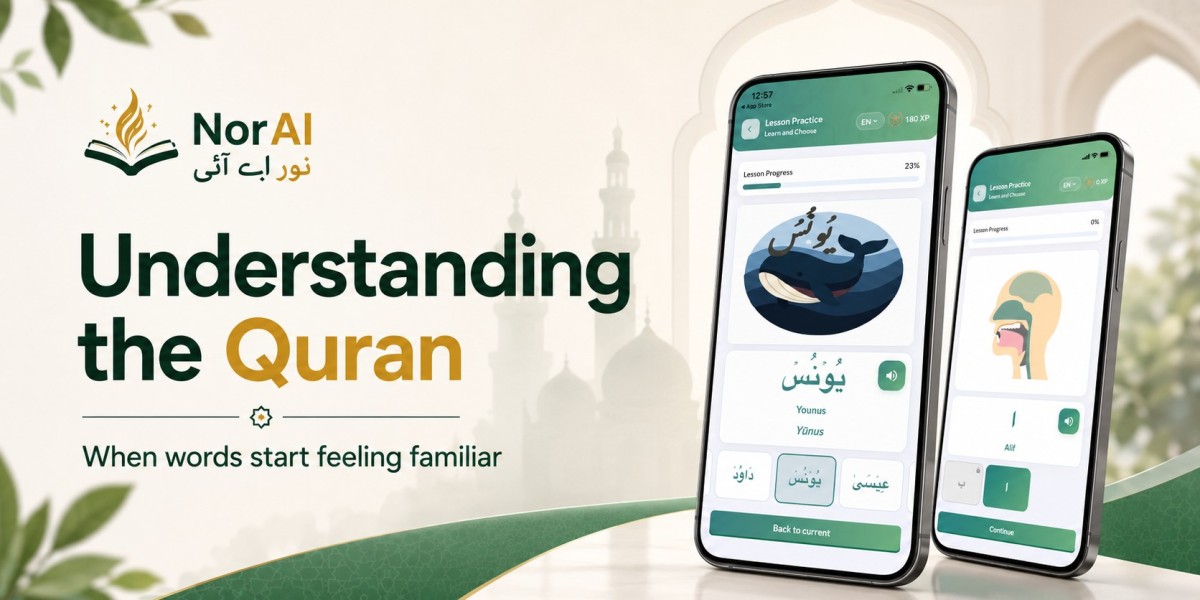

For many learners, understanding the Quran becomes difficult when too many skills are introduced at the same time. Reading Arabic, learning vocabulary, recognising verbs, understanding connectors, and noticing words in context are all useful, but they do not need to be learned together from the beginning.
A more organised approach is to build these skills in sequence.
NorAI is a Quranic Arabic learning app built around this principle. Its structured curriculum moves learners from reading foundations into vocabulary, word relationships, Quranic verbs, controlled context, and later connected forms.
The purpose is not to rush learners toward advanced Arabic. It is to make sure each stage gives them something useful before the next stage begins.
Why Does the Starting Point Matter?
Before learners can recognise Quranic vocabulary confidently, they need enough familiarity with the Arabic writing system. This includes recognising letters, basic sounds, vowel marks, and joined forms.
Without this foundation, a learner may spend more effort trying to identify the letters than remembering the word itself.
NorAI begins its curriculum with this reading foundation. Its first stage covers Arabic reading readiness before gradually introducing Quranic nouns and their approved meanings, creating a clearer transition from learning how Arabic looks and sounds to recognising actual Quranic vocabulary.
What Happens After Basic Reading Becomes Familiar?
Once the reading foundation is stronger, the next challenge is building a useful vocabulary base. Not every Quranic word needs to be introduced at the same time.
NorAI gradually introduces different types of words so learners can become familiar with them in an organised way. Early vocabulary focuses on approved Quranic nouns. Later, learners encounter pronouns, reference words, particles, connectors, and core Quranic verbs.
This progression matters because understanding a language involves more than collecting isolated translations. A learner eventually needs to notice what kind of word is being used and how it relates to the words around it.
Why Are Pronouns and Connectors Important?
Small words can carry important relationships. Pronouns help learners notice who or what is being referred to. Connectors and particles help show how parts of a phrase relate to one another.
These words may not always be as visually memorable as concrete nouns, but they become increasingly important as learners move toward connected Quranic Arabic.
NorAI introduces these forms after learners have already built a basic noun foundation, allowing the learner to work with familiar vocabulary while gradually noticing new relationships. For understanding the Quran, this is an important transition — the learner is no longer looking only at individual objects or ideas, but beginning to notice how language connects.
When Do Quranic Verbs Become Important?
Verbs introduce action and state. Once learners have some familiarity with nouns, pronouns, and connectors, Quranic verbs can become easier to place within the wider learning structure.
NorAI introduces core Quranic verbs before moving into selected verb variations, attached forms, and approved short phrases. The aim is recognition rather than advanced grammar study.
Learners are not expected to analyse every grammatical rule immediately. Instead, they become familiar with approved forms and begin distinguishing them through guided practice, gaining another layer of language awareness without turning the process into a full Arabic grammar course.
How Does Learning Move From Words Into Context?
Individual vocabulary is useful, but the Quran is not read as a list of separate words. Eventually, learners need to see familiar forms in more connected settings.
NorAI's later learning stages introduce approved phrases and controlled Quranic context using language that has already been studied, allowing learners to recognise familiar nouns, pronouns, connectors, or verbs when they appear beside other known forms.
The purpose is still controlled recognition. It is not an invitation to interpret Quranic verses independently. That distinction is important because understanding the Quran through language learning and explaining the complete meaning of a verse are different responsibilities. Vocabulary and language recognition can build a foundation, while tafseer requires qualified scholarship, context, and deeper study.
What Is Tarkeeb, and Where Does It Fit In?
Tarkeeb refers to how words connect structurally within a phrase — noun-centred relationships, attached forms, and verb-centred structures.
As the curriculum progresses, learners begin working with more connected approved forms. NorAI introduces Tarkeeb in its later stages, after learners have already encountered the required vocabulary and relationships, working with approved Quranic blocks built from material studied earlier.
This progression is deliberately later in the curriculum, meaning learners are not asked to build connected language before developing familiarity with the components used within it. A structured sequence therefore becomes important: recognise the foundations, learn the vocabulary, understand relationships, then practise connected forms.
Why Does NorAI Separate Progress From Mastery?
Completing a level and remembering its vocabulary are not exactly the same thing. A learner may complete an activity successfully but still need to encounter the same word again before it becomes reliably familiar.
NorAI tracks this difference through learning states such as New, Learning, Review, and Mastered. A new word first enters the learning process, then returns through practice and review. A word is considered more established only after it has been recalled successfully across separate sessions.
Progress shows where a learner has reached. Mastery shows what has remained familiar. For language learning, both matter — moving through lessons gives structure, while repeated recognition helps prevent earlier vocabulary from disappearing as new material is introduced.
Why Are Different Practice Types Used?
The same word can be difficult in different ways. A learner may recognise it visually but struggle to identify it by sound. Another learner may remember its meaning but have difficulty recognising the Arabic form.
NorAI uses different guided activities across its learning system, including Visual Learning, Articulation Practice, Audio Practice, Writing Practice, Match Quiz, and Word Joining. Each activity approaches recognition from a different direction — not simply to give learners more to complete, but to give studied material more than one opportunity to become familiar.
Does This Approach Replace Tafseer or Tajweed?
No. NorAI focuses on Quranic Arabic vocabulary, approved meanings, recognition, and structured language practice. It does not provide tafseer, fatwa, or AI generated Quranic interpretation, and its articulation and audio activities do not replace formal Tajweed instruction.
Learners who want to study recitation, interpretation, or deeper religious meaning should continue with qualified teachers and reliable scholarly resources. Keeping these boundaries clear allows language learning to remain useful without asking it to do something it was not designed to do.
Frequently Asked Questions
Can understanding the Quran begin with basic Arabic reading?
Yes. Recognising Arabic letters, sounds, vowel marks, and joined forms creates a useful foundation before learners move further into Quranic vocabulary.
Why does NorAI teach different word categories gradually?
Introducing nouns, pronouns, connectors, and verbs in stages allows learners to build on vocabulary and relationships they have already encountered, rather than facing everything at once.
Does NorAI teach advanced Arabic grammar?
No. NorAI focuses on structured recognition of approved Quranic vocabulary, forms, and relationships rather than providing a full advanced grammar course.
When does Quranic context appear in the curriculum?
Controlled Quranic context appears after learners have built earlier foundations in vocabulary, pronouns, connectors, and verbs.
Does completing a lesson mean every word is mastered?
No. NorAI separates lesson completion from word mastery, so studied words continue returning through review until recognition becomes more established.
Does NorAI provide Quranic interpretation?
No. NorAI does not provide tafseer, fatwa, or AI generated religious interpretation. Deeper Quranic explanation should be studied through qualified scholarly sources.
Building Understanding in the Right Order
Understanding the Quran does not need to begin by asking a learner to understand complete verses immediately. A structured path can begin much earlier.
First, Arabic letters and sounds become familiar. Then Quranic words begin to carry recognisable meaning. Pronouns and connectors introduce relationships. Verbs add action. Familiar language gradually moves into approved phrases, controlled context, and later connected forms.
NorAI organises these stages across a 20 level Quranic Arabic curriculum so that later learning builds on material introduced earlier. The value of that structure is simple: learners are given time to recognise what they have already learned before being asked to work with something more complex, creating a more realistic foundation for continued Quranic Arabic study and deeper learning through appropriate scholarship.