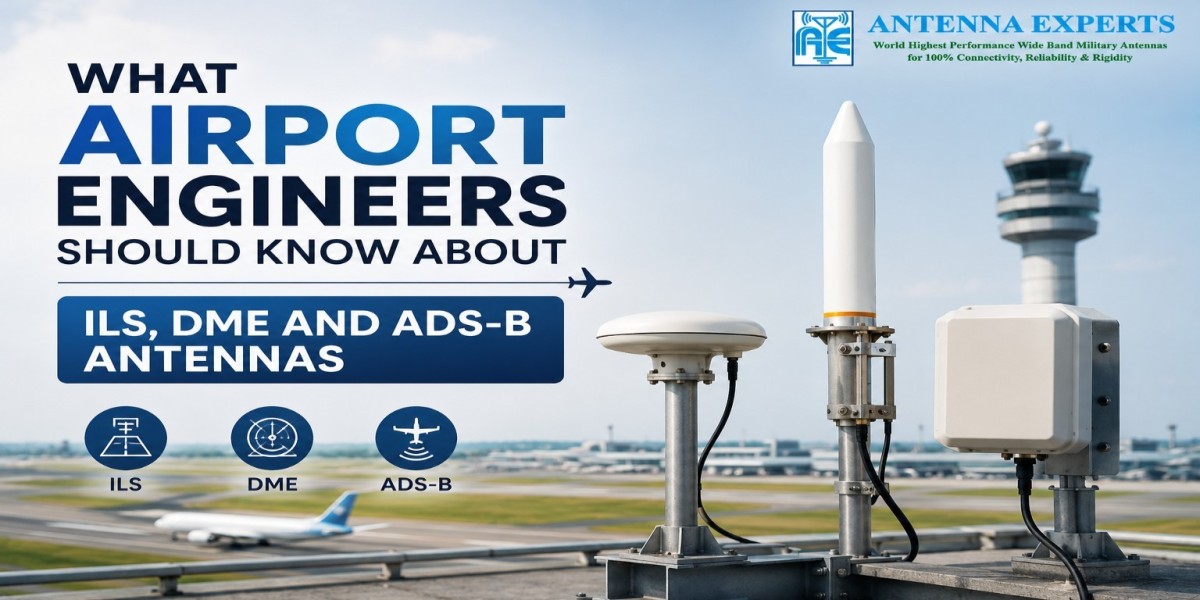

Airport infrastructure runs on signals working exactly as intended every single time. There is no room for a navigation antenna to underperform on a foggy morning when a pilot is relying entirely on instruments to land safely. An ILS antenna and the other navaid systems working alongside it form the backbone of that reliability. Properly selecting and maintaining these systems is no ordinary task for airport engineers and avionics integrators. It directly impacts flight safety every day. This guide walks through what actually matters when selecting ILS, DME and ADS-B antennas for airport use.
Understanding The Role of ILS In Safe Landings
The instrument landing system is very helpful in guiding aircraft. It ensures safety on the runway even when visibility is poor. It works through two main components. A localizer antenna keeps the aircraft aligned horizontally with the center of the runway. A glide slope antenna manages vertical guidance. It tells the pilot whether they are too high or too low. If the antennas are positioned correctly, that provides a seamless wireless connection.
All these systems together provide pilots with a reliable reference point during landing. It does not matter what the weather conditions are. If there is any inconsistency in the signal strength or coverage pattern from the ILS antenna. The problem can directly affect how accurately the pilot can align with the runway. That is why these systems go through such strict testing before installation and ongoing checks after deployment.
Why Coverage Pattern Accuracy Cannot Be Compromised
Airport antennas need very specific coverage patterns to function correctly. If it is not accurate, wireless communication is not achieved. A signal pattern that is too narrow, can risk missing aircraft. One that is too wide can create interference with nearby systems or airspace. Engineers designing airport navigation infrastructure. They require working together to come up with ILS Antenna specifications. That matches the exact coverage requirements for their runway, layout and surrounding terrain. This is not a detail that can be predicted.
Even slight deviations in the shape of the pattern or signal strength can affect the overall performance. So, the coverage pattern of the antenna matters. It decides how reliably the aircraft receives accurate guidance during a critical phase of flight. Connect with a reliable ILS Antenna manufacturer and supplier in India. They can provide you with a suitable antenna as per your unique requirements and applications. They deal with antennas like ILS, High Gain DME antenna, and ADS-B antennas for smooth communications.
DME And ADS-B: Supporting Navigation Beyond Landing
Airport navigation isn't just limited to landing guidance. Aircraft also rely on continuous positioning. It needs to be tracked during their arrival and departure.
A high gain DME antenna helps aircraft determine their exact distance from a ground station. That supports navigation accuracy well beyond just the landing phase. This distance data feeds directly into flight management systems. That helps pilots and air traffic control maintain safe separation between aircraft. And nothing critical happens.
A high gain ADS-B antenna allows aircraft to continuously broadcast their position. It ensures speed and altitude. Air traffic control and other aircraft use this data for tracking and collision avoidance. That has become an increasingly important part of modern airspace management. ADS-B data needs to reach ground stations reliably from various altitudes and distances. Antenna gain and coverage pattern both play a significant role here. These properties determine how consistently this system performs.
The Role of ATC Antennas in Communication Reliability
Airports depend on clear voice and data communication. It has to create smooth wireless communication with controllers and pilots. It is very important for them. A high gain ATC antenna supports this communication link. And it ensures instructions are received clearly even at longer ranges. It can be consistent even during busy traffic periods when communication reliability matters most.
A reliable ATC antenna offers stable communication between aircraft and control towers across the coverage area. It is helpful in establishing precise communication around runways. Taxiways and controlled airspace also get precision connection with its help. If there are any issues like interference and weak signals. That can be easily prevented with the help of ATC antennas. They provide timely instructions and pilots respond quickly during takeoff. The device also helps in landing, and flight operations.
Proper antenna placement and suitable gain are important for consistent performance. If you want to have clear and continuous communication. It is important to achieve it with a trusted antenna. Weak or inconsistent ATC antenna performance can lead to communication delays. That no one wants to happen to them. This can produce misunderstandings during critical moments. That is why this category of equipment deserves the same level of scrutiny as landing guidance systems even though it often gets less attention during planning.
Why Choose Antenna Experts
Antenna Experts is a trusted antenna manufacturer in India. We bring practical engineering experience to ILS, DME, ADS-B and ATC antenna design. And our state of art of devices are specifically built for aviation infrastructure requirements. Every product meets strict environmental and reliability standards. That ensures consistent performance across varying weather and operating conditions. Our team works directly with airport engineers and avionics integrators. We confirm new installations integrate smoothly with existing navaid systems. Our antennas are designed to provide any interference.