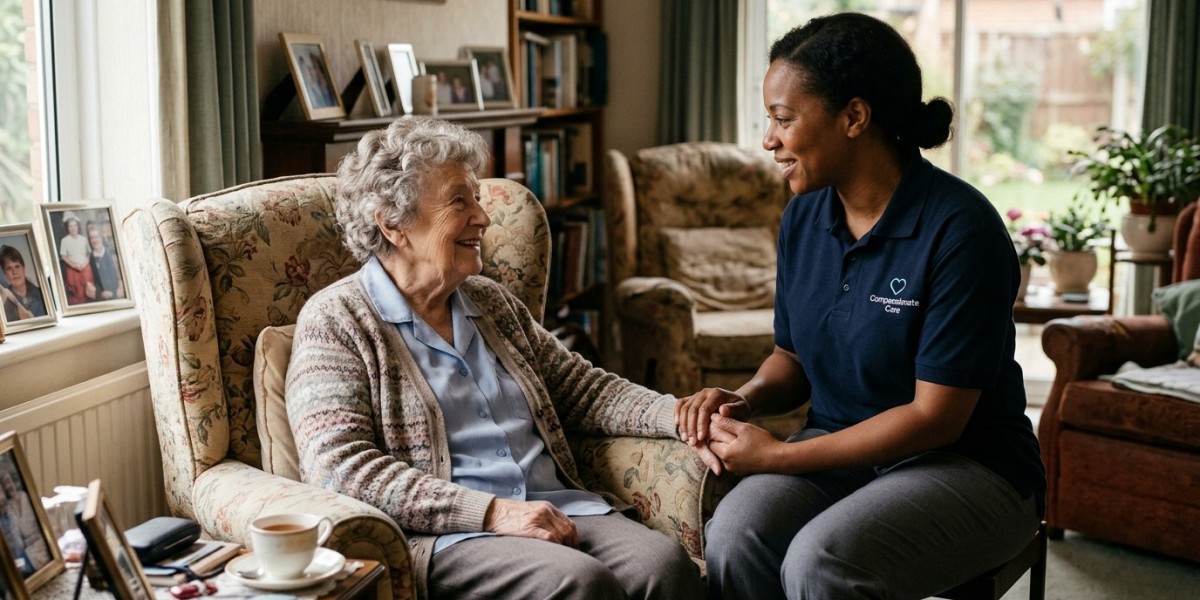

For an older adult who has lived in the same Sunnyvale neighborhood for twenty or thirty years, home can hold an entire lifetime. It is the kitchen where birthdays were celebrated, the living room where grandchildren learned to walk, the garden planted one spring at a time, and the bedroom window through which countless California mornings have begun.
That emotional connection helps explain why conversations about senior care can become so difficult.
Imagine a woman named Linda visiting her 82-year-old father one Saturday afternoon. He still lives independently in the Sunnyvale home where she grew up. His voice is strong. He insists that he is doing perfectly well.
Yet Linda notices things she had not seen before.
There are unopened envelopes on the counter. The refrigerator contains plenty of food, but little of it has been prepared. A hallway light has burned out. Her father mentions that he has stopped driving after sunset. Later, while carrying his coffee, he briefly reaches for a chair to steady himself.
Nothing appears serious enough to justify turning his life upside down.
But Linda leaves wondering whether "doing fine" and "not needing any help" are really the same thing.
Thousands of families face similar questions as parents and grandparents grow older. For many of them, In-Home Senior Care in Sunnyvale CA offers a middle path between leaving an older adult completely unsupported and making a major move before it is necessary.
The purpose of thoughtful in-home senior support is not to take independence away. It is to protect independence by providing assistance where daily life has become harder, more tiring, or less safe.
Why In-Home Senior Care in Sunnyvale CA Matters
Sunnyvale is often described through the language of technology and innovation. Yet it is also home to a significant and growing older population.
The U.S. Census Bureau estimates Sunnyvale's 2025 population at 156,577, with approximately 13% of residents age 65 or older.
That percentage represents thousands of individuals with different health conditions, family situations, cultural backgrounds, lifestyles, and levels of independence.
Some older adults remain completely self-sufficient.
Others need only occasional help.
Some have adult children nearby but do not want to rely on them for every errand.
Others have family members balancing careers, children, household responsibilities, and caregiving.
Still others may need increasingly structured assistance to continue living comfortably at home.
That is why senior care cannot be reduced to a single solution.
Quality home care for seniors in Sunnyvale CA should begin by asking what the individual actually needs instead of assuming that age automatically determines ability.
Most Older Adults Want to Preserve Their Independence
The desire to stay independent does not disappear with age.
A person who has spent decades making their own decisions may naturally resist the idea that somebody else should suddenly manage their life.
The National Institute on Aging explains that many older adults want to remain in their own homes as they age, commonly described as "aging in place." Successful aging at home, however, often requires planning for personal needs, household responsibilities, transportation, safety, health care, and other forms of assistance.
The key word is support.
An older adult may still choose what to wear, what to eat, where to go, who to see, and how to spend the day while receiving help with a few tasks that have become difficult.
Think of it like reading glasses.
Using reading glasses does not mean someone has surrendered the ability to read. The glasses simply remove a barrier.
In the same way, appropriate senior assistance at home in Sunnyvale can remove barriers that make everyday life unnecessarily stressful.
What In-Home Senior Care Can Look Like
Families sometimes hear the phrase "in-home care" and imagine someone providing round-the-clock medical treatment.
That is only one possible form of home-based support.
The National Institute on Aging notes that services for older adults living at home can include personal assistance, household help, meal support, transportation, safety measures, money-management assistance, and certain healthcare services depending on the provider and the individual's needs.
In other words, care exists on a spectrum.
One person may require licensed nursing care after surgery.
Another may primarily need companionship, errands, organization, scheduling help, and assistance navigating technology.
Understanding that difference helps families avoid both underreacting and overreacting.
Personal Assistance Can Reduce Everyday Stress
Daily life contains hundreds of small tasks.
Make an appointment.
Pick up groceries.
Remember a deadline.
Organize paperwork.
Schedule transportation.
Return a phone call.
Coordinate a home service.
For a younger adult, these responsibilities may feel routine.
For someone dealing with reduced mobility, vision changes, fatigue, grief, or simply the normal challenges of aging, those same tasks can become exhausting.
The public website for Julie's Signature Solutions describes personal assistance that can include managing appointments, organizing schedules, handling errands, and coordinating everyday tasks.
That kind of assistance can make a meaningful difference without taking control away from the senior.
Instead of saying, "You cannot manage this anymore," the message becomes, "You do not have to spend your energy on every difficult task."
That is a very different experience.
Companionship Is More Important Than It Looks
Picture two afternoons.
In the first, an older adult spends six hours alone watching television simply because there is nowhere to go and nobody expected to visit.
In the second, someone arrives for a conversation, helps organize an outing, shares lunch, or simply sits at the kitchen table and listens to stories.
The practical difference may seem small.
The emotional difference can be enormous.
Social isolation and loneliness are not merely unpleasant. The National Institute on Aging reports that they are associated with higher risks of health problems including depression, heart disease, and cognitive decline.
Companionship therefore deserves to be viewed as part of overall well-being, not simply entertainment.
A person can have a safe home, plenty of food, and every bill paid while still experiencing a deeply lonely life.
Good In-Home Senior Care in Sunnyvale CA should consider the human need for conversation, purpose, and connection.
Familiar Surroundings Can Carry Powerful Emotional Value
Why are some seniors so determined to remain at home?
Because a familiar environment reduces the number of things that need to change at once.
Consider an older adult who has lived in the same house since 1989.
They know exactly how morning sunlight enters the bedroom.
They know which cabinet contains the coffee.
They recognize the neighbor's dog.
They understand the sounds of the street.
They may know the grocery store employees, nearby walking routes, local restaurants, and community facilities.
Moving to a new environment changes all of those reference points simultaneously.
For some people, relocation is absolutely the right choice. Assisted living, residential care, or skilled nursing may eventually provide a safer and more appropriate setting.
But not every senior needs to move simply because they need some help.
The National Institute on Aging specifically recognizes home-based support as one way older adults may continue living independently when their needs can be safely managed at home.
Aging in Place Requires Planning, Not Wishful Thinking
There is an important counterargument to the idea of remaining at home.
Wanting to stay home does not automatically mean staying home is safe.
A house can become less suitable as mobility, vision, balance, or health changes.
The goal should never be to keep someone home at any cost.
The goal should be to determine whether home can continue to support the person's needs.
Home Safety Should Be Reviewed Regularly
A rug that has been in the hallway for fifteen years may suddenly become a hazard.
A dim stairwell may become difficult to navigate.
A bathtub that once seemed easy to enter can become intimidating.
Frequently used objects stored on high shelves may encourage unsafe reaching or climbing.
The National Institute on Aging recommends practical home-safety measures such as securing or removing area rugs, improving lighting, installing grab bars near toilets and bathing areas, adding nonslip surfaces, and addressing unsafe stairs or entrances.
These improvements may sound minor.
Yet aging safely often depends on details.
A home does not need to look like a medical facility. It simply needs to evolve with the person living there.
Fall Prevention Deserves Serious Attention
Falls are one of the strongest reasons families should pay attention to changes in mobility and the home environment.
According to CDC data updated in 2026, falls are the leading cause of injury among adults age 65 and older. More than 14 million older Americans—roughly one in four—report falling each year. The CDC also reports that about 37% of older adults who fall experience an injury requiring medical treatment or restricting activity for at least one day.
These numbers should not create panic.
They should create awareness.
If an older adult begins holding furniture while walking, avoiding stairs, becoming hesitant in the bathroom, or mentioning repeated near-falls, those signs deserve attention.
A family may need to discuss concerns with the person's physician or another qualified healthcare professional, particularly if the changes are sudden.
Home support can help reduce everyday risks, but it is not a substitute for appropriate medical evaluation.
The Family Caregiver Often Needs Support Too
When people discuss senior care, nearly all attention naturally goes to the older adult.
But there is usually another person quietly carrying much of the responsibility.
The daughter calling every morning.
The husband managing every appointment.
The son driving across the Bay Area several evenings a week.
The sibling organizing bills from another state.
The neighbor checking whether the curtains opened that morning.
According to the 2025 Caregiving in the U.S. research report, approximately 63 million American adults were providing ongoing care to an adult or child with a medical condition or disability, representing almost one-quarter of U.S. adults. That figure represented a substantial increase compared with the study's 2015 findings.
Family caregivers may love the person they support deeply.
Love, however, does not create unlimited energy.
Caregiving Can Quietly Become a Second Job
Imagine an adult daughter named Priya.
She works full time in Silicon Valley.
Every Tuesday she drives her mother to an appointment.
On Wednesday she orders groceries.
Thursday night she spends an hour resetting a forgotten password for an online account.
Friday she calls the pharmacy.
Saturday she cleans the kitchen, organizes paperwork, and prepares meals.
Sunday evening she remembers that her own laundry is still sitting in the washing machine.
None of these tasks individually appears overwhelming.
Together, they consume a large part of her week.
This is how caregiver stress often develops—not through one enormous responsibility, but through hundreds of small responsibilities that never completely stop.
The National Institute on Aging recognizes that caregiving can be demanding and stressful and notes that options such as respite assistance can give regular caregivers time to rest or handle other responsibilities.
Professional in-home senior support in Sunnyvale CA can sometimes provide that breathing room.
The purpose is not necessarily to replace the family caregiver.
It may be to make family caregiving sustainable.
Sometimes a Daughter Needs to Be a Daughter Again
This emotional side of caregiving is easy to overlook.
When every visit becomes a checklist, relationships can change.
"Did you take care of this?"
"Where is that paperwork?"
"Why haven't you scheduled the appointment?"
"Did you eat?"
"Where are your keys?"
Both people can begin feeling frustrated.
Additional support can allow family members to reclaim some normal moments.
Instead of spending an entire Sunday organizing the house, a daughter might have time to sit in the garden with her mother.
Instead of becoming the person responsible for every errand, a son might simply watch a baseball game with his father.
Care does not only affect tasks.
It affects relationships.
Good In-Home Senior Care Should Be Personalized
Two 80-year-olds can have completely different lives.
One may drive, exercise, volunteer, use a smartphone effortlessly, and travel regularly.
Another may need significant assistance with mobility and daily activities.
A third may be physically capable but struggle with technology or complicated household organization.
Age alone tells us very little.
That is why personalized senior care in Sunnyvale CA matters.
A useful care plan should consider what the senior can already do, where help would be valuable, what the person enjoys, which routines matter, what family members can realistically provide, and what kind of professional assistance may be appropriate.
The public website for Julie's Signature Solutions states that its approach emphasizes personalized care based on individual needs and preferences. The company also lists senior care, personal assistance, digital coaching, professional organizing, and life-transition support among its services.
That range is relevant because aging rarely affects only one part of life.
Technology Has Become Part of Independent Living
There is something uniquely ironic about getting older in Silicon Valley.
Some of the world's most advanced technology may be developed only a few miles away, yet ordinary digital tasks can become a major source of stress for seniors.
Healthcare portals require passwords.
Appointments arrive through text messages.
Banks encourage online statements.
Family photos live in cloud accounts.
Restaurant reservations may happen through apps.
Video calls connect grandchildren across the country.
Transportation may be arranged from a phone.
Technology can increase independence when it is accessible.
When it is confusing, it can do the opposite.
Digital Coaching Can Remove Modern Barriers
Suppose an older adult is fully capable of speaking with a doctor but cannot log in to the patient portal.
The problem is not health.
It is technology.
Suppose someone wants to video call grandchildren but struggles to understand microphone permissions.
The problem is not social motivation.
It is technology.
Digital coaching can help older adults use devices and online services with more confidence.
Julie's Signature Solutions publicly includes personalized digital coaching among its listed services.
In a community like Sunnyvale, technology support can become an important part of aging in place because digital access increasingly influences communication, organization, transportation, and everyday convenience.
Professional Organizing Can Support Safer, Easier Living
Older adults can accumulate decades of belongings.
Every closet tells a story.
Every drawer contains objects tied to another period of life.
That makes decluttering emotionally different for a senior than simply cleaning a room.
A box may contain family photographs.
A cabinet may hold dishes inherited from parents.
A closet may contain clothing connected to important memories.
The answer is not to march through the home throwing things away.
Thoughtful organizing respects both the person and the history of the space.
At the same time, organization can make a home easier to navigate.
Frequently used objects can be placed within comfortable reach.
Paperwork can become easier to locate.
Walking paths can remain clear.
Everyday routines can become simpler.
Julie's Signature Solutions lists professional organizing as part of its service offering, alongside personal assistance and senior support.
For some older adults, organization is not about appearance.
It is about making the home work better for the person who lives there now.
The Hardest Conversation May Be Asking a Parent to Accept Help
You can research providers.
You can create schedules.
You can identify safety concerns.
But none of that guarantees an older parent will agree.
"I don't need anybody."
"I've always taken care of myself."
"Why are you worrying so much?"
These reactions are understandable.
To an adult child, offering care may feel loving.
To a parent, the same conversation may sound like an announcement that independence is ending.
The way families frame the conversation therefore matters.
Talk About Convenience Before Dependence
Rather than beginning with everything the person can no longer do, focus on what would make life easier.
Instead of saying, "You cannot manage these errands anymore," try discussing whether it would be useful to have somebody handle errands occasionally.
Instead of saying, "You need someone watching you," talk about companionship, practical support, or assistance with specific tasks.
Instead of making every decision in advance, involve the senior in choosing what help feels acceptable.
People are usually more comfortable with support when they retain a sense of choice.
Start Small When Appropriate
Not every family needs to begin with extensive care.
Sometimes a few hours of assistance each week can reveal whether additional help improves everyday life.
Perhaps the first priority is errands.
Perhaps it is organization.
Perhaps it is companionship.
Perhaps it is technology coaching.
Perhaps the family simply wants another dependable person involved in the senior's support network.
Care can expand as needs change.
It does not always need to begin with the maximum possible level.
How to Recognize When an Older Adult May Need More Support
Families often ask for a specific sign that tells them when it is time to arrange help.
There is rarely one universal sign.
Patterns matter more than isolated incidents.
Everyday Tasks Are Being Missed Repeatedly
One forgotten appointment is human.
Repeatedly missed appointments may indicate that scheduling support would help.
One messy room is ordinary.
A noticeable decline in household management may suggest that certain tasks are becoming difficult.
One forgotten grocery item is nothing unusual.
Consistently having little usable food at home deserves attention.
The key is to notice change from the person's normal pattern.
Social Life Has Become Smaller
Has a parent stopped visiting friends because driving feels difficult?
Have they given up activities they once enjoyed?
Do days pass without meaningful conversation?
Reduced mobility, loss of friends or a spouse, health changes, and transportation problems can all increase the risk of social isolation in later life.
Companion support or assistance getting out into the community may help preserve connection.
The Family Is Constantly Worried
Sometimes the signal comes from the caregiver.
If family members are calling repeatedly throughout the day, constantly driving over to check something, or feeling unable to leave town because nobody else can help, the current support system may be too fragile.
An in-home care arrangement can add another reliable layer.
The Home Is Becoming Harder to Manage
Look at the environment realistically.
Are stairs difficult?
Is clutter increasing?
Are light bulbs remaining unreplaced?
Are repairs being ignored?
Is laundry piling up?
Are frequently used items difficult to reach?
These observations do not automatically mean someone must leave home.
They may mean the home or support plan needs to change.
In-Home Care Is Not the Right Solution for Every Situation
A responsible discussion of In-Home Senior Care in Sunnyvale CA should acknowledge its limitations.
Sometimes staying home is no longer the safest or most comfortable option.
The National Institute on Aging notes that there may come a time when an older adult can no longer live safely or comfortably at home and may require a residential setting offering more assistance.
Families should not treat aging in place as a competition they must "win."
A successful care decision is the one that best fits the older adult's actual needs.
If a person needs intensive supervision, complex nursing care, or a level of hands-on assistance that cannot realistically be provided at home, alternatives should be considered.
Preferences matter.
Safety matters too.
Understand the Difference Between Nonmedical and Medical Care
The phrase "senior care" covers many different services.
This can create confusion.
Nonmedical support may involve companionship, personal assistance, errands, organization, scheduling, transportation coordination, technology support, and household help.
Medical home health services are different and may include skilled nursing, medication-related services, wound care, medical equipment assistance, or therapy delivered by appropriately qualified professionals. The National Institute on Aging specifically distinguishes these forms of home-based support.
Families should always confirm exactly what a provider offers and whether a particular task requires a licensed healthcare professional.
When there are medical concerns, sudden changes in behavior, repeated falls, medication issues, serious mobility problems, or new symptoms, contacting the person's qualified healthcare provider is important.
What to Look for When Choosing In-Home Senior Care
Inviting someone into a loved one's home requires trust.
Families should evaluate more than a website headline.
Look for Respect
Pay attention to how the provider communicates with the older adult.
Does the person speak directly to the senior?
Do they listen?
Do they ask about preferences?
Do they treat the individual like an adult?
Care without respect quickly becomes control.
Look for Reliability
Consistency matters.
An older adult may organize the entire day around scheduled assistance.
Reliable communication and dependable service are therefore essential qualities.
Look for Personalized Support
A rigid one-size-fits-all plan may create unnecessary assistance in one area while ignoring a genuine need somewhere else.
The provider should understand the senior's routines, preferences, limitations, goals, and personality.
Look for Appropriate Boundaries
A trustworthy provider should clearly explain which services are available and when a different professional is required.
Families should never be afraid to ask detailed questions about responsibilities, qualifications, scheduling, communication, emergencies, and changing needs.
Where Julie's Signature Solutions Fits Into the Conversation
Families looking for In-Home Senior Care in Sunnyvale CA are often searching for something more flexible than a single narrowly defined service.
Julie's Signature Solutions publicly describes services that include senior care, personal assistance, digital coaching, professional organizing, and life-transition support. Its website also emphasizes individualized support, compassion, respect, and assistance designed around client needs.
That combination can be relevant for older adults whose challenges are spread across everyday life.
One senior may primarily need help keeping appointments and handling errands.
Another may need home organization.
Another may benefit from digital coaching and companionship.
Someone going through a major life change may need help establishing a new routine.
Rather than viewing aging as one single problem, this approach recognizes that independence depends on many small parts of daily life working together.
A Better Definition of Independence
Return to Linda and her father.
Imagine that several months pass.
Her father still wakes up in his own bedroom.
He still makes his own breakfast.
He still chooses exactly how strong the coffee should be.
He still complains about traffic.
He still watches the same evening news.
But a few things are different.
Appointments are better organized.
Some errands no longer require him to drive.
The hallway is better lit.
Clutter around a frequently used area has been removed.
Technology problems do not remain unresolved for weeks.
There is another dependable person available to provide practical support.
Linda still visits.
But she is no longer spending every visit solving problems.
Sometimes she simply sits with her father and talks.
Has he lost independence?
Or has the right amount of help allowed him to preserve more of it?
That is the question families should consider.
The Best Time to Plan Is Before a Crisis
Many senior-care decisions are made after something goes wrong.
A fall.
A hospitalization.
A missed medication.
A family caregiver reaching exhaustion.
A frightened phone call late at night.
Planning during a crisis is difficult because emotions are already high and options may be limited.
The National Institute on Aging recommends thinking about aging-in-place needs before extensive assistance becomes necessary. Planning early gives older adults more opportunity to participate in decisions about their future.
Families can begin with simple conversations.
What tasks are becoming difficult?
What does the senior want to continue doing independently?
Which responsibilities can relatives realistically handle?
What kind of outside assistance would be acceptable?
What changes would make the home safer?
Who should be contacted in an emergency?
What circumstances would mean the current care plan is no longer sufficient?
The answers will change over time.
That is normal.
A care plan should evolve just as the person does.
The Future of Senior Care Will Combine Human Support and Technology
Sunnyvale is uniquely positioned to see how technology may reshape aging.
Smart devices can create reminders.
Video calling can connect families across distances.
Digital calendars can simplify scheduling.
Transportation apps can increase mobility.
Home-monitoring technology may provide additional information about safety.
Yet technology should remain a tool rather than the entire solution.
A device can send a reminder.
It cannot replace genuine human attention.
An app can schedule transportation.
It cannot ask why someone seems unusually quiet today.
Artificial intelligence can organize information.
It cannot replace the comfort of another human being sitting at the kitchen table and listening.
The most effective future of senior home care in Sunnyvale CA will probably combine useful technology with something much older and more important: dependable human connection.
In-Home Senior Care in Sunnyvale CA Is Ultimately About Protecting a Life Someone Built
Families often begin the senior-care search by thinking about tasks.
Who will run errands?
Who will organize appointments?
Who will help around the house?
Who will check in?
Those questions are necessary.
But they are not the entire story.
Behind every task is a person who has spent decades building a life.
A mother who raised children.
A father who spent forty years working.
A grandmother who immigrated to California and created a home from nothing.
A grandfather who still tells the same stories every Thanksgiving.
Needing assistance does not erase any of that.
The best In-Home Senior Care in Sunnyvale CA should recognize the person before the task list.
For families exploring support through Julie's Signature Solutions, the goal should be the same goal that should guide every thoughtful senior-care decision: helping older adults experience everyday life with as much dignity, comfort, connection, and independence as their circumstances safely allow.
Growing older naturally changes what people can do.
It does not change their need to feel respected.
It does not eliminate their preferences.
It does not erase the importance of familiar routines or meaningful relationships.
Sometimes independence means doing everything yourself.
At other stages of life, independence can mean having enough support to continue making your own choices.