
Website optimization has changed dramatically over the past decade. Businesses once relied on simple analytics reports, basic A/B testing, and manual experimentation to improve website performance. While these methods helped companies increase conversions, they often required significant time, technical expertise, and continuous monitoring.
Today, artificial intelligence is transforming the way websites are optimized. Modern businesses are moving beyond traditional conversion rate optimization and adopting intelligent systems that can analyze data, identify opportunities, personalize customer experiences, and automate optimization strategies.
At the center of this transformation is the AI conversion optimization agent.
Combined with autonomous CRO software, AI-powered optimization is becoming the next major evolution in website growth. Instead of reacting to customer behavior after problems occur, businesses can now predict, adapt, and optimize experiences in real time.
In this article, we'll explore why AI-driven optimization is gaining momentum and how it is reshaping the future of digital marketing.
The Evolution of Website Optimization
Phase 1: Traditional Analytics
The earliest optimization strategies focused primarily on data collection.
Businesses monitored metrics such as:
- Page views.
- Bounce rates.
- Session duration.
- Traffic sources.
- Conversion rates.
Analytics platforms provided valuable insights, but marketers still needed to interpret the data and determine which changes should be implemented.
Phase 2: Manual CRO and A/B Testing
As competition increased, businesses began adopting conversion rate optimization strategies.
The traditional CRO process included:
- Collecting data.
- Identifying problems.
- Developing hypotheses.
- Running A/B tests.
- Measuring results.
- Implementing winning variations.
Although this process improved website performance, it presented several challenges:
- Slow experimentation.
- Limited scalability.
- High development costs.
- Manual analysis.
Optimization often became a lengthy process.
Phase 3: AI-Powered Optimization
Artificial intelligence introduced a completely different approach.
Instead of simply analyzing historical data, AI could:
- Identify patterns.
- Predict customer behavior.
- Recommend actions.
- Personalize experiences.
- Automate experiments.
This shift created a new category of optimization tools led by the AI conversion optimization agent.
What Is an AI Conversion Optimization Agent?
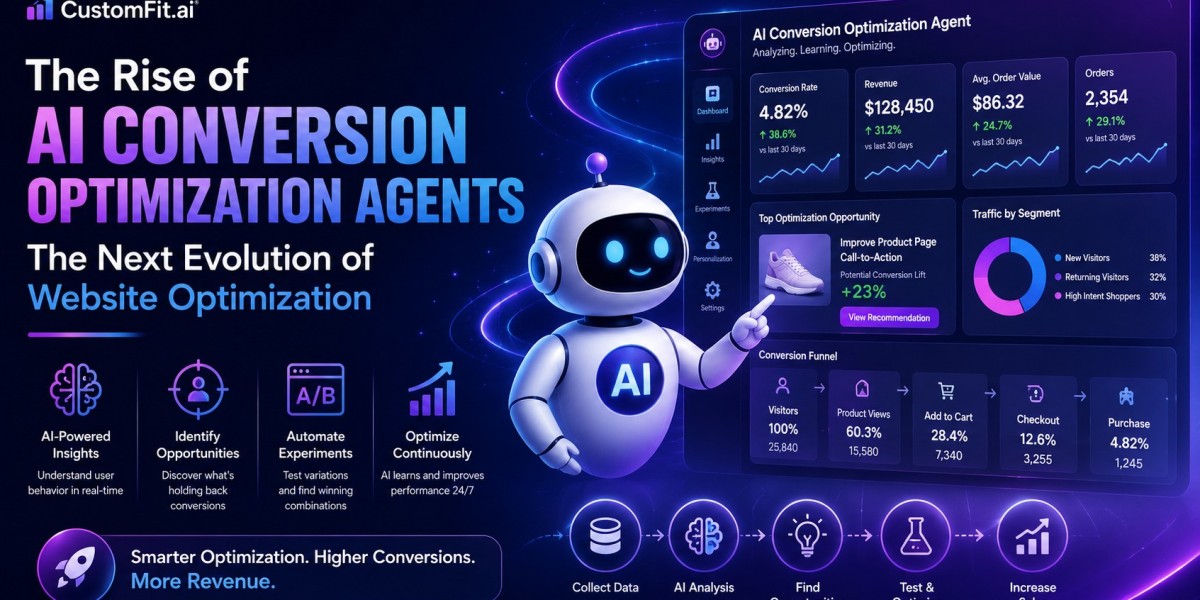
An AI conversion optimization agent is an intelligent system that continuously analyzes website data and automatically identifies opportunities to improve conversions.
Unlike traditional analytics platforms, AI actively participates in decision-making.
These systems can:
- Monitor visitor behavior.
- Detect conversion bottlenecks.
- Recommend optimization strategies.
- Create audience segments.
- Deliver personalized experiences.
- Automate experimentation.
Rather than relying entirely on human analysis, businesses can use AI to make optimization faster, smarter, and more effective.
Understanding Autonomous CRO Software
Autonomous CRO software expands the capabilities of AI by introducing automation throughout the optimization process.
Traditional optimization is often reactive.
Autonomous optimization is continuous.
Instead of requiring marketers to manually launch every experiment, AI-driven systems automatically:
- Collect behavioral data.
- Analyze customer interactions.
- Generate optimization recommendations.
- Test multiple variations.
- Measure performance.
- Apply improvements.
This creates a self-improving optimization cycle.
Why AI Conversion Optimization Agents Are Rising in Popularity
Growing Customer Expectations
Modern consumers expect personalized experiences.
They want:
- Relevant content.
- Personalized recommendations.
- Faster websites.
- Seamless checkout experiences.
Businesses that fail to meet these expectations risk losing customers.
AI helps brands adapt quickly by delivering experiences that align with customer preferences.
The Explosion of Ecommerce Data
Websites generate enormous amounts of information every day.
This includes:
- Click behavior.
- Product interactions.
- Customer journeys.
- Session recordings.
- Purchase histories.
- Engagement metrics.
Analyzing this information manually is becoming increasingly difficult.
An AI conversion optimization agent can process thousands of data points within seconds and uncover opportunities that humans might miss.
Faster Decision-Making
Traditional optimization often takes weeks.
Marketers must:
- Analyze reports.
- Develop hypotheses.
- Build experiments.
- Wait for statistical significance.
AI dramatically reduces this timeline.
Real-time analysis allows businesses to make faster decisions and implement improvements more quickly.
Better Personalization
Personalization has become one of the most powerful growth strategies in ecommerce.
AI can automatically personalize:
- Product recommendations.
- Homepage content.
- Promotional campaigns.
- Product pages.
- Landing pages.
Instead of showing every visitor the same content, AI delivers unique experiences based on individual behavior.
This significantly improves engagement and conversions.
How AI Conversion Optimization Agents Work
Step 1: Collect Behavioral Data
AI continuously monitors visitor interactions, including:
- Page visits.
- Clicks.
- Scroll depth.
- Time on page.
- Purchase activity.
This data provides valuable insights into customer behavior.
Step 2: Identify Conversion Bottlenecks
The system analyzes customer journeys to identify obstacles that prevent conversions.
Common bottlenecks include:
- Slow-loading pages.
- Poor navigation.
- Ineffective calls to action.
- Complex checkout processes.
- Irrelevant content.
AI identifies these problems automatically.
Step 3: Recommend Improvements
After identifying friction points, AI suggests optimization opportunities.
These recommendations may include:
- Redesigning landing pages.
- Simplifying navigation.
- Adjusting product page layouts.
- Improving checkout flows.
- Personalizing content.
Step 4: Automate Experimentation
Traditional A/B testing requires significant manual effort.
AI can automatically test:
- Headlines.
- Images.
- Product descriptions.
- Calls to action.
- Promotional messages.
Winning variations can then be implemented more quickly.
Real-World Ecommerce Applications
Product Page Optimization
AI identifies underperforming product pages and recommends improvements that increase engagement.
Checkout Optimization
Cart abandonment remains one of the largest ecommerce challenges.
AI identifies checkout friction and recommends changes that simplify the purchasing process.
Dynamic Product Recommendations
AI analyzes customer behavior and recommends relevant products in real time.
This improves:
- Product discovery.
- Customer engagement.
- Average order value.
Audience Segmentation
AI automatically groups visitors according to:
- Browsing behavior.
- Device type.
- Geographic location.
- Purchase history.
- Traffic sources.
This allows businesses to deliver highly targeted marketing campaigns.
Benefits of Autonomous CRO Software
Continuous Optimization
Optimization becomes an ongoing process instead of a periodic activity.
Reduced Dependence on Developers
Modern platforms provide no-code experimentation tools that allow marketers to launch campaigns without technical assistance.
Improved Customer Experiences
AI delivers personalized experiences that increase customer satisfaction.
Higher Conversion Rates
Continuous testing and optimization help businesses maximize every conversion opportunity.
Greater Scalability
Large ecommerce stores can simultaneously optimize multiple pages, campaigns, and customer segments.
AI Will Not Replace Marketers
One of the biggest misconceptions about AI is that it will eliminate human involvement.
In reality, AI enhances human capabilities.
Marketers remain responsible for:
- Brand strategy.
- Creative direction.
- Campaign planning.
- Customer communication.
AI simply automates repetitive tasks and provides better insights.
The most successful businesses will combine human creativity with AI-powered optimization.
The Future of Website Optimization
The future of optimization will focus on automation, prediction, and personalization.
Future AI systems will likely:
- Predict customer behavior before it happens.
- Optimize entire customer journeys automatically.
- Personalize every interaction in real time.
- Run thousands of experiments simultaneously.
- Continuously improve website performance without manual intervention.
Autonomous CRO software will become a standard technology for ecommerce businesses seeking sustainable growth.
Conclusion
The rise of the AI conversion optimization agent represents a major shift in digital marketing.
Traditional optimization methods can no longer keep pace with increasing customer expectations and growing amounts of behavioral data.
By combining artificial intelligence, experimentation, personalization, and automation, businesses can create smarter and more efficient optimization strategies.
As autonomous CRO software continues to evolve, AI-driven optimization will become the foundation of modern ecommerce growth.
Brands that embrace this technology today will be better positioned to increase conversions, improve customer experiences, and drive long-term revenue growth.