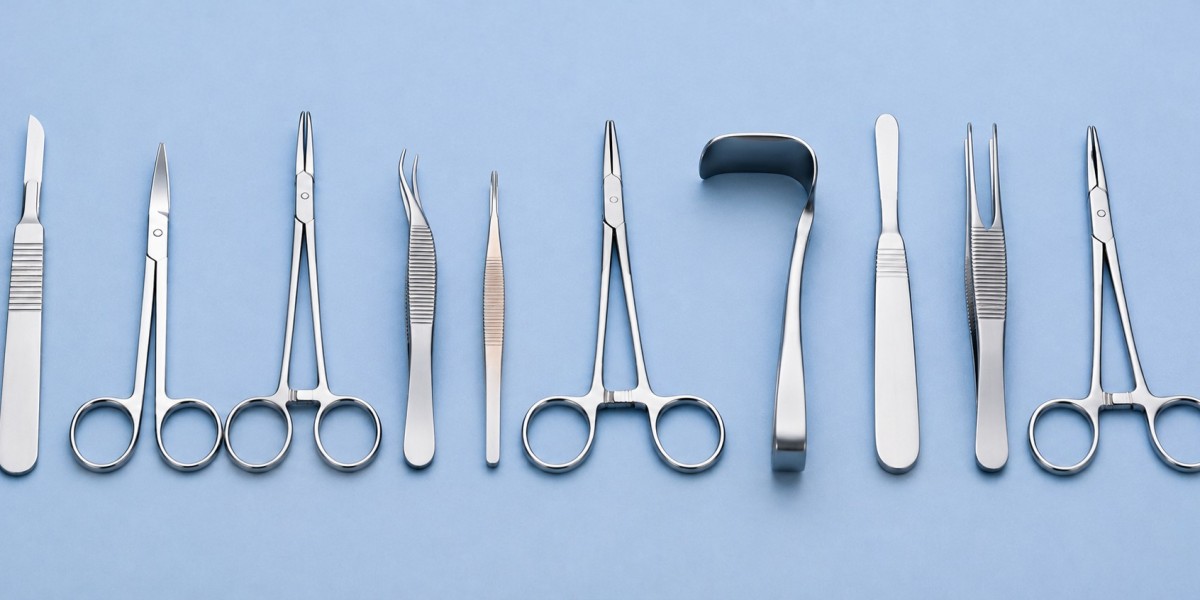

A scalpel handle and a needle holder solve completely different clinical problems, but buyers evaluating General Surgery Instruments often judge both the same way — by finish and packaging. That's the gap. The part that actually determines whether an instrument grips reliably, holds an edge, and survives hundreds of sterilization cycles happened weeks earlier, at the steel selection and forging stage, not at final polish. Understanding that engineering process changes how procurement teams evaluate manufacturers.
What Actually Happens Before a General Surgery Instruments Order Ships
Engineering a reliable instrument isn't one step. It's a sequence, and a weak link anywhere in that sequence shows up eventually in clinical use.
Steel Grade and Material Selection
Most General Surgery Instruments in this category are forged from martensitic stainless steel in the 410 to 440 series, chosen for the balance between edge retention, strength, and corrosion resistance under repeated autoclave cycles. This is the detail buyers frequently overlook — cheaper steel grades hold an edge poorly and corrode faster, a problem that doesn't show up until an instrument has already failed mid-procedure.
Forging and Heat Treatment
Instruments are hot-forged to rough shape, then heat-treated to reach a target hardness range, typically measured on the Rockwell C scale. Heat treatment that's rushed or inconsistent produces instruments that look identical on the shelf but perform very differently in the hand — one holds tension, another doesn't.
Grinding, Polishing, and Functional Testing
After heat treatment, instruments are ground to final dimensions, polished, and functionally tested for grip tension, joint movement, and cutting action before packaging. Skipping functional testing in favor of visual inspection alone is one of the more common shortcuts that shows up later as field complaints.
Five Questions That Separate Real Manufacturers From Traders
Can they name the exact steel grade used for a specific instrument? A bad answer is "surgical grade steel" without a number attached. Every legitimate manufacturer knows their steel specification by grade, not by marketing language.
What hardness range do they target after heat treatment? A bad answer avoids numbers entirely. A manufacturer who can't state a Rockwell hardness range hasn't controlled that step closely enough to actually know it.
Do they forge in-house or source forged blanks from a third party? A bad answer is evasive. Sourcing blanks isn't automatically a problem, but a manufacturer should be transparent about which parts of the process they actually control.
How do they validate function before shipping, not just appearance? A supplier who says "we visually inspect everything" doesn't have a functional testing process. Function testing catches problems visual inspection alone misses.
What's their policy when an instrument fails inspection after packaging? A supplier who says "we'll handle it case by case" doesn't have a real policy. That's a conversation worth settling before the first bulk order, not after a shipment is already in question.
Why Engineering Discipline Protects Your Business
Fewer field failures. Consistent steel grade and heat treatment reduce the risk of instruments failing mid-procedure, which carries far more cost than a delayed shipment.
Longer instrument lifespan. Properly treated steel withstands more autoclave cycles before losing edge retention or developing corrosion, extending usable life significantly.
Reduced liability exposure. Documented material and process traceability matters when a hospital or distributor requests compliance records.
Stronger negotiating position on price. Manufacturers who control their own forging and heat treatment can commit to fixed specs in writing, unlike traders reselling unverified stock.
Predictable reorder quality. When a manufacturer documents grade and hardness per batch, instrument three hundred performs like instrument one.
Better positioning for regulated markets. Buyers exporting to markets with strict medical device regulations need manufacturers who can produce traceable documentation on demand.
Why Location Shapes Engineering Quality
We operate out of Raja Garden, Basti Danishmandan in Jalandhar, Punjab — a region with a long-standing concentration of surgical instrument manufacturing expertise. That density of skilled labor and specialized equipment nearby isn't incidental to engineering quality.
It shapes what's actually achievable at scale.
Buyers comparing General Surgery Instruments Manufacturers in India should factor in this regional expertise directly, since Jalandhar's instrument-making tradition means access to forging and heat-treatment skills that newer manufacturing hubs simply haven't accumulated yet. The same applies when evaluating General Surgery Instruments Suppliers in India more broadly — sourcing from this region benefits from decades of craft knowledge that's genuinely difficult to replicate elsewhere. It's also worth asking General Surgery Instruments Wholesalers in India and General Surgery Instruments Dealers in India whether their stock actually originates from established regional manufacturers or gets blended from less experienced sources to meet volume demand.
What Nearly Six Decades of Forging Has Taught Us
We've been manufacturing since 1967, and we're ISO-certified, but neither fact explains how we actually catch a bad batch before it ships. What matters more is the inspection discipline behind every order.
We rejected an entire heat-treatment run in 2018 after hardness testing came back outside our target range on a random sample, even though the instruments looked visually identical to a passing batch. We melted them back down rather than shipping instruments we couldn't stand behind, which cost us the delivery deadline on that order. It's also the kind of call that nearly six decades of forging experience teaches you to make without hesitating.
What to Send Us to Get Started
If you're evaluating us for your general surgery instrument requirements, send us your required instrument list, target steel grade, and expected order volume. We typically respond within two business days with current specifications, hardness test data from recent batches, and MOQ terms. Our standard MOQ starts at 50 pieces per instrument type for new buyers, with sample orders available for evaluation before committing to volume.
The Bottom Line
The engineering behind General Surgery Instruments — steel selection, forging, heat treatment — determines far more about real-world performance than final polish ever will. General Surgery Instruments Manufacturers willing to walk you through that process, with numbers attached, are the ones worth building a long-term relationship with. Ask about the process before you ask about the price.
Frequently Asked Questions
What steel grade is typically used for General Surgery Instruments?
Most instruments in this category use martensitic stainless steel in the 410 to 440 series, chosen for the balance between edge retention, strength, and corrosion resistance. Ask your manufacturer for the exact grade rather than accepting "surgical steel" as a sufficient answer.
Do General Surgery Instruments Suppliers manufacture instruments themselves?
Not always. Some suppliers manufacture in-house, while others source finished instruments from third-party forgers and resell them under their own branding. Ask directly, since a vague answer here usually means the supplier isn't manufacturing.
How do General Surgery Instruments Wholesalers ensure consistent quality across bulk stock?
Reliable wholesalers source consistently from the same established manufacturers rather than blending stock across multiple sources to meet volume. Ask how they segregate and track inventory by source before committing to a large order.
Can General Surgery Instruments Dealers provide compliance documentation for regulated markets?
Only if they're passing along accurate manufacturer records rather than generic paperwork. A dealer without direct manufacturing knowledge is relying on what they were told, so request original batch documentation rather than a summary sheet.
How often should surgical instruments be re-sterilized before quality degrades?
This depends heavily on steel quality and heat treatment, but properly manufactured instruments typically withstand hundreds of autoclave cycles before showing meaningful wear. Instruments that degrade after a few dozen cycles usually indicate a steel or heat-treatment shortfall.
What's the biggest mistake buyers make when sourcing these instruments in bulk?
Judging quality from a small sample set instead of asking whether that sample reflects standard production. Some manufacturers hand-finish sample pieces more carefully than a full production run, which doesn't reflect what a bulk order will actually contain.
Is ISO certification enough to guarantee instrument quality?
Not on its own. ISO certification confirms a manufacturer follows a documented quality management system, but it doesn't guarantee every batch meets spec — ask for batch-level hardness and material test data alongside the certificate.