
Real-world asset (RWA) tokenization is becoming one of the most closely watched applications of blockchain technology. Instead of limiting blockchain to cryptocurrencies, tokenization connects blockchain infrastructure with assets that already exist in the traditional economy, including real estate, government bonds, private credit, commodities, artwork, and investment funds.
At its simplest, RWA tokenization means creating blockchain-based tokens that represent rights or interests connected to an underlying real-world asset. However, the process is much more complicated than simply creating a digital token. A successful tokenization model must connect the legal ownership structure, asset custody, compliance requirements, valuation, smart contracts, investor permissions, and blockchain infrastructure.
The market is already moving beyond experimentation. For example, BlackRock's BUIDL fund, tokenized by Securitize, surpassed $1 billion in assets under management in March 2025. The fund launched in March 2024 and provides qualified investors with on-chain exposure to U.S. dollar yields, demonstrating how tokenization can be applied to established financial products.
For beginners, understanding how RWA tokenization works requires looking at the complete journey from selecting an asset to issuing, managing, and potentially trading its digital representation.
What Is RWA Tokenization?
RWA tokenization is the process of representing ownership rights, economic interests, or claims associated with a physical or traditional financial asset through blockchain-based tokens.
Consider a commercial property valued at $10 million. Traditionally, purchasing an interest in that property may require substantial capital, legal documentation, intermediaries, and lengthy settlement processes. Through a properly structured tokenization model, the economic interest in the property could be divided into a large number of digital tokens. Each token could represent a defined fractional interest or economic claim, depending on the legal structure.
The important point is that the token itself does not automatically create legal ownership of the underlying asset. The relationship between the token holder and the real-world asset must be established through enforceable legal agreements, corporate structures, custodial arrangements, or other mechanisms.
This is why modern RWA systems are generally hybrid in nature. Research examining RWA systems highlights that blockchain handles functions such as representation, transfers, compliance controls, and settlement, while important legal guarantees often remain connected to off-chain entities and legal structures.
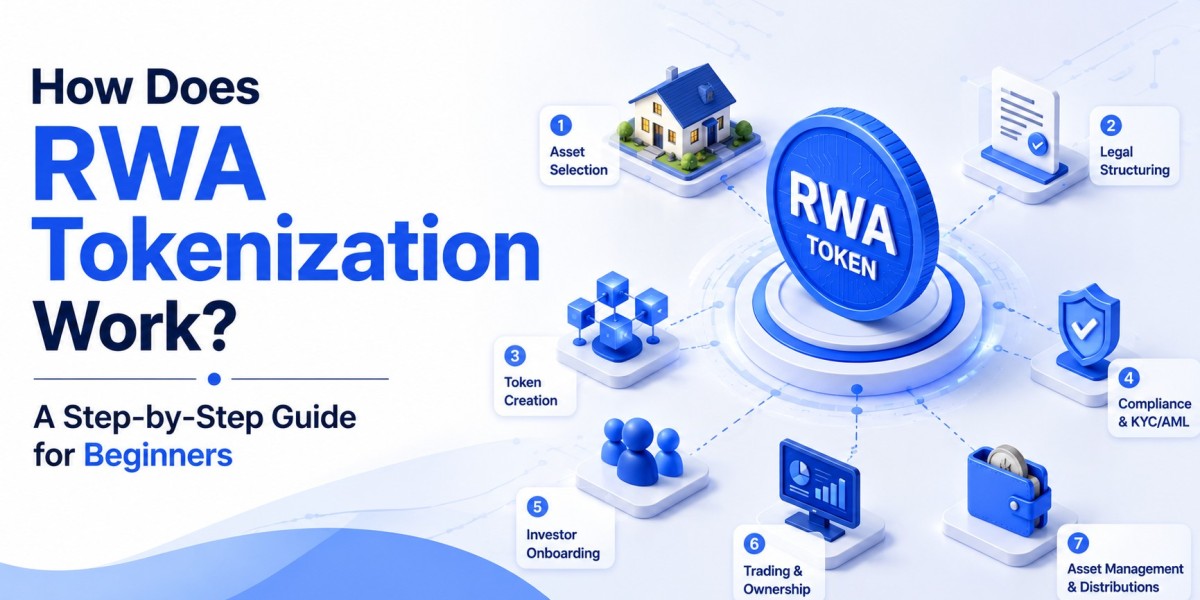
Step 1: Select and Evaluate the Real-World Asset
The first step is deciding which asset should be tokenized. Almost any asset cannot simply be placed on a blockchain without careful evaluation. The asset needs a clear ownership structure, reliable valuation methodology, appropriate documentation, and a realistic business case for tokenization.
Common examples include:
- Real estate
- Government securities
- Private credit
- Corporate bonds
- Investment funds
- Gold and other commodities
- Infrastructure assets
- Collectibles and artwork
The asset owner must determine what investors are actually receiving. Are they receiving direct ownership, shares in a special-purpose vehicle, a debt claim, revenue rights, or another economic interest?
This distinction is critical because the token's value and investor rights depend on the underlying legal arrangement.
Step 2: Establish the Legal and Regulatory Structure
Once an asset has been selected, the next stage is creating the legal framework that connects the blockchain token to the underlying asset.
For example, a real estate owner may establish a special-purpose vehicle (SPV) that legally owns a property. Investors may then purchase tokens representing interests in that entity. Depending on the jurisdiction and structure, the tokens may be classified as securities or another regulated financial instrument.
This stage normally requires legal analysis covering securities regulations, investor eligibility, ownership rights, transfer restrictions, taxation, anti-money-laundering requirements, and reporting obligations.
This is also one of the reasons RWA tokenization is different from launching a conventional cryptocurrency. A crypto token can be created technically within minutes, but a compliant RWA product requires the blockchain representation to align with real-world legal rights.
The Bank for International Settlements has emphasized that tokenization can improve efficiency and create new possibilities in financial markets, while also stressing the importance of sound institutional and regulatory foundations.
Step 3: Verify the Asset and Its Value
Before issuing tokens, the underlying asset must be verified.
For real estate, this may involve confirming property ownership, title documentation, valuation reports, insurance, liens, and other relevant records. For financial assets, verification may involve confirming the securities, reserves, issuer information, maturity, and custodial arrangements.
This process creates an important bridge between the physical world and blockchain.
Blockchain can provide a transparent record of token ownership, but it cannot independently determine whether a building actually exists or whether a company genuinely owns the asset. Trusted third parties, custodians, auditors, valuation providers, and data sources may therefore be required.
This is sometimes referred to as the oracle problem: blockchain systems need reliable information from outside the blockchain to represent real-world events accurately.
Step 4: Design the Token Economics
After the legal structure and asset verification are established, the token itself can be designed.
The token model determines what each token represents and how it behaves. For example, a $10 million property might theoretically be represented by 1 million tokens, with each token corresponding to a defined economic interest.
However, token supply is only one part of the design. Developers must determine:
- Token price and issuance structure
- Ownership rights
- Revenue or dividend distribution
- Redemption mechanisms
- Transfer restrictions
- Investor eligibility
- Voting rights
- Lock-up periods
- Token burning or minting rules
For regulated assets, transferability may be restricted to verified or whitelisted investors. This means that RWA tokens often require more sophisticated compliance functionality than ordinary utility tokens.
Step 5: Develop the Smart Contracts
The next step is implementing the tokenization logic through smart contracts.
Smart contracts are blockchain programs that automatically execute predefined rules. In an RWA platform, they can control token issuance, transfers, investor permissions, distributions, redemptions, and other processes.
For example, if only verified investors are allowed to purchase a particular token, the smart contract can be designed to prevent transfers to unauthorized wallet addresses.
Smart contracts can also automate distributions. Suppose investors are entitled to rental income from a tokenized property. Once the relevant conditions are met, the platform can distribute eligible payments according to the token holders' ownership percentages.
This programmability is one of tokenization's strongest advantages because financial rules can become embedded directly into the infrastructure rather than being handled entirely through manual processes.
However, smart contracts introduce their own risks. Coding errors, permission-management problems, oracle failures, and poorly designed upgrade mechanisms can create significant vulnerabilities. Thorough testing and independent auditing are therefore essential before deployment.
Step 6: Issue the Tokens on a Blockchain
After the smart contract has been tested and the legal and compliance framework is ready, the tokens can be issued on a selected blockchain network.
The choice of blockchain depends on factors such as transaction costs, scalability, security, interoperability, ecosystem support, privacy requirements, and regulatory needs.
Ethereum remains widely used for tokenized assets, but institutional projects are increasingly operating across multiple networks. BUIDL, for example, expanded to Solana in 2025, while its tokenized fund ecosystem was also available across several other blockchain networks.
The issuance process typically records token balances on-chain while the underlying asset remains under the control of the relevant legal entity, custodian, fund, or asset owner.
Step 7: Complete Investor Onboarding and Compliance
Tokenization does not remove traditional financial compliance requirements.
Investors may need to complete Know Your Customer (KYC), Anti-Money Laundering (AML), accreditation or eligibility checks, and other jurisdiction-specific requirements before purchasing tokens.
A compliant RWA platform can integrate identity verification and permission systems with the token infrastructure. An investor who passes the required checks may receive permission to hold or transfer a particular asset, while an unverified wallet may be blocked.
This creates an important difference between many RWA tokens and permissionless cryptocurrencies. The objective is not necessarily to make every asset freely transferable to anyone. Instead, the blockchain can provide programmable control over who can participate and under what conditions.
Step 8: Enable Trading, Settlement, and Asset Management
Once tokens have been issued, the final stage is creating a functioning ecosystem around them.
Depending on the structure, investors may be able to purchase tokens through a primary marketplace and potentially transfer or trade them through an approved secondary market.
Tokenization can make settlement more programmable and potentially reduce reliance on multiple intermediaries. BUIDL provides a practical example: Securitize reported that the tokenized fund offered near-real-time peer-to-peer transfers and later became usable as collateral across crypto trading venues.
However, tokenization should not automatically be equated with high liquidity. Putting an asset on a blockchain does not guarantee that buyers and sellers will appear. Research into tokenized RWA markets has found that tokenization and actual market liquidity are distinct outcomes, with trading activity varying significantly between asset categories.
A Simple Example of RWA Tokenization
Imagine a company owns an office building worth $20 million and wants to make investment participation more accessible.
First, the company establishes an appropriate legal entity to hold the property. The property is independently valued and its ownership documents are verified. The legal structure then defines what rights token holders receive.
Next, developers create a smart contract and issue, for example, 2 million tokens. If the structure provides proportional economic interests, each token could represent a defined fraction of the investment vehicle.
Investors complete the required KYC and eligibility checks before purchasing tokens. Smart contracts record ownership and can automate eligible income distributions. If the legal framework permits secondary transfers, compliant investors may later transfer their tokens through an approved marketplace.
The blockchain therefore becomes the digital infrastructure for managing ownership records and transactions, while the property, legal entity, custody arrangements, and regulatory framework continue to exist in the real world.
Why Businesses Are Exploring RWA Tokenization
The appeal of RWA tokenization comes from its potential to modernize parts of traditional asset markets.
Tokenization can support fractional investment, programmable transactions, transparent ownership records, faster settlement, automated distributions, and integration with blockchain-based financial applications.
Real estate is a particularly interesting example because traditional property markets often involve large capital requirements and complex transaction processes. A 2025 BIS working paper examining tokenized real estate specifically investigated whether tokenization could address some of the liquidity gaps associated with conventional real estate markets.
Financial institutions are also exploring tokenized funds and government securities because blockchain infrastructure can operate continuously and potentially connect assets with other digital financial applications.
For businesses planning these projects, specialized RWA tokenization services can help bring together the technical, legal, compliance, and operational components required for a complete tokenization ecosystem.
Key Challenges Beginners Should Understand
Despite its potential, RWA tokenization is not a shortcut around traditional asset-market problems.
The most important challenges include regulatory uncertainty, legal enforceability, asset valuation, custody, smart-contract security, investor protection, interoperability, and secondary-market liquidity.
Another misconception is that tokenization automatically makes an illiquid asset liquid. It can make ownership easier to divide and transfer technologically, but meaningful liquidity still requires market demand, appropriate regulations, reliable pricing, trading infrastructure, and willing buyers and sellers.
For this reason, an effective RWA tokenization solution should be designed around the entire asset lifecycle rather than focusing only on token creation.
Conclusion
RWA tokenization works by connecting real-world assets with blockchain-based digital representations through a combination of legal structuring, asset verification, smart contracts, compliance systems, token issuance, custody, and marketplace infrastructure. As institutional adoption grows, the technology is moving from an experimental blockchain concept toward a potential component of modern financial infrastructure. Businesses considering this model should therefore focus on creating a legally sound, secure, transparent, and scalable ecosystem rather than simply launching a token. Blockchain App Factory provides best services for businesses looking to develop secure and scalable RWA tokenization platforms, helping combine blockchain technology, smart contracts, token infrastructure, and business requirements into a comprehensive solution.
FAQs
1. What is RWA tokenization?
RWA tokenization is the process of representing ownership rights or economic interests in real-world assets through blockchain-based digital tokens.
2. What assets can be tokenized?
Real estate, government bonds, private credit, commodities, investment funds, artwork, and other suitable assets can potentially be tokenized.
3. Does an RWA token represent legal ownership?
Not automatically. The legal rights represented by a token depend on the underlying legal structure and applicable regulations.
4. Is RWA tokenization the same as cryptocurrency?
No. RWA tokens are generally connected to underlying real-world assets or financial claims, while cryptocurrencies typically function as native digital assets.
5. Why are smart contracts important for RWA tokenization?
Smart contracts can automate token issuance, transfers, compliance rules, distributions, and redemption processes according to predefined conditions.