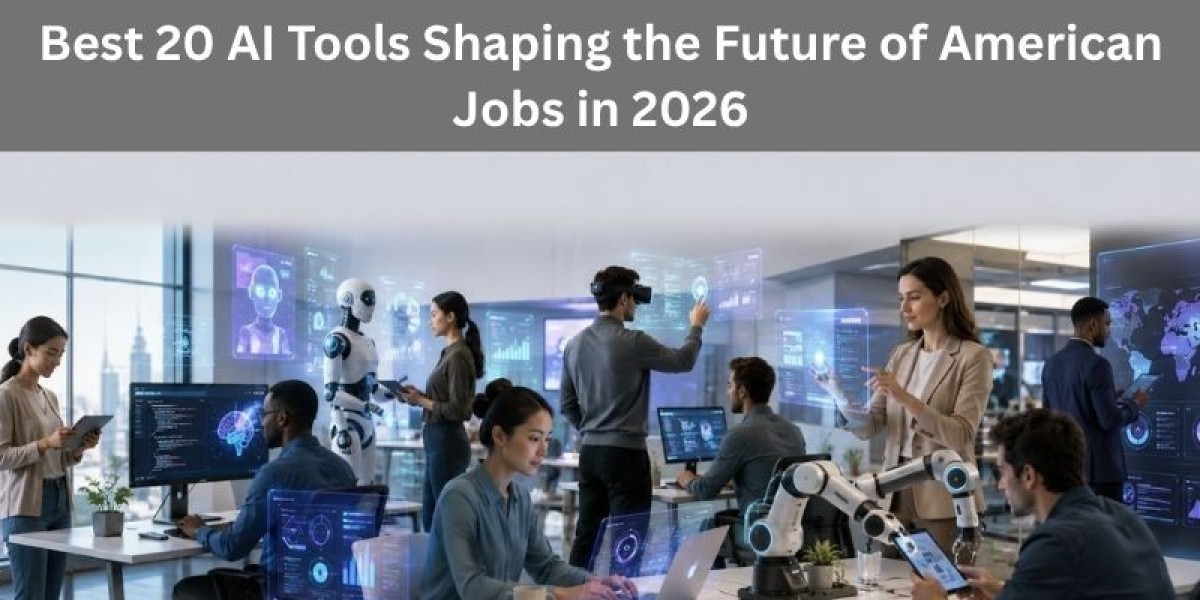

Artificial intelligence is rapidly becoming part of the American workplace. In 2026, employees across technology, marketing, finance, customer service, design, sales, education, and administration are using AI to complete tasks that once required significant amounts of manual effort.
The best 20 AI tools changing American jobs represent different stages of this transformation. Some help workers write and research, while others generate images, develop software, analyze information, automate workflows, manage customer relationships, and produce audio or video.
According to Stanford's 2026 AI Index, 88% of surveyed organizations reported using AI in at least one business function during 2025. Generative AI was used in at least one business function by 70% of organizations.
1. ChatGPT
ChatGPT is one of the most widely applicable AI tools for professional work.
Employees use it for drafting, brainstorming, research, summarization, coding, analysis, and planning. Because it can support many different tasks, it has applications across numerous industries.
Its importance comes from its ability to function as a general-purpose workplace assistant rather than a tool limited to one profession.
2. Microsoft 365 Copilot
Microsoft 365 Copilot integrates AI into Word, Excel, PowerPoint, Outlook, and Teams.
Professionals can use AI to summarize information, draft documents, analyze spreadsheets, prepare presentations, and work with communications.
This integration is significant because employees can use AI within software they already depend on for daily work.
3. Google Gemini
Google Gemini provides AI assistance for writing, research, analysis, brainstorming, and information processing.
Its integration with Google's broader ecosystem makes it relevant to employees already using Google Workspace and other Google services.
Gemini illustrates how workplace AI is increasingly becoming embedded directly into existing productivity platforms.
4. Claude
Anthropic's Claude is used for writing, coding, analysis, research, and document-heavy assignments.
Its ability to work with substantial amounts of text makes it useful for professionals who regularly handle reports, technical documentation, policies, and other written material.
Claude is also increasingly being used in enterprise environments.
5. GitHub Copilot
GitHub Copilot is transforming software development through AI-assisted programming.
Developers can use it for code generation, explanations, documentation, debugging, and increasingly complex development workflows.
The developer's role can consequently shift toward reviewing AI-generated code, testing implementations, defining requirements, and managing larger technical systems.
6. Cursor
Cursor is an AI-powered coding environment built around natural-language interaction with software.
Developers can ask AI to understand a codebase, modify files, generate solutions, and investigate technical problems.
This approach makes AI a more active participant in software development rather than simply a source of autocomplete suggestions.
7. OpenAI Codex
OpenAI Codex represents the growing use of AI agents for software-development tasks.
Agentic coding systems can work through larger assignments and multiple steps while developers supervise the process.
This technology demonstrates how software engineering is moving toward workflows in which humans define objectives and AI performs portions of the implementation.
8. Claude Code
Claude Code is another example of an AI coding agent.
Instead of assisting only with individual lines of programming, it can work across project files and perform sequences of development actions.
The emergence of these systems is changing the relationship between programmers and software tools.
9. Adobe Firefly
Adobe Firefly brings generative AI into professional creative workflows.
Designers and marketing professionals can use it to generate images, modify assets, explore concepts, and produce creative variations.
AI can therefore accelerate parts of visual production while human professionals continue to determine the creative direction and final result.
10. Canva AI
Canva AI makes AI-assisted design available to a much wider audience.
Employees can create presentations, promotional materials, social-media graphics, and other visual assets without extensive graphic-design expertise.
For smaller organizations, this can reduce the number of simple design tasks that must be sent to specialized teams.
11. Perplexity
Perplexity focuses on AI-assisted search and research.
Professionals can use it to explore unfamiliar topics, identify relevant information, and organize preliminary research.
For analysts, researchers, marketers, and consultants, AI-assisted information discovery can reduce the time spent on early research stages.
12. NotebookLM
Google's NotebookLM helps users interact with their own documents and source material.
Professionals can use reports, research papers, manuals, notes, and other documents as sources for AI-assisted analysis and summarization.
This makes the platform especially relevant to jobs that require extensive document review.
13. Notion AI
Notion AI combines AI with project documentation, notes, databases, and workplace knowledge.
Teams can use it to summarize information, draft content, organize notes, and manage project documentation.
The tool demonstrates how AI can reduce repetitive administrative work without necessarily replacing an entire role.
14. Grammarly
Grammarly applies AI to professional communication.
Employees can use it for drafting, rewriting, editing, and adjusting the tone of written material.
Its applications extend across emails, reports, proposals, marketing content, customer communications, and internal business documents.
15. Salesforce Einstein
Salesforce Einstein integrates AI into customer relationship management.
Sales and customer-service employees can receive AI assistance while working with customer records and existing business workflows.
This type of embedded AI is increasingly important because it connects artificial intelligence with real business information.
16. HubSpot AI
HubSpot AI supports marketing, sales, and customer-service activities.
Its AI capabilities can assist with content, research, customer communications, and campaign workflows.
Marketing employees can therefore spend more time reviewing and refining output while AI handles portions of routine content production.
17. Zapier AI
Zapier AI combines artificial intelligence with workflow automation.
It can help connect applications and automate repetitive digital processes such as moving information, updating records, sending notifications, and triggering business actions.
This shows that AI's impact extends beyond writing and creative work into everyday business operations.
18. ElevenLabs
ElevenLabs specializes in AI-generated speech and voice technology.
Businesses can use AI voices for voiceovers, localization, educational material, audio content, and other production requirements.
For organizations producing large volumes of audio, synthetic speech can significantly alter traditional production workflows.
19. Synthesia
Synthesia uses AI avatars to create business-oriented videos.
Companies can produce training, onboarding, educational, and internal communication videos using AI-generated presenters.
This can change how organizations produce instructional material, particularly when content needs frequent updates or multiple language versions.
20. DeepL
DeepL provides AI-powered translation and writing assistance.
American companies operating internationally can use the platform for multilingual documents, websites, communications, and other language-related work.
AI translation can accelerate routine language processing while human expertise remains important for specialized and sensitive material.
Why These Tools Are Changing American Jobs
The best 20 AI tools changing American jobs show that workplace transformation is occurring at the task level.
AI does not need to perform an entire occupation to significantly change a job. Automating several repetitive activities can alter how an employee spends the rest of the workday.
A marketer may spend less time producing initial drafts. A programmer may spend less time writing repetitive code. A customer-service employee may spend less time searching for information. A designer may create more visual concepts in less time.
The overall result is a gradual redistribution of workplace responsibilities.
AI Is Moving Toward Agentic Work
One of the most important developments in 2026 is the growth of AI agents.
Traditional AI systems generally wait for a user instruction and return an answer. Agentic systems can perform sequences of actions toward a broader objective.
Microsoft's 2026 Work Trend Index reports that organizations are increasingly experimenting with human-agent teams and AI systems capable of handling more complex workflows.
This could eventually change organizational structures by allowing one employee to supervise several AI-powered workflows.
Productivity Is a Major Driver
Companies are investing in AI partly because of its potential to increase employee productivity.
Stanford's 2026 AI Index reports productivity improvements in several structured areas, including customer support, software development, and marketing. The report cites gains ranging from approximately 14% to 15% in customer support to 26% in software development and 50% in marketing output in studies it reviewed.
The results vary by task, industry, and implementation, but they help explain why businesses continue adopting AI.
AI Skills Are Becoming Workplace Skills
As AI becomes more common, understanding how to work with these systems is becoming increasingly relevant.
Employees need to know how to evaluate AI-generated information, recognize errors, protect sensitive information, and determine when human review is necessary.
The World Economic Forum's Future of Jobs Report 2025 identifies AI and big data among the fastest-growing skill areas while also emphasizing analytical thinking, creative thinking, resilience, leadership, and technological literacy.
The combination suggests that future workplace skills will involve both technological familiarity and human judgment.
Not Every Job Will Change in the Same Way
AI exposure differs significantly between occupations.
Digital jobs involving structured information can often be affected more directly because their tasks can be performed inside software environments.
Jobs involving physical activity, interpersonal relationships, complex real-world environments, or highly specialized judgment may experience different forms of AI assistance.
This makes it difficult to describe AI as simply a technology that "replaces jobs." In many cases, the more immediate effect is changing the tasks that make up a job.
Early-Career Roles Face Particular Attention
AI's effect on entry-level work is receiving increasing attention.
Many junior positions include repetitive research, documentation, analysis, coding, and administrative responsibilities. These are also areas where AI tools can provide substantial assistance.
Stanford's 2026 AI Index reports that employment among software developers aged 22 to 25 had fallen nearly 20% from 2024, while also reporting that one-third of surveyed organizations expected AI to reduce their workforce over the following year.
The findings highlight why AI's effect on career entry points is becoming an important labor-market issue.
Human Judgment Still Matters
AI can produce text, images, code, translations, summaries, and recommendations, but output does not automatically equal correct output.
Professionals remain responsible for checking information, identifying mistakes, protecting confidential data, understanding context, and making final decisions.
This is particularly important in industries where incorrect AI output could create financial, legal, operational, or reputational consequences.
The emerging workplace therefore involves a combination of AI capabilities and human accountability.
High-Authority Sources for AI and Employment
The Stanford AI Index provides research covering AI adoption, investment, productivity, employment, and labor-market trends.
Microsoft's 2026 Work Trend Index examines AI agents, human-agent collaboration, productivity, and changing organizational structures.
The World Economic Forum's Future of Jobs Report provides research into changing jobs and skill requirements, including the growing importance of AI and big data.
Primary information about individual AI platforms is also available from OpenAI, Microsoft, Google AI, Anthropic, GitHub Copilot, and Adobe Firefly.
Conclusion
The best 20 AI tools changing American jobs represent a broad transformation in how work is performed in 2026. From ChatGPT and Gemini to GitHub Copilot, Firefly, Salesforce Einstein, Zapier AI, and other specialized platforms, AI is influencing writing, coding, research, design, communication, customer service, translation, and business automation.
The biggest change is occurring through individual tasks. AI can handle portions of routine or structured work, allowing employees to devote more attention to review, strategy, decision-making, and other responsibilities.
Research from Stanford, Microsoft, and the World Economic Forum shows that AI adoption is accelerating while the effects on jobs and skills remain uneven.
As AI capabilities continue to develop, American jobs are likely to evolve alongside them. The workplace of 2026 is increasingly defined not simply by human workers or AI systems alone, but by the growing interaction between the two.