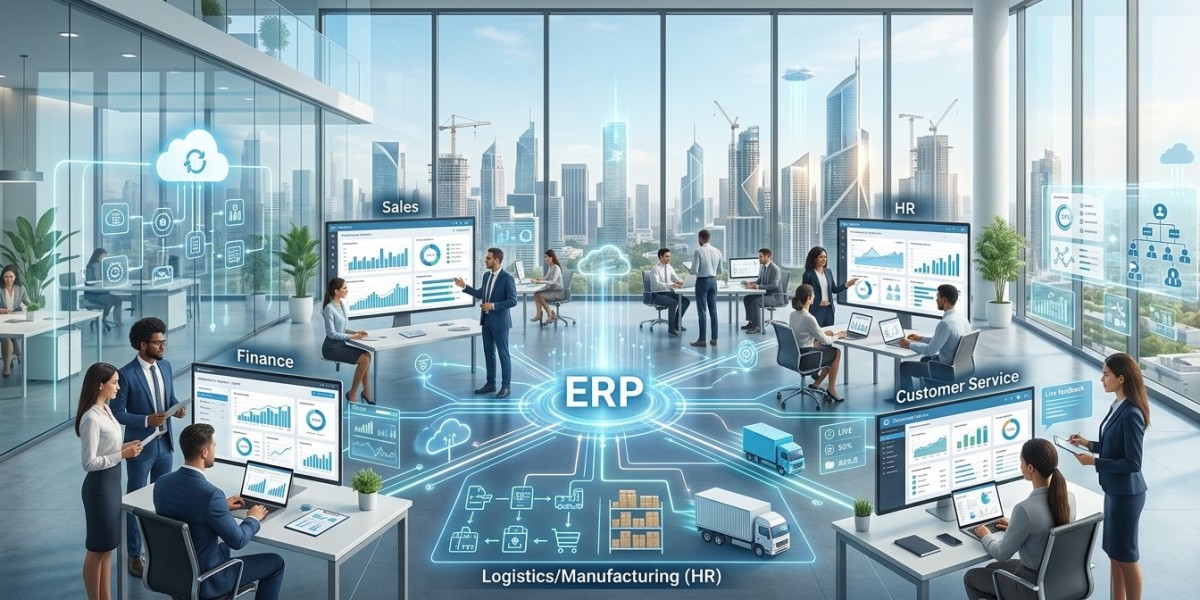

Every growing business reaches a point where spreadsheets, disconnected software, and manual processes start to slow things down instead of helping. Orders get delayed, inventory numbers don't match, finance teams spend hours reconciling data, and departments end up working in silos. This is usually the moment when companies start looking at ERP development as a way to bring order to the chaos.
ERP, or Enterprise Resource Planning, is not just another business tool. It is a system that connects the different parts of a company, such as finance, inventory, sales, human resources, and production, into one shared platform. When built correctly, it gives everyone in the organization access to the same accurate information at the same time. This article looks at how ERP development supports long-term business growth in practical, easy to understand terms.
What ERP Development Actually Means
ERP development refers to the process of designing, building, customizing, or configuring an ERP system so that it fits the specific needs of a business. Some companies choose to build a custom ERP from scratch, while others start with an existing ERP platform and adapt it through configuration and custom modules. Either way, the goal is the same: create a system that matches how the business actually operates, rather than forcing the business to change its processes to fit generic software.
This is an important distinction. Off the shelf software often works for a while, but as a company grows, its processes become more specific and its needs more complex. ERP development allows the system to grow alongside the business instead of becoming a limitation.
Bringing Information Together in One Place
One of the most immediate benefits of ERP development is data centralization. Before ERP, many businesses store information in separate places. Sales data lives in one tool, inventory numbers in another, and financial records in a third. None of these systems talk to each other, so someone has to manually pull data together whenever a report is needed.
ERP systems solve this by acting as a single source of truth. When a sale is recorded, inventory levels update automatically. When inventory changes, finance can see the impact on cost and revenue right away. This kind of connection reduces errors, saves time, and gives decision makers a clearer picture of what is actually happening in the business at any given moment.
Supporting Smarter Decision Making
Growth depends heavily on good decisions, and good decisions depend on accurate, timely information. When data is scattered across different systems, it is hard to trust any single report completely. Numbers may be outdated by the time they reach a manager's desk, or different departments may report slightly different figures for the same thing.
A well developed ERP system solves this by generating reports and dashboards directly from real time data. Business owners and managers can see sales trends, cash flow, stock levels, and employee productivity without waiting for someone to compile a report manually. This immediate access to reliable information helps leaders respond quickly to problems and opportunities, rather than reacting after the fact.
Improving Efficiency Across Departments
As businesses grow, the number of daily tasks and transactions increases significantly. Manual processes that worked fine for a small team often become a burden once the company scales. Employees spend more time on repetitive administrative work and less time on tasks that actually move the business forward.
ERP development addresses this by automating routine processes. Purchase orders, invoicing, payroll calculations, and stock updates can all be handled automatically within the system. This does not just save time. It also reduces the chances of human error, which can be costly when it comes to financial records or customer orders.
When departments are connected through one system, handoffs between teams also become smoother. For example, when a sales team closes a deal, the information can automatically flow to the finance team for invoicing and to the warehouse team for order fulfillment, without anyone needing to send separate emails or spreadsheets.
Adapting to Business Needs Over Time
No two businesses operate in the same way, and needs change as a company grows. A system that worked well for a business with twenty employees may not work at all once that business reaches two hundred employees or expands into new markets.
This is where custom ERP development becomes especially valuable. Instead of using a rigid, one size fits all system, businesses can build or configure their ERP to match their specific workflows. New modules can be added as new departments form. Reporting can be adjusted as new metrics become important. Integrations with other tools, such as e-commerce platforms or customer support software, can be built in as the business expands its operations.
This flexibility means the ERP system does not become outdated the moment business needs shift. Instead, it continues to support operations at every stage of growth.
Strengthening Financial Control
Financial visibility is one of the most important factors in sustainable growth. Without a clear view of income, expenses, and cash flow, it becomes difficult to plan for the future or make confident investment decisions.
ERP systems bring financial data together with operational data, so businesses can see not just how much money is coming in and going out, but why. For example, a company can track how a specific product line is performing, how much it costs to fulfill certain orders, or which departments are running over budget. This level of detail supports better budgeting, more accurate forecasting, and stronger overall financial discipline.
Helping Businesses Scale Without Losing Control
Growth often brings a difficult trade off. As a company expands, it becomes harder to maintain the same level of oversight and coordination that was possible when the team was small. Without the right systems in place, growth can actually create more confusion rather than more success.
ERP development helps solve this problem by giving businesses a structured way to manage growth. As more employees join, more products are added, or new locations open, the ERP system can be expanded to handle the added complexity. Instead of losing visibility as the company grows, businesses can maintain, and often improve, their level of control.
Supporting Better Customer Experiences
While ERP systems are often associated with internal operations, they also have a direct impact on customer experience. When inventory data is accurate, customers are less likely to order something that is actually out of stock. When order processing is automated, deliveries happen faster and with fewer mistakes. When customer service teams have access to accurate order and account history, they can resolve issues more quickly.
These improvements may seem small individually, but together they build trust with customers over time. A business that consistently delivers accurate information and reliable service has a stronger foundation for long-term customer relationships, which in turn supports steady growth.
A Long-Term Investment, Not a Quick Fix
It is worth being clear that ERP development is not something that produces results overnight. Planning, designing, and implementing an ERP system takes time, and businesses need to be involved in the process to make sure the system reflects how they actually work. There is also a period of adjustment as employees learn new workflows and processes.
However, the businesses that approach ERP development thoughtfully, taking the time to understand their own processes and choosing a system or development path that fits those needs, tend to see lasting benefits. The system becomes part of the operational backbone of the company, supporting everything from daily transactions to long-term strategic planning.
Conclusion
ERP development is ultimately about building a solid operational foundation that can support a business as it grows. By integrating data, automating routine tasks, improving financial visibility, and adapting to changing needs, ERP systems help businesses operate more efficiently and make better decisions. Growth is rarely just about doing more. It is about doing things in a way that remains organized, accurate, and sustainable, and this is exactly the kind of foundation that thoughtful ERP development can provide.