
Data is one of the most valuable assets for any business or application. Whether you are creating a small website, a business management system, or a large enterprise platform, organizing data correctly is essential for long-term success. Effective data modeling strategies help developers design databases that are efficient, scalable, and easy to maintain. Companies like WP-1click understand the importance of structured data because a well-designed database improves application performance, reduces errors, and supports future growth.
Data modeling is not just about creating tables and relationships. It is a systematic approach to understanding how information is stored, connected, and retrieved. A thoughtful data model allows businesses to manage increasing amounts of data without sacrificing speed or accuracy.
What Is Data Modeling?
Data modeling is the process of defining how data will be organized within a database. It provides a visual and logical representation of data elements, their relationships, and the rules that govern them.
The primary purpose of data modeling is to create a blueprint before database development begins. Instead of making structural decisions during development, teams establish a clear plan that reduces confusion and minimizes costly changes later.
A good data model helps ensure that information remains consistent, accessible, and secure throughout the application's lifecycle.
Why Data Modeling Matters
Without proper planning, databases often become difficult to manage as applications grow. Duplicate records, inconsistent information, and slow queries can create serious challenges.
An effective data model offers several important benefits:
- Improves data consistency across the application.
- Reduces duplicate information.
- Simplifies maintenance and future updates.
- Enhances application performance.
- Supports better reporting and analytics.
- Makes collaboration easier for development teams.
When databases are built on a solid foundation, future improvements become much easier to implement.
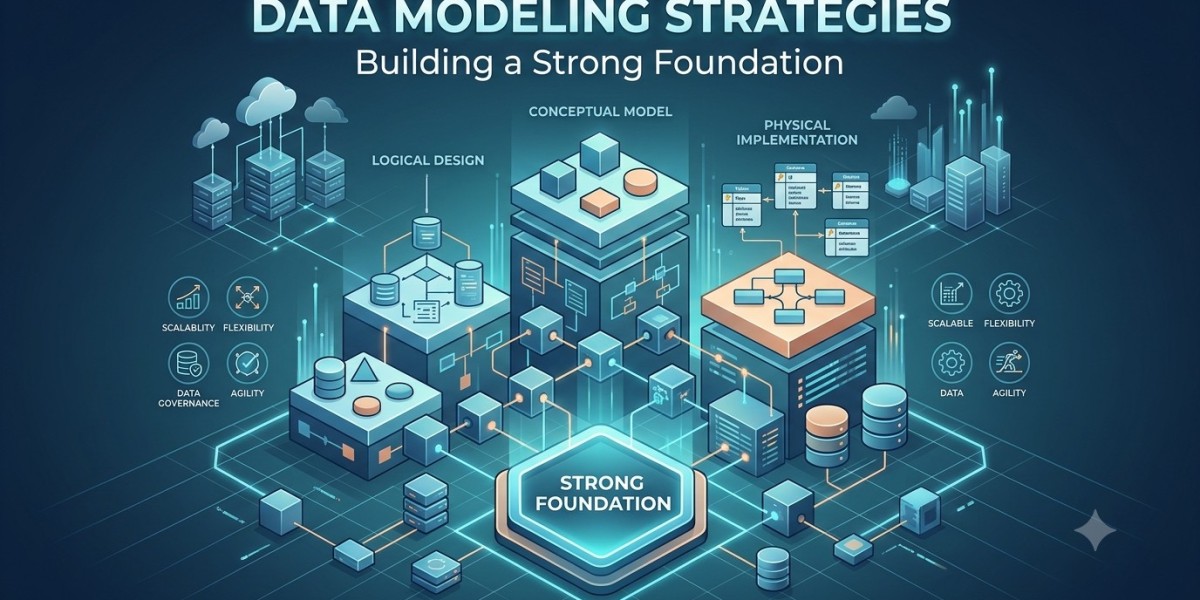
Understanding the Different Levels of Data Modeling
Data modeling generally follows three different levels, each serving a specific purpose during database planning.
Conceptual Data Model
The conceptual model provides a high-level overview of the system. It focuses on business requirements rather than technical implementation.
For example, an online shopping platform may include entities such as Customers, Products, Orders, and Payments without specifying table structures or data types.
This stage helps stakeholders understand the overall business process before technical design begins.
Logical Data Model
The logical model adds more detail by defining attributes, relationships, and business rules.
At this stage, designers determine:
- Primary entities
- Relationships between entities
- Required attributes
- Data validation rules
- Normalization requirements
The logical model remains independent of any specific database technology.
Physical Data Model
The physical model converts the logical design into an actual database implementation.
It includes:
- Table names
- Column data types
- Primary keys
- Foreign keys
- Indexes
- Storage considerations
- Performance optimization
This model serves as the final blueprint used during database development.
Core Data Modeling Strategies
Creating a reliable database requires more than simply connecting tables. Several proven strategies help ensure better performance and long-term scalability.
Focus on Business Requirements First
Every successful database begins with understanding business needs rather than technical preferences.
Before designing tables, identify:
- What information needs to be stored
- How users interact with the data
- Which reports will be generated
- Future expansion requirements
Starting with business goals ensures the database supports real-world operations effectively.
Use Normalization Wisely
Normalization organizes data to reduce redundancy and improve consistency.
The most common normalization levels eliminate duplicate information while maintaining meaningful relationships between tables.
Proper normalization helps:
- Prevent inconsistent records
- Save storage space
- Simplify updates
- Improve data integrity
However, excessive normalization may increase the number of joins required for complex queries. Finding the right balance is important.
Design Clear Relationships
Relationships are the backbone of relational databases.
The most common relationship types include:
- One-to-One
- One-to-Many
- Many-to-Many
Clearly defining these relationships ensures accurate data retrieval and reduces logical errors during application development.
Foreign keys play an important role in maintaining these connections while preserving referential integrity.
Select Meaningful Naming Conventions
Consistent naming conventions make databases easier to understand and maintain.
For example:
- Use descriptive table names.
- Keep column names consistent.
- Avoid abbreviations that may confuse future developers.
- Follow a standardized naming format throughout the database.
Readable structures reduce onboarding time for new team members and simplify long-term maintenance.
Optimize Data Types
Choosing appropriate data types directly affects storage efficiency and query performance.
Instead of using large text fields everywhere, select data types based on actual requirements.
For example:
- Integer for numeric identifiers
- Date for timestamps
- Boolean for true/false values
- Decimal for financial calculations
- Varchar for variable-length text
Using suitable data types reduces storage consumption while improving overall database performance.
Plan for Scalability
Many databases perform well during initial development but struggle as data volumes increase.
Scalable data models consider future growth by:
- Supporting larger datasets
- Allowing new entities
- Maintaining efficient relationships
- Avoiding unnecessary complexity
Planning for expansion early prevents expensive redesigns later.
Maintain Data Integrity
Data integrity ensures that stored information remains accurate, complete, and trustworthy.
Several techniques help maintain integrity, including:
- Primary key constraints
- Foreign key constraints
- Unique constraints
- Check constraints
- Validation rules
These safeguards reduce the risk of invalid or inconsistent records entering the database.
Improve Query Performance
Database performance depends heavily on how efficiently information can be retrieved.
Some practical optimization techniques include:
- Creating appropriate indexes
- Avoiding unnecessary joins
- Optimizing frequently executed queries
- Reducing duplicate calculations
- Archiving outdated records
Performance optimization should be considered during the design phase rather than after performance issues appear.
Document the Entire Data Model
Documentation is often overlooked but provides significant long-term value.
A well-documented data model should explain:
- Entity purposes
- Relationships
- Business rules
- Naming conventions
- Validation logic
Clear documentation improves collaboration among developers, database administrators, analysts, and future maintenance teams.
Common Mistakes to Avoid
Even experienced developers occasionally make design decisions that create future challenges.
Some common mistakes include:
- Designing without understanding business requirements
- Using inconsistent naming conventions
- Ignoring normalization completely
- Over-normalizing every table
- Creating unnecessary relationships
- Failing to define primary and foreign keys
- Skipping documentation
- Neglecting performance testing
Avoiding these issues early leads to more stable and maintainable databases.
Modern Approaches to Data Modeling
As applications continue to evolve, data modeling strategies have expanded beyond traditional relational systems.
Modern applications may combine relational databases with document databases, graph databases, or cloud-native storage depending on project requirements.
Even in these environments, the fundamental principles remain the same:
- Understand business needs.
- Organize information logically.
- Maintain consistency.
- Ensure scalability.
- Prioritize performance.
These principles continue to guide successful database design regardless of the technology being used.
In many projects, developers also rely on established database design patterns to solve recurring structural challenges efficiently while maintaining consistency across complex systems.
Best Practices for Long-Term Success
Successful data modeling is an ongoing process rather than a one-time task.
Regularly reviewing and refining the database helps ensure it continues to meet changing business needs. As applications grow, periodic optimization, updated documentation, and performance monitoring become increasingly important.
Teams should also encourage collaboration between business stakeholders, developers, database administrators, and analysts. Their combined perspectives often lead to better data structures that support both technical efficiency and business objectives.
Investing time in thoughtful planning ultimately reduces maintenance costs, minimizes future redesign efforts, and creates databases that remain reliable for years.
Conclusion
Data modeling is the foundation of every successful database system. A carefully planned model improves consistency, enhances performance, and prepares applications for future growth. By understanding business requirements, designing meaningful relationships, selecting appropriate data types, maintaining data integrity, and documenting the entire structure, organizations can build databases that remain efficient and dependable over time.
Rather than treating data modeling as a simple technical task, it should be viewed as a strategic investment that supports long-term application success. Applying proven strategies from the beginning creates databases that are easier to manage, adapt, and scale as business demands evolve. To further strengthen your database architecture and improve long-term efficiency, explore Optimized Relational Data Structures.