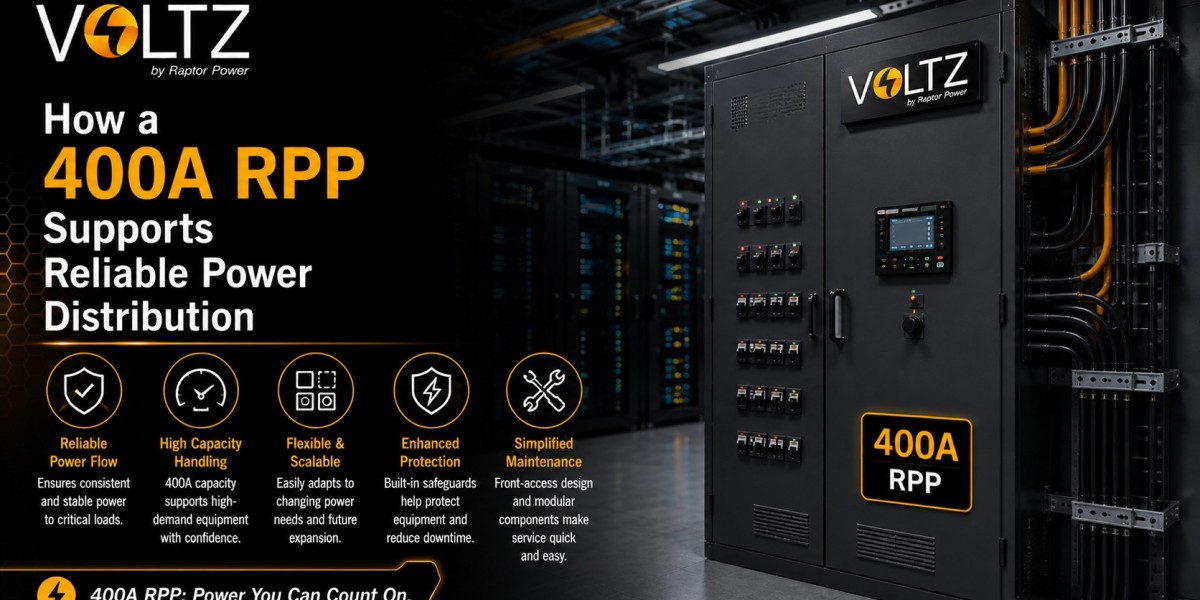

In modern data centers and enterprise computing facilities, keeping servers running continuously is not just about bringing massive amounts of utility power into the building. The true challenge lies in the final 50 feet of power delivery—taking hundreds of kilowatts from upstream transformers and safely splitting them into dozens of individual rack circuits without introducing single points of failure.
As rack power densities continue to climb due to high-performance computing, artificial intelligence workloads, and dense blade servers, traditional central Power Distribution Units (PDUs) are stretched to their limits. Dragging dozens of heavy copper conduit runs from a centralized panel on the far side of a data hall creates cable congestion under raised floors or in overhead trays, leads to line voltage drops, and increases the risk of human error during routine changes.
This is where a 400A RPP (Remote Power Panel) becomes a critical operational tool. Sitting directly between upstream power sources and equipment racks, a 400A RPP acts as a localized distribution anchor. By bringing circuit management directly to the server row, it stabilizes voltage, isolates electrical faults, simplifies maintenance, and ensures your critical infrastructure remains resilient.
The Hidden Failure Points in Traditional Power Distribution
To understand why a 400A RPP is vital for uptime, it helps to examine where power reliability usually breaks down in high-density facilities.
1. The Bottleneck of Long Branch Circuits
When every circuit originates from a main PDU located tens or hundreds of feet away, branch conductors must travel through crowded pathways. Long cable runs increase electrical resistance, causing voltage drops that force server power supplies to draw more current to compensate. Over time, this added heat degrades cable insulation and increases the likelihood of nuisance breaker trips.
2. Cable Congestion and Airflow Blockage
Bundling hundreds of branch cables into overhead ladder racks or underfloor plenums limits ventilation. In underfloor setups, dense cable mats physically block cooling air from reaching cold aisles, creating thermal hot spots in server racks. When ambient temperatures rise around power cables, their current-carrying capacity drops, introducing thermal risks to your power delivery network.
3. Human Error During Moves, Adds, and Changes (MACs)
In a crowded central panel feeding multiple rows, tracing a circuit wire back to its origin is difficult. When a field technician needs to service or add a circuit for a new server cabinet, identifying the correct breaker in a panel packed with 84 or 168 closely spaced switches becomes risky. Accidental trips of adjacent live breakers remain one of the leading causes of human-induced data center outages.
How a 400A RPP Anchors Reliable Power Delivery
A 400A RPP addresses these operational bottlenecks by decoupling bulk power transport from branch distribution. Instead of running dozens of small branch cables across the data hall, you run a few high-capacity feeder cables from your main UPS or PDU to a 400A RPP positioned inside or at the end of the server row.
Shortening the Final Conductor Distance
By locating sub-distribution directly adjacent to the server cabinets, branch circuit lengths drop from hundreds of feet to just a few paces. This reduction in physical conductor length provides immediate operational benefits:
Stable Line Voltage: Shorter copper runs virtually eliminate voltage drop, delivering clean, steady potential to server dual-corded power supplies.
Simplified Cable Management: Overhead or underfloor pathways only carry a few thick main feeder conduits rather than a chaotic mass of individual branch cables.
Faster Emergency Response: When an issue arises, technicians can immediately identify the corresponding distribution cabinet within the same row, drastically reducing Mean Time to Repair (MTTR).
The Four Pillars of Reliability Provided by a 400A RPP
Installing a 400A RPP does not simply add extra breaker slots; it establishes structural safeguards that prevent minor electrical glitches from escalating into catastrophic row-level outages.
1. True Dual-Source Redundancy (Side-A / Side-B)
In high-availability environments (such as Tier III or Tier IV facilities), maintaining continuous power requires complete concurrent maintainability. A dual-bus 400A RPP accommodates two completely separate power feeds—Feed A and Feed B—within a single cabinet enclosure.
Each incoming feed powers its own isolated busbar section. Server racks equipped with dual-corded power supplies draw from both Side A and Side B. If an upstream transformer fails, a utility transfer switch operates, or an entire upstream feed requires de-energization for routine maintenance, the secondary feed inside the cabinet carries 100% of the load without dropped packets or server resets.
At Voltz, our distribution cabinets are engineered with physical phase barriers separating Side-A and Side-B bus sections, ensuring an electrical arc or fault on one side cannot cross over to compromise the redundant feed.
2. Selective Fault Coordination
In poorly planned distribution networks, an electrical short inside a single server power supply can cause a chain reaction, tripping the main upstream breaker and taking down dozens of unrelated servers.
A properly configured 400A RPP relies on precise selective coordination. The trip response curves of the individual branch circuit breakers are precisely matched against the higher-capacity main input breaker:
Localized Tripping: When a short circuit occurs at the server rack level, the small 20A or 30A branch breaker trips instantly (within milliseconds).
Upstream Stability: The 400-amp main breaker and upstream PDU sources remain completely unaffected, isolating the fault exclusively to the problematic outlet while keeping the rest of the row running smoothly.
3. Thermal and Harmonic Stress Mitigation
Modern computing equipment relies on switch-mode power supplies (SMPS) that draw current in short, non-linear pulses rather than smooth sine waves. These non-linear loads generate triplen harmonics (3rd, 9th, and 15th harmonic frequencies) that return along the neutral line.
In standard commercial electrical panels, excessive harmonic currents cause neutral busbars to overheat, degrading insulation and posing a fire hazard. A heavy-duty 400A RPP addresses this risk through specialized engineering:
200% Rated Neutral Busbars: By doubling the copper cross-sectional area of the neutral bar relative to the phase bars, the cabinet easily carries accumulated harmonic currents without thermal buildup.
Solid Copper Bus Assemblies: Using solid, high-conductivity copper busbars instead of flexible stranded jumper wires lowers internal resistance and keeps operating temperatures low under heavy loads.
4. Safe Concurrent Maintenance (IP20 Touch Protection)
Reliability is directly linked to maintenance safety. If technicians cannot safely inspect or service a panel without risking an accidental contact short, routine preventive care gets delayed.
Modern 400A RPP enclosures incorporate clear, high-impact polycarbonate barriers over live internal components. This IP20 finger-safe design ensures that even when the main cabinet door is open for thermal scanning or wire tracing, primary busbars and high-voltage feeder lugs remain completely covered. Technicians can safely add new branch breakers or adjust monitoring wiring without exposing the room to arc flash risks or needing to shut down the entire panel.
Preventing System Overloads with Real-Time Monitoring
Physical durability is only half the battle when securing power reliability; the other half is operational visibility. You cannot manage capacity you cannot measure.
Running a 400-amp sub-distribution hub without real-time circuit tracking leaves facility managers vulnerable to sudden overloads. As server workloads auto-scale, current draw can rise rapidly on a single phase, leading to unexpected breaker trips.
By integrating a Branch Circuit Monitoring System (BCMS) directly inside the 400A RPP, facility teams gain pole-by-pole analytics:
Proactive Load Balancing: Identify phase imbalances early. If Phase A is drawing 280A while Phase C is drawing only 120A, technicians can re-balance branch connections before a single phase triggers an thermal overload alarm.
Threshold Warning Alerts: Configure automated DCIM alerts when any branch circuit exceeds 70% of its continuous rating, giving engineers ample time to adjust workloads long before reaching the 80% NEC continuous load cap.
Energy Analytics: Track exact kilowatt-hour (kWh) consumption per cabinet row, simplifying internal cost allocations and tenant billing in colocation facilities.
At Voltz, our intelligent 400A RPP platforms ship with pre-calibrated CT monitoring arrays that communicate natively via open Modbus TCP and SNMP protocols, giving you full data visibility without locking you into expensive proprietary software.
Practical Step-by-Step Guide: Deploying a 400A RPP for Maximum Reliability
To ensure your distribution panel operates smoothly throughout its operational lifespan, follow this practical deployment roadmap:
Step 1: Conduct a Spatial and Structural Audit
Verify that the floor location—whether raised floor or slab—can support the combined static weight of the cabinet, heavy copper feeders, and internal transformers. Ensure clear working space complies with local code requirements (such as NEC 110.26), maintaining at least 36 to 42 inches of front clearance for door swings and technician access.
Step 2: Implement Strict Phase Balancing During Termination
When landing downstream branch circuit cables for rack PDUs, balance phase loads sequentially across the 42 or 84 available pole positions:
1-Pole Loads: Distribute evenly across A, B, and C phases.
2-Pole & 3-Pole Loads: Group high-density 208V/415V connections so total current draw remains within a 10% tolerance margin across all three incoming lines.
Step 3: Perform Pre-Energization Torque Audits
Vibrations from transport and handling can cause mechanical wire lugs and busbar connections to loosen slightly. Before applying input voltage:
De-energize all incoming feeds (LOTO).
Use a calibrated torque wrench to verify every main lug, neutral terminal, and breaker connection against the manufacturer’s torque specs (typically stamped on the cabinet door label).
Perform a 1000V DC insulation resistance (megohmmeter) test to ensure no metallic debris or wire strands are causing internal shorts.
Step 4: Schedule Annual Thermal Scanning
Include infrared (IR) thermography in your routine preventive maintenance program. Scan incoming lugs, neutral busbars, and individual circuit breakers under peak operational load every 6 to 12 months. Any junction showing a temperature rise of 10°C or more above adjacent connections points to a loose lug or localized resistance that requires immediate cleaning and re-torquing.
Troubleshooting Operational Challenges in Sub-Distribution
Even high-performance power distribution systems can encounter operational issues if surrounding environmental conditions change. Here is how to diagnose and resolve common field issues:
Problem 1: Unexpected Breaker Trips at Normal Current Levels
Root Cause: Excessive cable crowding inside the side gutters traps heat, causing thermal-magnetic breakers to react as if the circuit is overloaded.
Solution: Re-organize branch cables using non-conductive ties to clear air pathways inside side gutters. Ensure wire insulation temperature ratings match environmental conditions (use 75°C or 90°C rated copper wire).
Problem 2: Overheating Neutral Bus Bar
Root Cause: Accumulation of 3rd harmonic currents from non-linear server power supplies, or severe phase current imbalance.
Solution: Audit phase distribution across all active pole slots using your BCMS dashboard. Rebalance single-phase loads across Phases A, B, and C, and confirm that the panel is equipped with a 200% rated copper neutral bar.
Problem 3: Intermittent Loss of BCMS Communication
Root Cause: Incorrect RS-485 signal polarity, duplicate Modbus network IDs, or missing 120-ohm end-of-line termination resistors on serial loops.
Solution: Check signal wiring polarity (+ and - lines), verify unique address assignments on the display controller, and verify that termination resistors are properly installed at the physical ends of the communication chain.
Frequently Asked Questions (FAQs)
1. How does a 400A RPP improve power distribution reliability compared to a standard wall-mounted subpanel?
A 400A RPP is specifically engineered for high-density computing environments. Unlike standard commercial wall panels, it features a freestanding rack form factor that places power distribution directly within server rows, eliminating long cable runs and reducing voltage drops. Additionally, it incorporates 200% rated neutral busbars, dual-feed split-bus options for true redundancy, IP20 finger-safe shielding, and integrated branch circuit monitoring designed to handle continuous non-linear IT loads without thermal degradation.
2. Can a 400A RPP support 100% continuous electrical loads under full operational conditions?
Standard NEC safety guidelines require continuous loads (operating for 3 hours or more) not to exceed 80% of an electrical panel's total rating, which limits a 400A panel to 320 amps of usable continuous current. However, selecting a unit constructed with heavy-duty solid copper busbars and engineered thermal ventilation ensures that the panel operates safely at this maximum 320A continuous threshold without experiencing premature thermal breaker trips or hot spots.
3. What role does selective breaker coordination play in maintaining data center uptime?
Selective coordination ensures that circuit breaker trip curves are calibrated so that downstream branch breakers trip much faster than the main upstream input breaker. If a short circuit occurs inside an individual server cabinet, only the specific 20A or 30A branch breaker protecting that rack trips. The 400A main input breaker remains closed, preserving power to all other server cabinets connected to the panelboard.
4. Why are 200% neutral busbars necessary for reliable sub-distribution in computing facilities?
Switch-mode power supplies found in modern servers draw non-linear currents that create triplen harmonics (3rd, 9th, and 15th harmonic orders). These harmonic currents do not cancel each other out on three-phase systems; instead, they add together along the neutral wire. A 200% neutral busbar provides twice the copper cross-sectional area of standard phase bars, safely carrying these additive currents without overheating or risking insulation breakdown.
5. How does an integrated Branch Circuit Monitoring System (BCMS) help prevent unexpected outages?
An integrated BCMS uses current transformers (CTs) on every breaker slot to continuously track current, voltage, active power, and power factor. By monitoring these metrics in real time through your DCIM software, facility managers receive early warnings when a phase becomes imbalanced or a circuit approaches its 80% continuous load cap, allowing proactive load rebalancing before a breaker trips.
6. What safety features in a 400A RPP protect technicians during live routine inspections?
High-quality distribution panels feature IP20 finger-safe touch protection, utilizing clear polycarbonate protective barriers over primary vertical busbars and high-voltage line lugs. This shielding allows qualified technicians to safely open access doors, perform infrared thermal imaging, trace wiring, or configure monitoring modules without coming into physical contact with energized high-voltage components.
Conclusion: Building a Resilient Power Architecture
Power reliability in modern data halls depends on smart, localized distribution choices. Relying on centralized PDUs with long, congested branch cable runs introduces unnecessary thermal risks, voltage instability, and human error into your facility.
Deploying a purpose-built 400A RPP brings clean, redundant, and monitored power directly to your server rows. With features like dual-feed split-bus isolation, 200% rated neutral bars, IP20 finger-safe protection, and real-time branch circuit monitoring, you establish a resilient infrastructure built for maximum uptime.
When you're ready to enhance your data center's sub-distribution network, trust the engineering expertise of Voltz to deliver reliable, robust power solutions tailored to your operational demands.