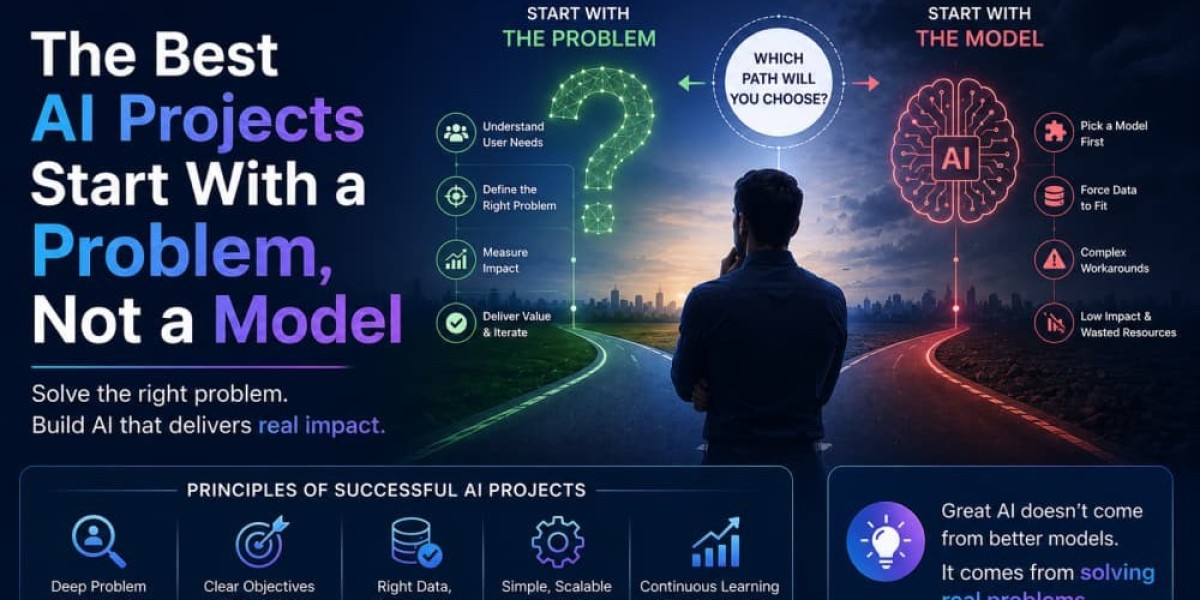

Most stalled AI programs share the same origin story: a model went looking for a job. A team saw a capable system, felt the pressure to act, then hunted for somewhere to put it. Gartner predicted that at least 30% of generative AI projects will be abandoned after proof of concept by the end of 2025, with unclear business value near the top of the reasons. That pattern is expensive, and it repeats.
The strongest AI consulting services in 2026 open somewhere else entirely. They start with a problem that already drains money, time, patience, or customers, then work backward to whether a model belongs anywhere near it. The deliverable is not a strategy deck describing where you could go. It is a governed path from a rough experiment to a production system that people trust and keep using. When a partner leads with the model, you inherit the abandonment risk. When the partner leads with the problem, the model becomes one option among several, judged on whether it moves a number that matters.
Why AI Consulting Services Should Start With a Painful Problem
A painful problem has three qualities: it is measurable, it recurs, and someone already owns the cost. Claims fall behind by four days at month-end. Support agents copy the same answer into 200 tickets a week. Underwriters re-key data across three systems because none of them talk to each other. These are not aspirations. They are frictions with a price tag, and that price tag is what makes the math of a project honest.
Starting here changes the first conversation. Instead of asking which model to use, a good partner asks what the four-day delay costs, who feels it, and what "fixed" would look like in numbers. That framing does two useful things at once. It filters out problems too vague to solve, and it hands you a baseline to measure against later. A team that cannot describe the current cost of a problem has no way to prove the solution worked.
The reverse order fails quietly. A model-first project produces impressive demos and thin outcomes, because the technology was never pointed at anything that hurt. MIT's Project NANDA, in its State of AI in Business 2025 study, found that 95% of enterprise generative AI pilots delivered no measurable profit-and-loss impact. The gap was rarely the model itself. It was the absence of a real problem, a workflow to change, and accountability for the result. Problem-first work closes that gap before a single prompt is written.
Picking Use Cases That Deserve a Budget
Not every painful problem deserves an AI project, and choosing well is a prioritization exercise rather than a wish list. A useful screen scores each candidate on three axes: the value at stake, the feasibility of a solution, and the organization's readiness to adopt it. High value with low feasibility becomes a research bet, not a first project. High feasibility with low value becomes a distraction that burns credibility. The first project should sit where value and feasibility both hold up.
A short prioritization pass keeps the shortlist honest:
- Value at stake: quantify the annual cost or missed revenue, and name the metric a solution would move.
- Feasibility: judge whether the data exists, whether the task is well defined, and whether a wrong answer is recoverable.
- Adoption readiness: check whether the people who would use the output actually want it and can fit it into their day.
- Time to signal: favor problems where a working version shows measurable value within a quarter, not a fiscal year.
Sequencing matters as much as selection. A first project that returns a visible result in weeks earns the trust and budget for harder work later. Good artificial intelligence consulting services resist the urge to open with the most ambitious idea. They open with the one most likely to prove the approach, then use that proof to fund the ambition.
The scoring also protects you from a subtler trap: the impressive idea that no one asked for. A prioritized shortlist forces a conversation with the people who own the problem, and that conversation surfaces constraints a slide never shows. An underwriting team may need explanations they can defend to a regulator, not just an answer. A support desk may need a draft a human approves, not an autonomous reply. Ranking candidates against real value, real feasibility, and real willingness to adopt keeps the first project pointed at something the business will actually use.
Data and Feasibility: An Honest Look Before the Build
Feasibility lives or dies on data, and this is where optimistic projects meet reality. Before anyone commits to a build, a competent partner runs a plain assessment: where the relevant data sits, how clean it is, who governs it, and whether it can be used for this purpose without legal or privacy trouble. That assessment often reshapes the plan. A problem that looked ready sometimes needs three months of data work first, and it is far cheaper to learn that in week two than in month six.
The honest look covers a few concrete questions:
- Availability: does the data needed to solve the problem exist, and can the project access it in practice, not just in theory?
- Quality: how complete, current, and consistent is it, and what breaks if the gaps stay?
- Lineage and rights: who owns the data, where did it come from, and does using it for this purpose respect consent and regulation?
- Ground truth: is there a reliable way to know when the system is right, so accuracy gets measured rather than assumed?
Skipping this step is the most common reason pilots collapse. A model trained or prompted against messy, poorly governed data produces confident nonsense, and the failure surfaces only after money is spent. Treating data and feasibility as the first deliverable, rather than an afterthought, is what separates a serious engagement from a demo. It also sets a realistic scope, because you now know what the build actually requires.
A Governed Path From Pilot to Production
A pilot proves a model can work once, under friendly conditions. Production means it works every day, for real users, under load, with monitoring and a way to recover when it drifts. The distance between those two states is where most projects die, and crossing it is the real product of good AI solutions consulting. The path is deliberate, and each stage carries an exit test.
A workable progression looks like this:
- Scoped experiment: a narrow build against real data that answers whether the approach moves the target metric at all.
- Guarded pilot: a limited release to a small group, with human review, clear boundaries, and logging on every decision.
- Controlled rollout: expansion to more users once accuracy, cost per transaction, and adoption clear agreed thresholds.
- Sustained production: full operation with monitoring, retraining triggers, an owner, and a documented rollback plan.
Each stage carries a decision, not just an activity. Money flows to the next stage only when the current one passes its test, which keeps a weak idea from consuming a full budget before anyone admits it stalled. This staged model is also how cost stays visible. Instead of one large commitment made on hope, spending tracks evidence. A partner who cannot describe how a pilot graduates to production, with named gates and owners, is selling a demo dressed as a program.
Where AI Solutions Consulting Earns Its Return
Return on an AI project is a business number, not a technical one, and it should be defined before the build starts. The baseline captured during problem framing becomes the yardstick: hours returned to underwriters, days cut from month-end close, tickets resolved without escalation, revenue recovered from faster quotes. When the metric is set early, the argument for continuing or stopping stays grounded in evidence rather than enthusiasm.
Mature AI solutions consulting frames value in three layers. Direct savings come from work that no longer needs doing by hand. Capacity gains come from the same team handling more volume without adding headcount. Risk reduction comes from fewer errors, better audit trails, and faster response to problems. A single project rarely delivers all three, and naming which layer a project targets keeps expectations honest and the review objective.
Total cost belongs in the same view. Model usage, data preparation, integration, monitoring, and the human review that keeps outputs safe all carry ongoing expense, and a return calculated on model cost alone flatters the result. A trustworthy artificial intelligence consulting company shows the full cost against the measured gain, then revisits both after launch. That discipline is what turns a promising pilot into a defensible line in next year's budget.
Set the review cadence early too. A quarterly check against the original baseline catches drift while it is still cheap to correct, and it gives finance a reason to keep funding what works. Numbers that move in the wrong direction become a signal to adjust or retire the system, not a surprise discovered at renewal. Value that gets measured on a schedule stays honest, and honest value is what earns the next project.
Governance and Risk You Set Before the First Model Ships
Governance is cheapest when it is designed in, and most painful when it is bolted on after an incident. Before a model reaches real users, a serious engagement settles a short list of questions:
- who is accountable for the system's decisions
- what a wrong answer could cost
- how sensitive data is protected
- how the behavior stays explainable to a regulator or an auditor
These answers shape the build; they are not paperwork filed afterward.
Practical governance rests on a few commitments:
- Clear ownership: A named person accountable for the system in production, not a committee that meets once a quarter.
- Human oversight: Defined points where a person reviews or can override the model, sized to the stakes of the decision.
- Data protection: Controls on what the system sees, retains, and exposes, aligned to the regulations that apply to your sector.
- Traceability: Logging that lets anyone reconstruct why a given output happened, months after the fact.
Risk work also means naming what the system will not do. Boundaries keep a helpful tool from wandering into decisions it was never validated for, and they give users confidence that the guardrails are real. The projects that reach production and stay there treat governance as part of the design brief. That is the quiet difference between a model that impresses in a demo and a solution the business can defend, operate, and grow.
Start with the problem that costs you the most, and let it decide everything downstream. The value of practical AI consulting services shows up not in the ambition of the plan but in the discipline of the path: a measurable problem, a prioritized use case, honest data work, staged gates from pilot to production, and governance set before launch. That sequence turns experimentation into a system people trust. To pressure-test your hardest problem against this approach, explore a problem-first AI consulting services engagement and map the route from idea to production before committing a budget. The next breakthrough will not come from a better model chasing a use case. It will come from a sharper problem, solved on a governed path.