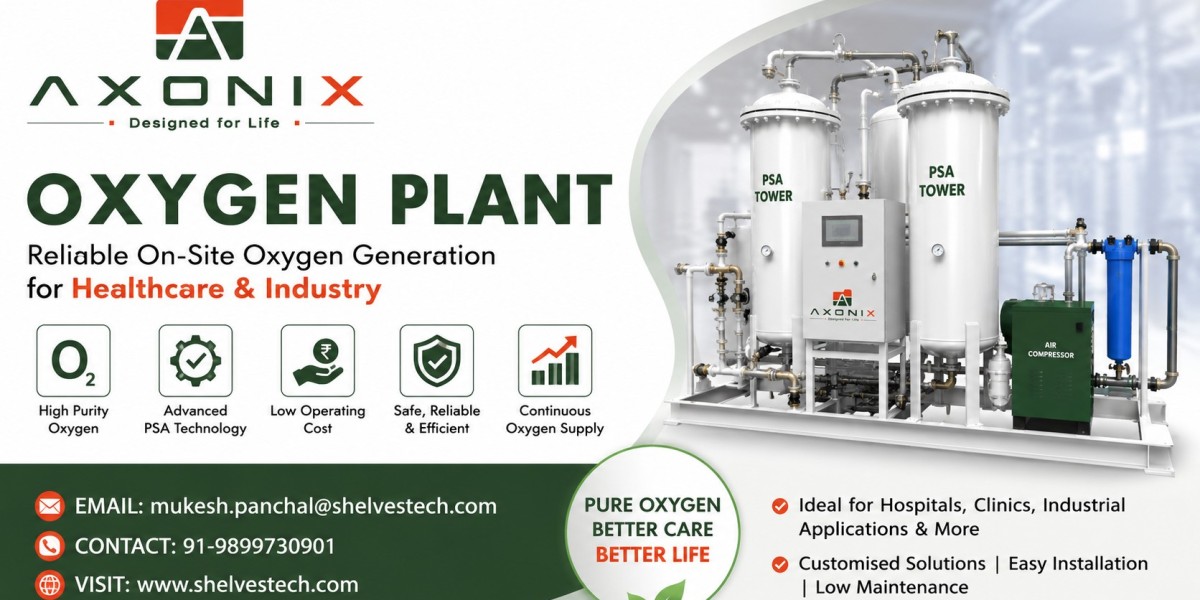

During the second wave, a 120-bed hospital in Indore ran through its entire cylinder reserve in under six hours because ICU occupancy tripled overnight. That hospital survived on borrowed cylinders from three different suppliers, none of whom could guarantee a second delivery the same day. An Oxygen Plant would have changed that entire situation — not eliminated the surge, but removed the single point of failure that turned a medical crisis into a logistics crisis. Hospitals that lived through that period didn't need convincing afterward. The ones still running on cylinders today are usually the ones who assumed it wouldn't happen to them.
Nobody plans for oxygen demand at 3 a.m. on a Sunday. Which is exactly why an on-site plant matters more than most hospital administrators initially think — it doesn't ask for a delivery window, doesn't care if it's a holiday, and doesn't depend on a supplier's truck making it through traffic in time.
Specification — What a Hospital-Grade Oxygen Plant Actually Requires
A hospital-grade Oxygen Plant isn't the same build as an industrial unit, even though both rely on Pressure Swing Adsorption technology at the core. The difference sits in the compliance layer — monitoring frequency, redundancy requirements, and documentation standards that industrial buyers simply don't need.
Hospital-Specific Build Requirements
Dual-tower PSA configuration for uninterrupted output during sieve bed regeneration cycles
Continuous oxygen purity monitoring with automated alarm thresholds
Backup power integration for compressor and control systems
Medical-grade piping compatible with existing hospital gas manifold systems
Documented purity logs for NABH and state health department audits
The Detail Hospitals Consistently Underestimate
Purity for medical applications must hold at 93% ± 3% continuously, not just at commissioning. What administrators frequently miss: purity monitoring needs calibration checks on a fixed schedule, not "whenever someone remembers." A sensor that drifts uncalibrated for eight months can report false-positive purity readings while actual output quietly falls out of spec — and nobody notices until an audit catches it, or worse, a patient outcome raises the question first.
Bed count matters more than most facilities realize when sizing a plant. A 50-bed facility with a 10-bed ICU has wildly different peak demand than a 50-bed facility with two ICU beds, even though the total capacity looks identical on paper.
Objective — 5 Questions Every Hospital Should Ask Before Choosing an Oxygen Plant Supplier
Procurement committees often default to comparing quoted capacity and price per Nm³. That misses the questions that actually determine whether the plant holds up during a real emergency.
Does the manufacturer provide NABH-aligned documentation from day one? Bad answer: "We can arrange documentation once the PO is confirmed." That delay leaves your compliance team scrambling during your next accreditation cycle.
What's the actual guaranteed output during peak simultaneous demand? Bad answer: a flat capacity number with no mention of simultaneous multi-ward draw. Peak ICU demand doesn't look like average daily consumption — ask for both figures.
How fast can a technician physically reach the hospital during a failure? Bad answer: "Our support team is available 24/7" without a stated travel radius or response window. Availability on a phone line isn't the same as a technician standing at your compressor room door.
Is there a backup protocol if the plant goes down entirely? Bad answer: "That's unlikely to happen." Every plant fails eventually — the question is whether the supplier has a cylinder backup arrangement built into the contract, or whether you're left improvising.
What does the warranty actually cover for sieve bed degradation? Bad answer: "We'll assess it case by case when it happens." That's not a warranty — that's a conversation you'll have leverage in only until the invoice is paid.
Benefits — How an Oxygen Plant Reduces Clinical and Financial Risk
An oxygen supply failure in a hospital isn't a budget problem first — it's a patient safety problem that becomes a budget problem the moment litigation or accreditation review enters the picture.
Hospitals running purely on cylinder logistics carry a layered cost structure that rarely gets audited properly: rental charges on cylinders sitting in storage, demurrage on delayed trucks, overtime for staff managing emergency deliveries, and the reputational cost of a documented supply gap during an inspection. An on-site plant collapses most of that into one predictable operating cost.
Continuous supply independent of external delivery risk — critical during regional shortages or transport disruptions
Lower cost per litre over the plant's operating life compared to ongoing cylinder procurement
Documented, auditable purity logs that support NABH and JCI accreditation reviews
Reduced on-site cylinder storage — fewer pressurized vessels means lower staff handling risk
Scalable capacity for facilities planning ICU or bed-count expansion
Predictable maintenance budgeting instead of reactive emergency procurement costs
Availability — Oxygen Plant Manufacturers, Suppliers, and Exporters Serving Hospitals in India
Where your plant is manufactured determines more than delivery time — it determines how quickly a service engineer reaches your compressor room during a 2 a.m. failure.
Shelves Tech is counted among the active Oxygen Plant Manufacturers in India, supplying government and private hospitals, medical colleges, and teaching institutions across the country. As one of the Oxygen Plant Suppliers in India manufacturing domestically, response times for hospitals in tier-2 cities stay meaningfully shorter than what importers or metro-only suppliers typically offer. For institutions or partners requiring cross-border supply, Shelves Tech also operates among Oxygen Plant Exporters in India, handling export documentation for international healthcare buyers.
One insight worth flagging: hospitals located outside major metro clusters often face the longest emergency response windows from suppliers headquartered elsewhere. A plant with local manufacturing and service infrastructure closes that gap — proximity isn't a convenience here, it's a clinical safety factor.
About Us
We build oxygen plants specifically for hospitals because we've watched too many facilities get sold industrial-grade systems repackaged with a medical label slapped on, with none of the monitoring rigor a hospital actually needs. Manufacturing everything in-house means we control the calibration standards on our purity sensors ourselves, instead of trusting a third-party component supplier's spec sheet.
A few years ago we started shipping every hospital-grade unit with a dedicated calibration log book as standard, not an optional add-on. We made that change after seeing how often purity drift went unnoticed simply because nobody had a structured way to track it. It added a small cost to every unit. We kept it anyway, because a hospital finding out about drift during an audit is a worse outcome than us absorbing that cost upfront.
Our engineers handle commissioning directly with hospital biomedical teams — not through a reseller relaying specifications back and forth.
Call to Action
Send us your bed count, ICU capacity, and current oxygen sourcing method (cylinder, PSA, or liquid oxygen), along with your facility location. We respond to hospital procurement enquiries within 24 hours on working days. Minimum order quantity is one unit — hospital-scale installations don't need bulk commitments to get proper sizing and support. Reach out to Shelves Tech through our website, and we'll configure a system around your actual ICU and ward demand, not a generic bed-count formula.
Conclusion
An Oxygen Plant stops being a discretionary upgrade the moment a hospital's patient safety depends on uninterrupted supply, and most facilities only realize that after a near-miss. The manufacturers worth trusting are the ones who build for peak demand, not average demand, and who document everything before you ask. Plan for the surge now, while you still have the choice.
FAQs
How does an Oxygen Plant improve patient safety compared to cylinder-based supply?
It removes dependency on delivery timing entirely. Cylinder supply works fine until demand spikes or a truck gets delayed — a plant keeps generating regardless of what's happening outside the hospital gates.
Can existing hospitals retrofit an Oxygen Plant without disrupting operations?
Usually yes, though it depends on existing manifold infrastructure. Retrofits typically take longer than new-build installations because piping integration has to work around an operational facility — we won't pretend that part is simple.
How do Oxygen Plant manufacturers in India differ in hospital-specific compliance support?
Some manufacturers build the same core system for hospitals and factories alike, adding only a purity sticker for medical claims. Others, including facilities built with continuous monitoring and NABH-aligned documentation from the start, treat hospital compliance as a design requirement, not an afterthought.
What's the real difference between Oxygen Plant suppliers and manufacturers for hospital procurement?
Manufacturers control the build quality of critical components like sieve beds and compressors directly. Suppliers frequently resell third-party units — which becomes a real problem when a compliance issue traces back to a component nobody at the supplier actually built or tested.
How often does hospital oxygen purity monitoring need calibration?
We recommend calibration checks on a fixed quarterly schedule at minimum, tighter for high-ICU-load facilities. Skipping this is the single most common reason hospitals discover purity drift during an audit instead of catching it in routine maintenance.