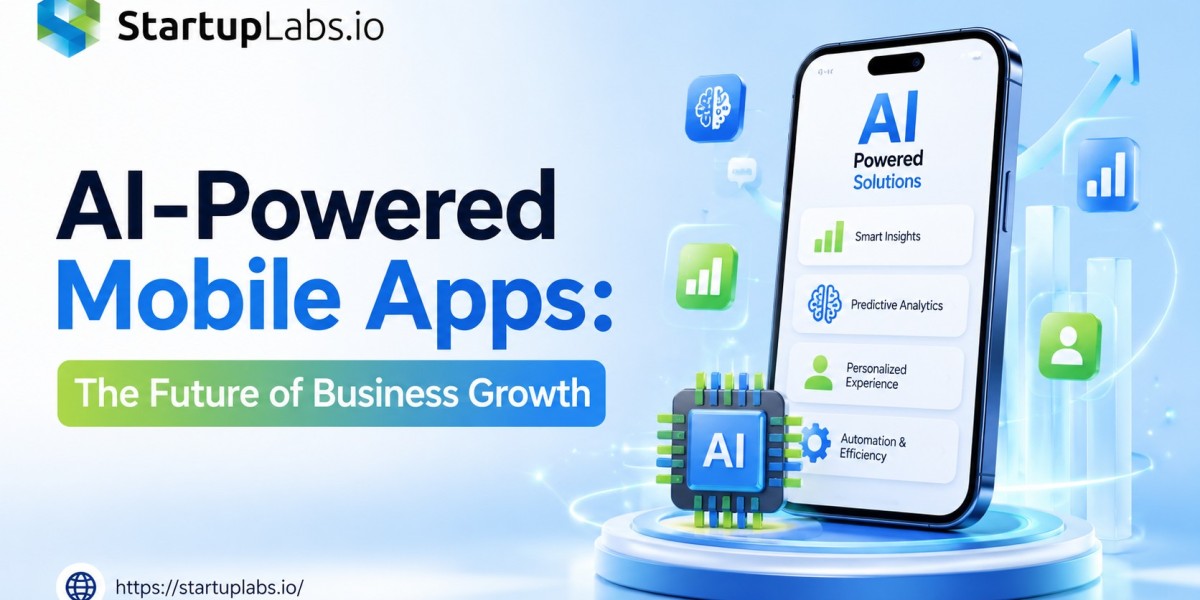

Artificial intelligence (AI) is no longer limited to research labs or large enterprises. Today, businesses of every size are integrating AI into mobile applications to improve customer experiences, automate operations, and make smarter business decisions. From personalized shopping recommendations to AI-powered virtual assistants, intelligent mobile apps are becoming a competitive advantage across industries.
As consumer expectations continue to rise, businesses that invest in AI-powered mobile apps are better positioned to deliver faster services, higher engagement, and long-term growth. This guide explains how AI is transforming mobile app development services, its key business benefits, and the essential AI features companies should consider.
What Is an AI-Powered Mobile App?
An AI-powered mobile app uses technologies such as Machine Learning (ML), Natural Language Processing (NLP), Computer Vision, Predictive Analytics, and Generative AI to perform tasks that traditionally required human intelligence.
Unlike traditional applications that follow fixed rules, AI-enabled apps learn from user behavior, analyze data, and continuously improve their performance.
Examples include:
- Personalized product recommendations
- AI chatbots and virtual assistants
- Voice search and speech recognition
- Image recognition
- Predictive analytics
- Intelligent automation
These capabilities help businesses provide more relevant, efficient, and personalized digital experiences.
Why AI-Powered Mobile Apps Matter for Businesses
Businesses today compete on customer experience as much as price or product quality. AI helps companies understand users better and respond to their needs in real time.
Key business benefits include:
- Improved customer engagement
- Personalized user experiences
- Faster customer support
- Better decision-making through analytics
- Reduced operational costs
- Increased customer retention
- Higher conversion rates
Instead of offering the same experience to every user, AI enables apps to create unique experiences based on customer preferences and behavior.
Key AI Features Driving Business Growth
Personalized Recommendations
Recommendation engines analyze customer behavior, browsing history, and purchase patterns to suggest relevant products or services.
Popular examples include:
- E-commerce product suggestions
- Streaming content recommendations
- Personalized learning paths
- Financial investment suggestions
This personalization improves user satisfaction while increasing revenue opportunities.
AI Chatbots and Virtual Assistants
Modern AI chatbots provide instant responses to customer questions 24/7.
Businesses use AI assistants for:
- Customer support
- Appointment scheduling
- Order tracking
- Lead qualification
- Product recommendations
With advancements in Large Language Models (LLMs), conversational experiences are becoming increasingly natural and accurate.
Predictive Analytics
AI analyzes historical and real-time data to predict future customer behavior.
Businesses use predictive analytics to:
- Forecast sales
- Reduce customer churn
- Improve inventory management
- Optimize marketing campaigns
- Detect purchasing trends
This allows organizations to make proactive decisions instead of reacting after problems occur.
Voice Recognition
Voice-enabled mobile applications make user interactions faster and more convenient.
Common applications include:
- Voice search
- Smart assistants
- Voice commands
- Accessibility improvements
- Hands-free navigation
Voice technology continues to gain popularity across healthcare, retail, logistics, and finance.
Image Recognition
Computer vision allows mobile apps to understand images captured through a smartphone camera.
Popular use cases include:
- Product identification
- Document scanning
- Facial recognition
- Medical image analysis
- Visual search
This technology improves accuracy while reducing manual work.
Industries Benefiting from AI Mobile Apps
Healthcare
Healthcare organizations use AI mobile apps for:
- Symptom assessment
- Virtual consultations
- Patient monitoring
- Appointment management
- Medical record analysis
These applications improve patient engagement while reducing administrative workload.
Retail and E-commerce
Retail businesses leverage AI for:
- Personalized shopping
- Dynamic pricing
- Customer segmentation
- Inventory optimization
- AI shopping assistants
The result is higher customer satisfaction and increased online sales.
Financial Services
Banks and fintech companies integrate AI into mobile applications for:
- Fraud detection
- Credit risk assessment
- Investment recommendations
- Expense tracking
- Customer support automation
AI improves both security and customer experience.
Logistics
AI-powered logistics apps help companies optimize:
- Delivery routes
- Fleet management
- Warehouse operations
- Demand forecasting
- Shipment tracking
This reduces operational costs while improving delivery performance.
Generative AI Is Changing Mobile Apps
The rise of Generative AI has accelerated innovation in mobile applications.
Businesses now integrate technologies like OpenAI GPT models, Google Gemini, Anthropic Claude, Llama, Mistral, and DeepSeek to deliver intelligent user experiences.
Examples include:
- AI writing assistants
- Customer support automation
- Content generation
- Intelligent search
- Code assistance
- Personalized recommendations
Generative AI allows applications to understand context and generate human-like responses, making digital interactions more engaging and productive.
Challenges Businesses Should Consider
Although AI offers significant advantages, successful implementation requires careful planning.
Common challenges include:
- Data privacy compliance
- AI model accuracy
- Integration with existing systems
- Infrastructure costs
- Security risks
- Continuous model improvement
Businesses should establish clear AI strategies, maintain high-quality datasets, and regularly monitor model performance to maximize long-term value.
Best Practices for Building AI-Powered Mobile Apps
To maximize business outcomes, consider these best practices:
- Start with clearly defined business goals.
- Focus on solving real customer problems.
- Use high-quality and secure datasets.
- Prioritize user privacy and compliance.
- Continuously monitor AI performance.
- Optimize the app for speed and scalability.
- Regularly update AI models using user feedback.
Successful AI implementation is not only about adding intelligent features—it is about creating meaningful user experiences that deliver measurable business value.
The Future of AI Mobile Applications
The future of mobile app development will be driven by intelligent automation and contextual experiences.
Emerging trends include:
- AI agents that complete complex tasks autonomously
- Hyper-personalized user experiences
- On-device AI processing
- Multimodal AI combining text, voice, and images
- Predictive customer engagement
- AI-powered cybersecurity
- Autonomous business workflows
As AI technology matures, mobile applications will become increasingly proactive, helping businesses make faster decisions and deliver exceptional customer experiences.
Final Thoughts
AI-powered mobile apps are no longer a future concept—they are becoming a business necessity. Organizations that embrace AI can automate processes, personalize customer interactions, improve operational efficiency, and unlock new revenue opportunities.
Whether you're building a new mobile application or upgrading an existing one, integrating AI strategically can create long-term competitive advantages. Businesses looking to accelerate digital transformation often partner with experienced development teams such as StartUpLabs to design scalable AI-powered mobile solutions tailored to evolving market needs.
Frequently Asked Questions
What is an AI-powered mobile app?
An AI-powered mobile app uses technologies like machine learning, natural language processing, and generative AI to automate tasks, personalize experiences, and make intelligent decisions.
Which industries benefit most from AI mobile apps?
Healthcare, retail, finance, logistics, education, manufacturing, and real estate are among the industries seeing significant benefits from AI-powered mobile applications.
Does AI increase mobile app development costs?
Initial development costs may be higher, but AI often delivers long-term savings through automation, improved efficiency, and increased customer retention.
What AI technologies are commonly used in mobile apps?
Common technologies include Machine Learning, NLP, Computer Vision, Predictive Analytics, Large Language Models (LLMs), and Generative AI.
Can small businesses benefit from AI mobile apps?
Yes. Many AI services are available through cloud platforms, allowing startups and small businesses to build intelligent applications without massive infrastructure investments.