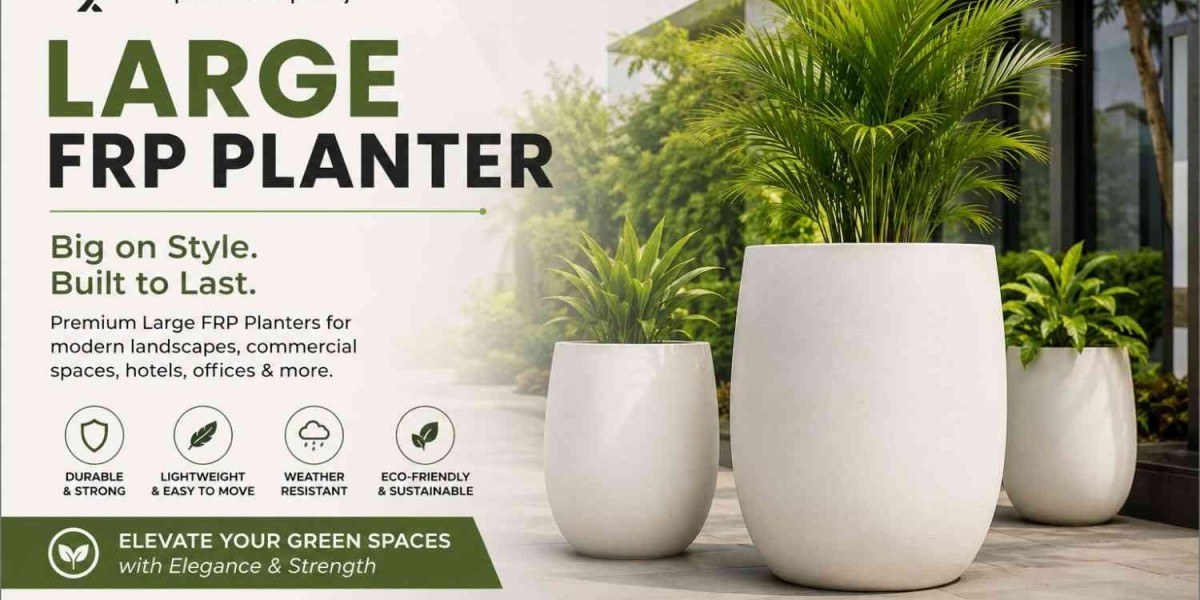

Four workers carried a single cast-stone planter up a narrow staircase for a terrace project last year. It took them twenty minutes and nearly cracked a tile on the way. The replacement order — a Large FRP Planter in the same size — went up in under five minutes, two people, no drama. That difference sums up why FRP has quietly taken over large-format planter specification across India's premium residential and commercial projects. It's not one advantage. It's several, stacked together, and most buyers only discover the full list after they've already made the switch.
Durability, weight, and appearance usually get treated as competing priorities in planter selection — pick two, sacrifice one. FRP is one of the few materials that doesn't force that tradeoff, though it does have its own set of things buyers need to get right to actually see those benefits play out.
Specification: What Makes FRP Behave Differently From Stone or Concrete
The material science underneath the finish is what delivers the benefits people notice on the surface.
Composite Structure
FRP planters are built from layers of fiberglass mat bonded with polyester or vinyl ester resin, cured into a rigid shell. That layered composite is what gives FRP its strength-to-weight advantage over solid-cast materials — strength without the mass.
Size Range for Large-Format Units
Most larger FRP are over 100cm diameter and over 220cm. In general the wall thickness increases with size rather than staying uniform. It‘s unlikely any end user of large FRP growers is aware of this. A 220cm FRP planter requires significantly thicker lamination than a 100cm one of the same design, and anyone using the same thickness for both is saving at least one stitch somewhere.
Finish and Texture Options
Stone-effect textures, matte coatings, and custom RAL colors are standard, letting FRP mimic the visual weight of concrete or terracotta without carrying the actual weight.
Objective: Five Criteria Worth Checking Before You Order
Here's what separates a supplier who understands the material from one who's just selling a shape.
Do they specify resin type and lamination layers on request? A bad answer is "high-quality FRP" with nothing more specific — that phrase describes every product on the market and none of it usefully.
Can they explain how wall thickness scales with size? A bad answer treats all sizes as structurally identical, which they aren't.
What's their actual UV testing or field performance data? A bad answer claims "won't fade" without any testing basis behind it.
How do they handle large-format packaging for freight? A bad answer assumes standard packaging works for oversized units, which is exactly how large planters arrive cracked.
What's their defect and replacement policy in writing? A bad answer stays vague on paper and only gets specific verbally — verbal promises don't hold up when a shipment problem actually happens.
Benefits: Why FRP Outperforms Traditional Planter Materials
Significant weight reduction lowers installation risk and cost. Fewer people and less equipment are needed to move and place large units, which cuts labor cost directly on every project.
Structural load savings protect rooftop and podium budgets. Lighter planters mean less pressure on load calculations, which can be the difference between a design getting approved or redesigned.
Higher impact resistance reduces breakage-related reorders. FRP flexes under shock rather than shattering, a real advantage during handling, transit, and installation.
UV-stable coatings extend appearance life and cut refinishing costs. A properly coated planter holds its color for years, avoiding the recurring maintenance spend that painted metal or unsealed stone requires.
Corrosion and rot resistance eliminates a category of failure. No rust streaks, no base decay — a real cost and appearance advantage over metal and wood alternatives in outdoor settings.
Design flexibility supports premium aesthetic requirements without the weight penalty. Custom textures and colors let large FRP planters match high-end material references — stone, metal, matte concrete — without the structural cost those materials actually carry.
Availability: Sourcing Large FRP Planters Across Indian Markets
For buyers comparing Large FRP Planter Manufacturers in India against import alternatives, the calculation usually comes down to lead time reliability more than raw unit price.
Manufacturing clusters in Gujarat and Maharashtra keep fiberglass and resin supply chains close, which shortens production cycles compared to suppliers dependent on imported raw materials. That proximity advantage compounds when a project needs a repeat order fast — waiting on international freight for a follow-up batch can stall an installation for weeks. Working with regional Large FRP Planter Suppliers in India also simplifies logistics for multi-city projects, since domestic freight doesn't carry the customs uncertainty that overseas sourcing does.
One thing that surprises first-time bulk buyers: large-format units often need custom crating solutions per order, and that's a cost worth confirming upfront rather than discovering on the final invoice.
About Us
We've been manufacturing FRP products since 2013. Planters have made up most of our production volume for the better part of that. We moved away from a specific polyester resin blend in 2021 after coastal clients in three cities reported early yellowing on outdoor units — not a massive share of our output, but enough to act on. We requalified a replacement blend, tested it through a full monsoon season before switching fleet-wide, and haven't seen that complaint return.
We keep every large-format mold on-site rather than outsourcing production runs to third-party job shops, which means the lamination quality on a repeat order matches the original exactly.
CTA
If durability, weight, and finish are all priorities for your project, send us your size requirements, quantity, and intended installation — indoor, outdoor, coastal, or rooftop — and we'll respond within 24 hours with a lead time and quote. Standard sizes start at an MOQ of 10 units; custom molds are priced individually. Get in touch with FRP Planters through frpplanters.com, and we'll flag any spec detail worth reconsidering before you finalize the order.
Conclusion
A Large FRP Planter can get what it promises long-lasting, light, and stylish without requiring the client to make compromises on any of those counts, provided it‘s designed from the beginning with the proper lamination, resin, and finish. The advantages add up with the suppliers, who can‘t demonstrate the inherent material choices, may struggle to keep the customer over the longer term.
FAQs
How much lighter is a large FRP planter compared to a concrete one?
Generally somewhere between a fifth and a third of the weight for the same footprint, though the exact figure depends on wall thickness and lamination density.
Do large FRP planters fade or discolor outdoors over time?
Without UV-stable gel coat, yes — noticeably within a couple of years in high-sun climates. With proper coating, that timeline extends considerably, though we won't promise zero fading since every outdoor material weathers eventually.
What's the real advantage of choosing Large FRP Planter Manufacturers over importing from overseas?
Faster repeat orders and simpler logistics, mainly. Domestic manufacturers can turn around a follow-up batch in weeks, not months, since there's no customs process involved.
Can large FRP planters handle high-impact environments like retail or hospitality foot traffic?
Yes, better than most people expect — the flex tolerance in FRP absorbs impact that would crack stone or terracotta outright.
Are Large FRP Planter Suppliers in India able to match custom colors for large orders?
Most established manufacturers offer RAL color matching, though matching an existing installation exactly gets harder as the original units age and fade slightly.